After a successful trial in October 2023, we are delighted we have managed to secure a subscription to Policy Commons. We received some great feedback from academics about how the platform would fit in with teaching and learning in Schools including :
“This is an absolute treasure, especially for my research. I am also sure it will be an invaluable teaching resource for the environmental law module starting next semester.”
“There are huge amounts of so-called ‘grey’ policy literature that students working and being taught policy-oriented skills and modules cannot access because it is fragmented, hosted by various institutions and the organisations which commissioned such reports. Policy Commons makes the universe of policy-relevant literature, which is often the cutting edge of a field and more up-to-date than academic literature, accessible to students through just one easily searchable source. This is a highly recommended resource, which improves student skills, research and their written work”.
So if you aren’t familiar already, the database is one resource to locate publications from policy experts, NGO’s and think tanks. Publications include : -The Council of Europe -Environmental Law Institute -European Parliamentary Research Service -Center for Security Studies -OECD -World Bank Group -United Nations -International Institute for Environment and Development
This short video from Policy Commons tells you a little bit more
To access Policy Commons follow this link via Library Search
If you’re working on a dissertation, thesis or project right now, or will be doing so next academic year, what can you do if the Library doesn’t have access to all the specialist books and other information resources you need? How can you find out about resources relating to your research topic which are held elsewhere? Can you visit other libraries and archives if you’re away from Newcastle over the vacation?
Read on to find out how you can expand your search beyond our library….
1. Search
You can search across the catalogues of over 170 UK and Irish academic and national libraries, together with other specialist and research libraries, via Library Hub Discover (formerly COPAC). The range of libraries included in Library Hub Discover is expanding all the time, and includes all UK universities, as well as the libraries of such diverse organisations as Durham Cathedral, the Institution of Civil Engineers, the Victoria and Albert Museum, and the Royal Horticultural Society.
In response to Covid restrictions, Library Hub Discover has also made it easier for you to find Open Access resources via its catalogue: it has recently incorporated the HathiTrust Digital Library, as well as the Directories of Open Access Books and Journals to its searchable database.
For a more in-depth and up-to-date search, you can also search individual academic library catalogues online. Need to look further afield? Search library catalogues internationally via WorldCat.
If we haven’t got the book you want, you can ask us to consider buying or borrowing it via our Recommend a book service.
If you need a copy of a journal article to which we don’t have access, you can apply for it via our inter library loan service, which is currently free.
You can search UK doctoral theses via the national EThOS service. This has records for over 500,000 theses, dating back to the year 1800, of which over half are freely available online (do note you have to register with EThOS before being able to download: it’s a separate login process to your usual University login).
3. Visit
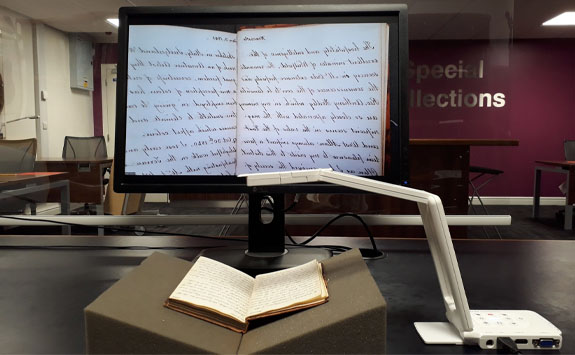
Special Collections Virtual Reading Room
The SCONUL Access Scheme enables students to visit most other academic libraries around the country, and in some cases, borrow from them. This service has recently resumed since its suspension during the Covid pandemic, but please note that not all academic libraries are currently participating in the scheme, so do check carefully before you visit, and read the latest information on the SCONUL Access site.
You will need to register with SCONUL Access before you can visit another Library, so do allow time for your registration to be processed.
If you want to consult archives or special collections elsewhere, you’ll need to check with the organisation in question beforehand (you’ll usually need to request to consult items in advance of your visit). If you can’t visit in person, archives services may still be able to answer queries, provide access to selected digitised items, or even operate a Virtual Reading Room, so it may well be worth enquiring.
Institute of Physics Ebook collections offer high-quality research across physics and related disciplines. They have been created to meet the needs of students, early-career researchers and established leaders in the fields.
An additional 255 IOP ebooks covering subjects such as astronomy, particle and nuclear physics, medical physics and biophysics, quantum science and more have just been added to the Library’s collection.
If you find a title that we don’t have full-text access to and you would like us to add it to the collection, just use our Books on Time form available on the Library website to request it.
OECD iLibrary is the online library of the Organisation for Economic Cooperation and Development (OECD) it contains a vast collection of books, papers and statistics, some of which date back to the 1960s, it is the gateway to OECD’s analysis and data. OECD content covers over 100 countries.
Every year around 300 new titles are published, associated with the following themes:
Agriculture & Food,
Development,
Economics,
Education,
Employment,
Energy
Environment
Finance and Investment
Governance
Industry and Services
Nuclear Energy
Science and Technology
Social Issues / Migration / Health
Taxation
Trade
Transport
Urban, Rural and Regional Development
You can browse by theme, country, or choose the type of content you require (for example, books, papers, statistics). You can also carry out simple or advanced searches.
If you’re looking for Statistics and Indicators?
OECD iLibrary contains all of the publications and datasets released by International Energy Agency (IEA), Nuclear Energy Agency (NEA), OECD Development Centre, PISA (Programme for International Student Assessment), and International Transport Forum (ITF) since 1998 – present.
It presents all content so users can find and cite tables and databases as easily as articles or chapters in any available format: PDF, WEB, XLS, DATA, ePUB,READ.
For a quick introduction to OECD i Library, including how to search the database and how to use advanced features and find statistical information and indicators, take a look at the user guide.
You can find details on other sources of statistics on our Statistics Guide.