
Westlaw platform upgrade

The legal database, Westlaw, has had an upgrade. The content remains the same, but you should notice significant improvements to the search and display options, and its overall look and feel.

How can I access it?

You can find links to the new Westlaw platforms on the Law subject guide and Library Search. There are separate links for Westlaw UK and Westlaw International.

What are the main features of the new platform?

You’ll find the main search headings (e.g. cases, legislation, journals, current awareness, books) are still there,  but arranged differently.

As before, you can still search or browse across all content types, or limit to a specific content type (e.g. cases or legislation). Specific search options (such as using connectors) are similar to the old system, but you should find everything more clearly set out.

You’ll also find a wider range of personalisation features, including favourites, and options to annotate and share content with others.

Other new features include a Legislation Compare tool, which makes it easier to track recent and future changes to legislation.

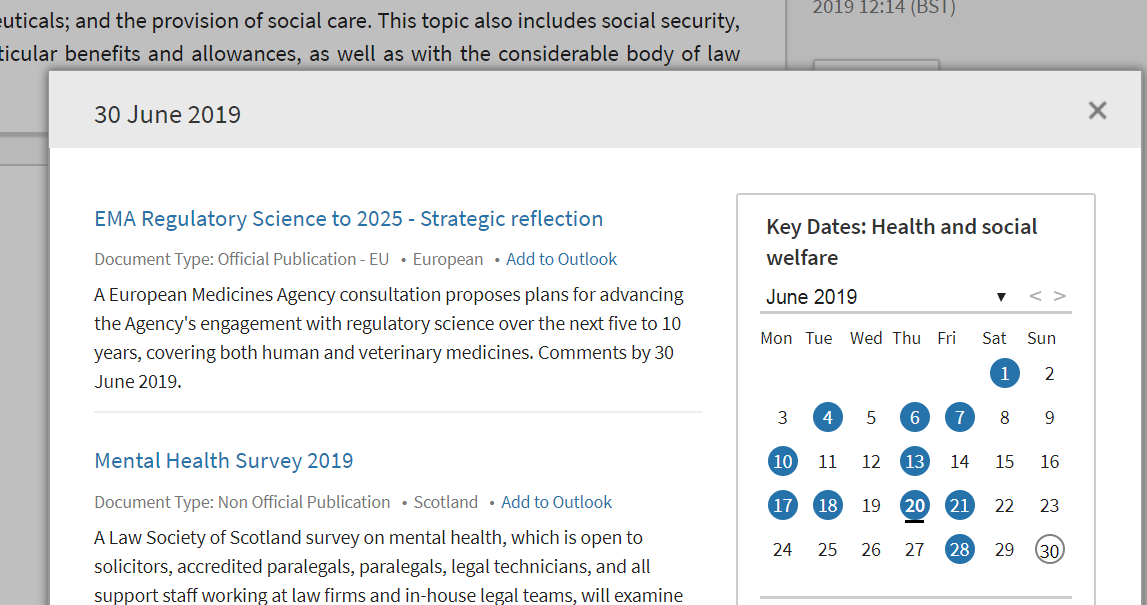
You can browse topics to find key documents (including cases and legislation), and track the latest and future developments via an interactive calendar.
Where can I find out more?

You can get more help via handy quick reference guides to the new platform, or videos. As a minimum, we’d recommend watching the short overview video  or the getting started guide, which take you through the key features, and give you useful tips. However, there are also helpful videos and guides on specific aspects, such as alerts, annotations, cases and legislation.

What do I need to do?

Please note, the old Westlaw platform will be switched off on 5th August 2019, so we would strongly encourage you to start using the new platform as soon as you can.

Personalisation features such as alerts and folders can’t be migrated to the new Westlaw platform. Therefore, if you have set up any of these on old Westlaw, you will need to set them up again on the new platform. You should find the new platform has much improved personalisation features.
Spotlight on OnePetro

Looking for authoritative and comprehensive information on the oil and gas exploration and production (E&P) industry?  Then have a browse of OnePetro! A unique library of technical documents and peer reviewed articles, it includes full text documents of many key conference proceedings in the field and provides access to a number of subject relevant journals.

For a quick introduction to OnePetro, including how to search the database and how to use advanced features, take a look at our helpful video guide (4:49 min):

This video includes sections on:

0:29 – Accessing OnePetro
0:37 – Basic Search
2:57 – Exporting Citations
3:17 – Advanced Search
4:00 – Saving Searches and Setting up Alerts

Identify resources for your research project

A strong research project such as an essay, dissertation or thesis will always be supported by good quality information from a wide range of sources.  There are a huge variety of resources available to you and being able to make appropriate choices when selecting materials to include in your project and explain why you have chosen them, is an important academic skill that demonstrates a good awareness of your subject and an ability to think critically about ideas and research.

Of course, not all information resources will be relevant to your particular research.  You will have to think about the type of information you need then identify the type of resource that will provide that kind information.

For example:

Books will offer an in-depth overview of popular ideas, theories, and opinions in your subject area and are likely to be broader in scope than a journal article or conference paper.

While a conference paper will often discuss ‘work-in-progress’, and therefore can be an ideal way of finding out about up to date research and ideas.

For more information on different resource types, including standards, patents, maps, newspapers and more, take a look at our range of Resource guides.

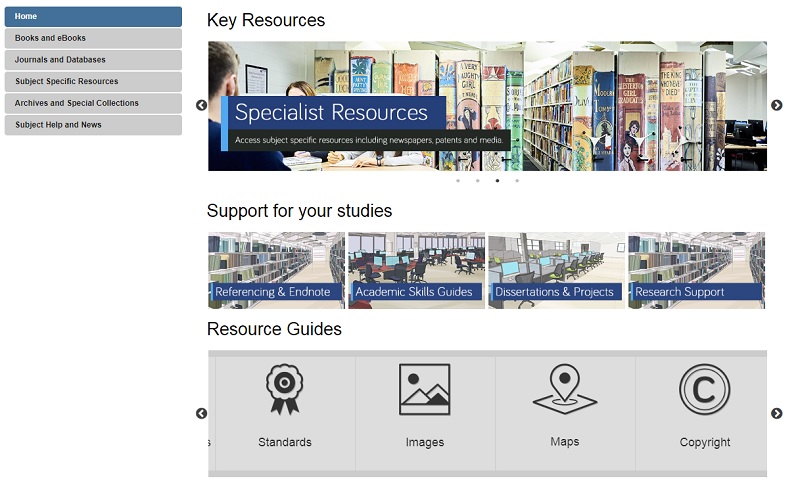
Your Subject Guide can also help you identify useful sources of information for your research as it contains a carefully curated list of resources that are tailored to your subject area.  Here you’ll  find useful lists of online reference books, eBook collections and recommended databases for finding relevant journal articles and conference papers.  Also, under the Subject Specific Resources tab, you’ll discover a further host of specialised materials relevant to your subject such as audiovisual media, data-sets or professional organisation’s websites.

Screen capture of a Library Subject Guide, showing various tabs and resource links.

Depending on your research topic, you might also want to explore the Special Collections tab to see materials held in our Library archives that are relevant to your subject area specifically.

For more advice on finding and evaluating resources for your research take a look at our Finding Information and Evaluating Information Guides.

Dippy the Dinosaur and Climate Change Heroes

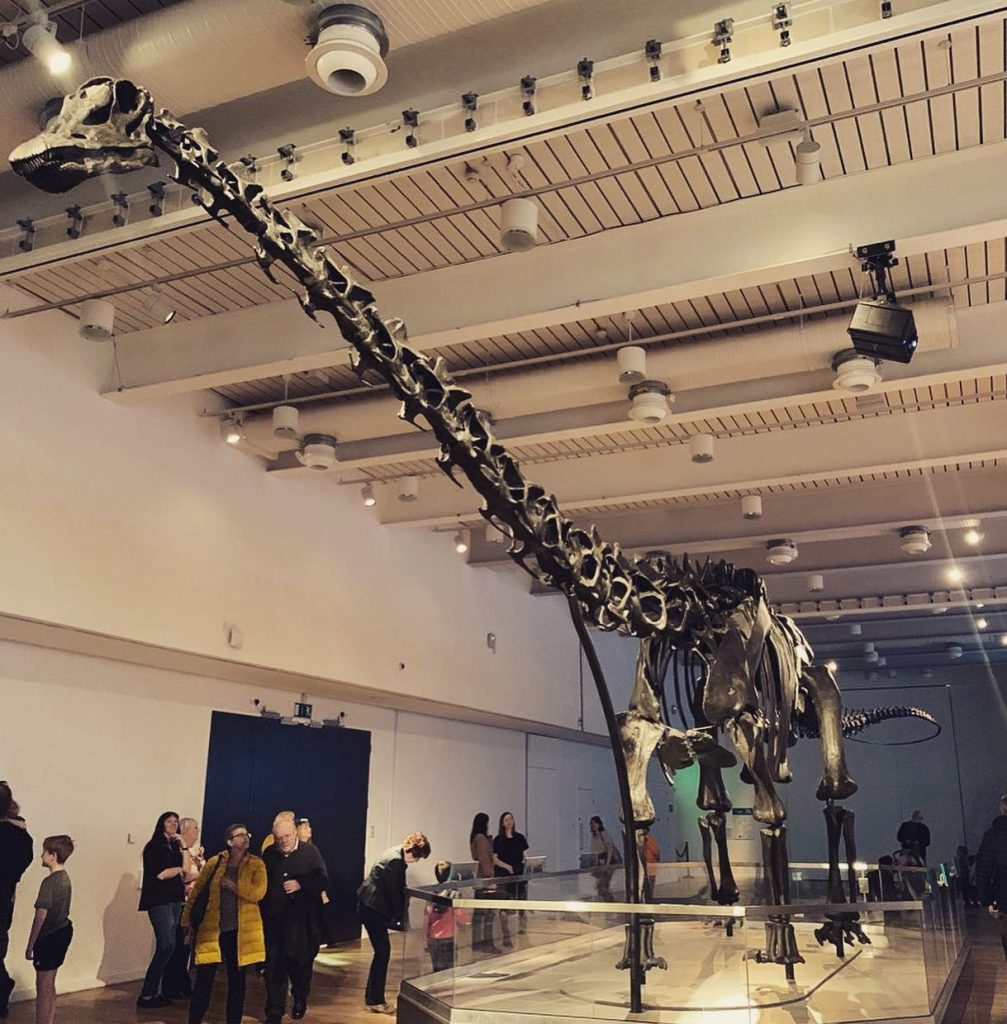
Dippy the Dinosaur ExhibitionThe Liaison team visited the wonderful Dippy the Dinosaur at the Great North Museum: Hancock this week.
First put on display over 100 years ago, Dippy is a cast of a Diplodocus dinosaur and measures a massive 21.3 metres long –  he was an incredible sight to see!

Dippy, who belongs to the Natural History museum, is currently touring the country and will be in Newcastle for this special exhibition until Sunday 6 October 2019.  You can find out more about Dippy and book tickets here.

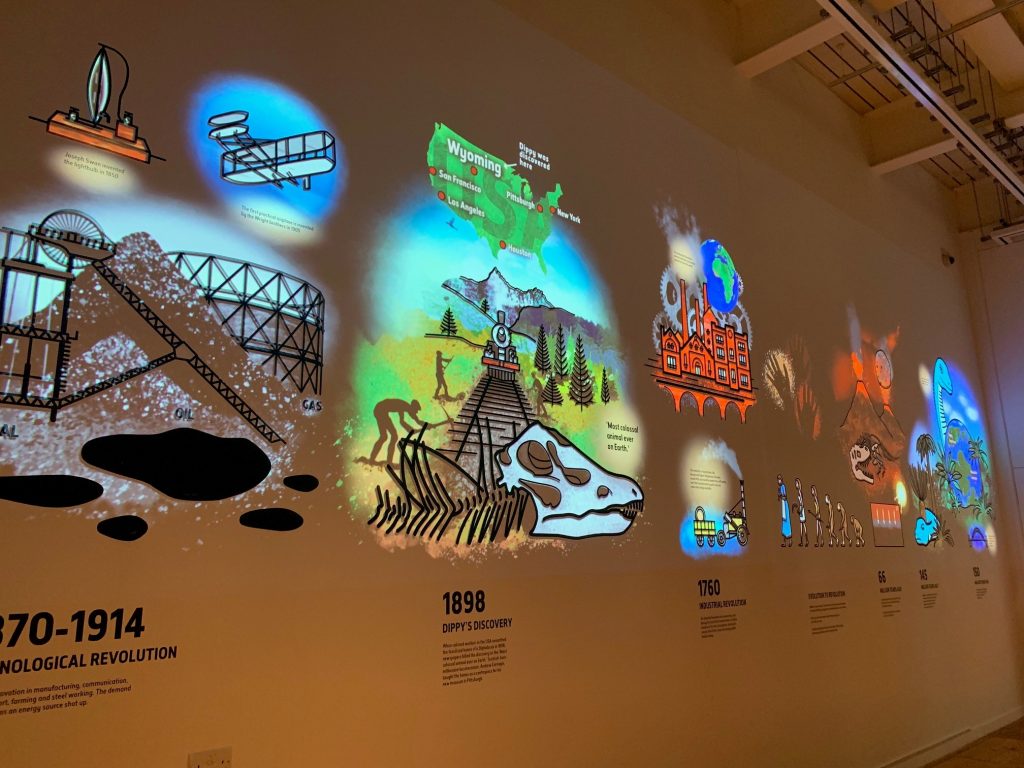
Dippy the Dinosaur exhibition showing timeline

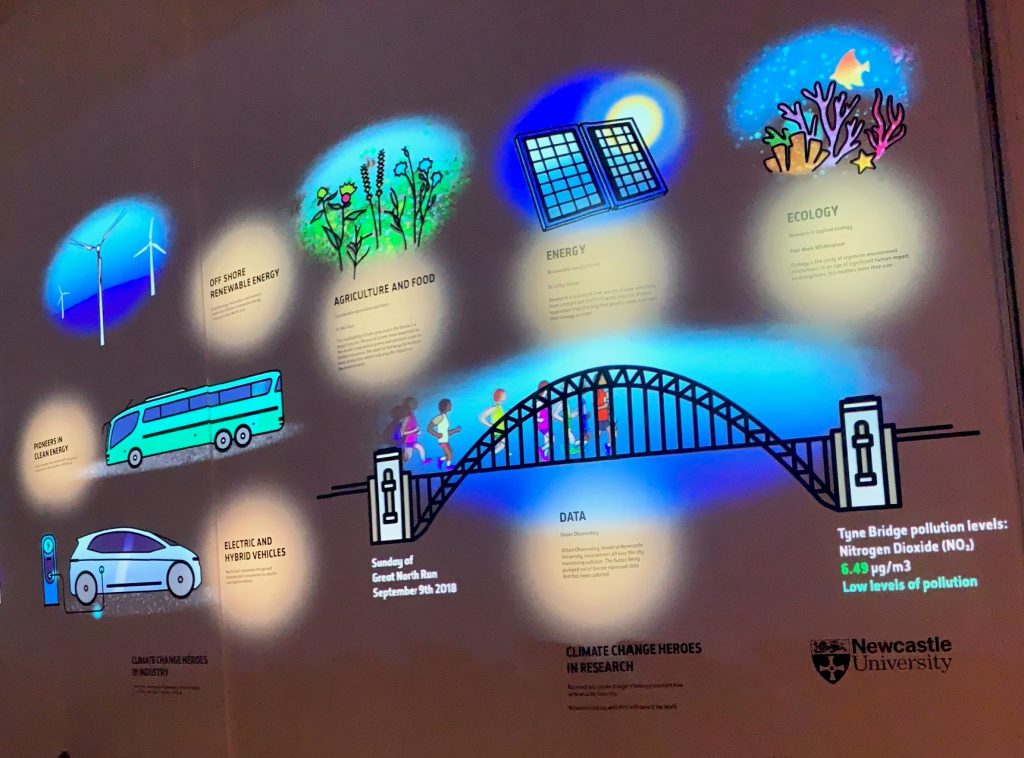
Alongside the brilliant Dippy, the exhibition at the Great North Museum also features a spectacular visual timeline that emphasises the significance of climate change.  Beginning in the time of the dinosaurs and highlighting the climate change brought about by the meteor that killed the species, it continues up through the industrial revolution to the climate emergency of today.

The display spotlights academics and teams from Newcastle University who are researching important climate change related issues.  You can find out more about the work of these researchers below:

Dippy’s ‘Climate Change Heroes’ Reading List:

Dippy the Dinosaur exhibition display showing research on climate change


Professor Mark Whittingham (Professor of Applied Ecology)

Franks, J.R., Emery, S.B., Whittingham, M.J. and McKenzie, A.J. (2016) ‘Farmer attitudes to cross-holding agri-environment schemes and their implications for Countryside Stewardship.’ International Journal of Agricultural Management, 5(4). pp.78-95

Dunn, J.C., Buchanan, G.M., Stein, R.W., Whittingham, M.J. and McGowan, P.J.K. (2016) ‘Optimising different types of biodiversity coverage of protected areas with a case study using Himalayan Galliformes.’ Biological Conservation, 196, pp. 22-30

Hiron, M., Part, T., Siriwardena, G.M. and Whittingham, M.J. (2018) ‘Species contributions to single biodiversity values under-estimate community contribution to a wider range of values to society.’ Scientific Reports, 8, pp.1-7

Find more of Professor Whittingham’s work via his Newcastle University’s ePrints page.


Dr Elizabeth Gibson (Reader in Energy Materials)

Summers, G.H. and Gibson, E.A. (2018) ‘Bay Annulated Indigo as a New Chromophore for p-type Dye-Sensitized Solar Cells.’ ChemPhotoChem, 2(6), pp.498-506

Summers, G.H., Lefebvre, J.F., Black, F.A., Davies, E.S., Gibson, E.A., Pullerits, T., Wood, C. and Zidek, K. (2016) ‘Design and characterisation of bodipy sensitizers for dye-sensitized NiO solar cells.’ Physical Chemistry Chemical Physics, 18(2), pp.1059-1070

ElMoll, H., Black, F.A., Wood, C.J., AlYasari, A., ReddyMarri, A., Sazanovich, I.V., Gibson, E.A. and Fielden, J. (2017) ‘Increasing p-type dye sensitised solar cell photovoltages using polyoxometalates.’ Physical Chemistry Chemical Physics, 19, pp.18831-18835

Find more of Dr Gibson’s work via her Newcastle University’s ePrints page.


Dr Niki Rust (Research Associate)

Braczkowski, A., Holden, M., O’Bryan, C., Choi, C., Gan, X., Beesley, N., Gao, Y., Allan, J., Tyrrell, P., Stiles, D., Brehony, P., Meney, R., Brink, H., Takashina, N., Lin, M., Lin, H., Rust, N., Salmo, S., Watson, J., Kahumbu, P., Maron, M., Possingham, H. and Biggs, D. (2018) ‘Reach and messages of the world’s largest ivory burn.’ Conservation Biology, 32 (4), pp.765-773

Rust, N, and Kehoe, L. (2017) ‘A call for conservation scientists to empirically study the effects of human population policies on biodiversity loss.’ Journal of Population & Sustainability, 1(2), pp. 53-66

Rust, N. and Taylor, N. (2016) ‘Carnivores, Colonization, and Conflict: A Qualitative Case Study on the Intersectional Persecution of Predators and People in Namibia.’ Anthrozoos, 29 (4), pp. 653-667

Find more of Dr Rust’s work via her Newcastle University’s ePrints page.


Urban Observatory

Newcastle University’s Urban Observatory collects real-time urban data from across the Tyne and Wear area. With over 50 data types available, including air quality, traffic, sewage and noise levels, it provides the largest set of publicly available real time urban data in the UK.


Brush up on your search skills

A pot of paint brushes

Searching should be easy, right? We do it all the time in our day to day lives and with Google so ingrained into our existence, we don’t give it much thought. We type some words into the search engine and most of the time we find what we are looking for. Nothing to it!

However, while this approach certainly works for checking out cinema times or booking flights, it lets us down where research is concerned. We have high expectations that information will be quick and easy to come by and that it will be neatly organised in one place, rather than having to search in multiple locations, using different techniques. We imagine that the time consuming part of our research will be the analysing, synthesizing and the writing of it and we often don’t even think about the searching side of things.

The reality though is quite different. Without investing in our searching techniques and the development of a search plan, we can often find ourselves overwhelmed by information and not being able to see the wood from the trees. Our stress levels rise and our frustrations explode. Surely finding information shouldn’t be this hard!

The good news is, is that there is help to be had. Our job as Liaison Librarians is to equip you with the skills you need to create that all-important search plan and to encourage you to pause and stop before you dive straight into finding information for your research. We have a fantastic range of online tools for you to do this, not least an interactive search planner that you can keep adding to throughout your search and which you can even email to yourself, your supervisor, or us as a Liaison team for feedback. The Academic Skills Kit has lots of advice on how to start a search, including how to break your concept down into manageable chunks and how to identify keywords and synonyms.

You can also check out this short video to get you started…….

Keep your eyes peeled for our next blog installment of how to find particular resources. See you then!

Photo by Debby Hudson on Unsplash