New resource trial: Modern Construction Online

The Library is hosting a short trial to Modern Construction Online.

Modern Construction Online logo

Modern Construction Online is a comprehensive resource that gives students, architects, engineers, and construction professionals the most relevant information on modern construction techniques and materials. By using this platform, practitioners and students keep up to date with current trends and improve their skills in designing and constructing of modern buildings. 
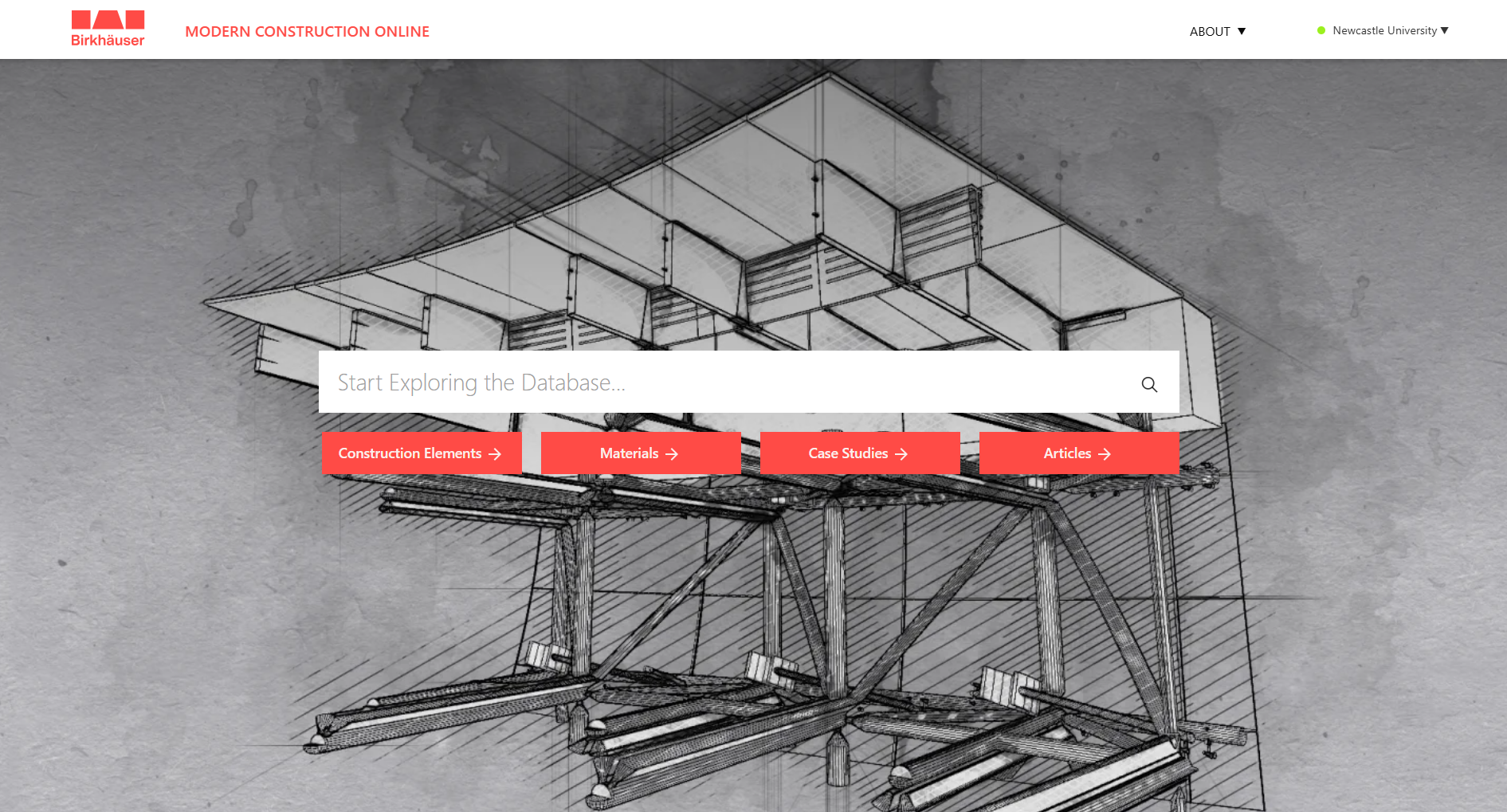
Modern Construction Online homepage showing keyword search function

Modern Construction Online consists of case studies, learning materials, articles, and entries on construction elements.

The search box situated in the middle of the screen enables a full-text search, making it easy to search for anything you are interested in. For example, a material (“stainless steel”), building parts (“ceiling”), a general search term (“humidity”, “daylight”).

Once you have conducted a search, you can use the filters on the left-hand side of the results page to support refining your results, as shown in the example search below for “glass rooflight”:
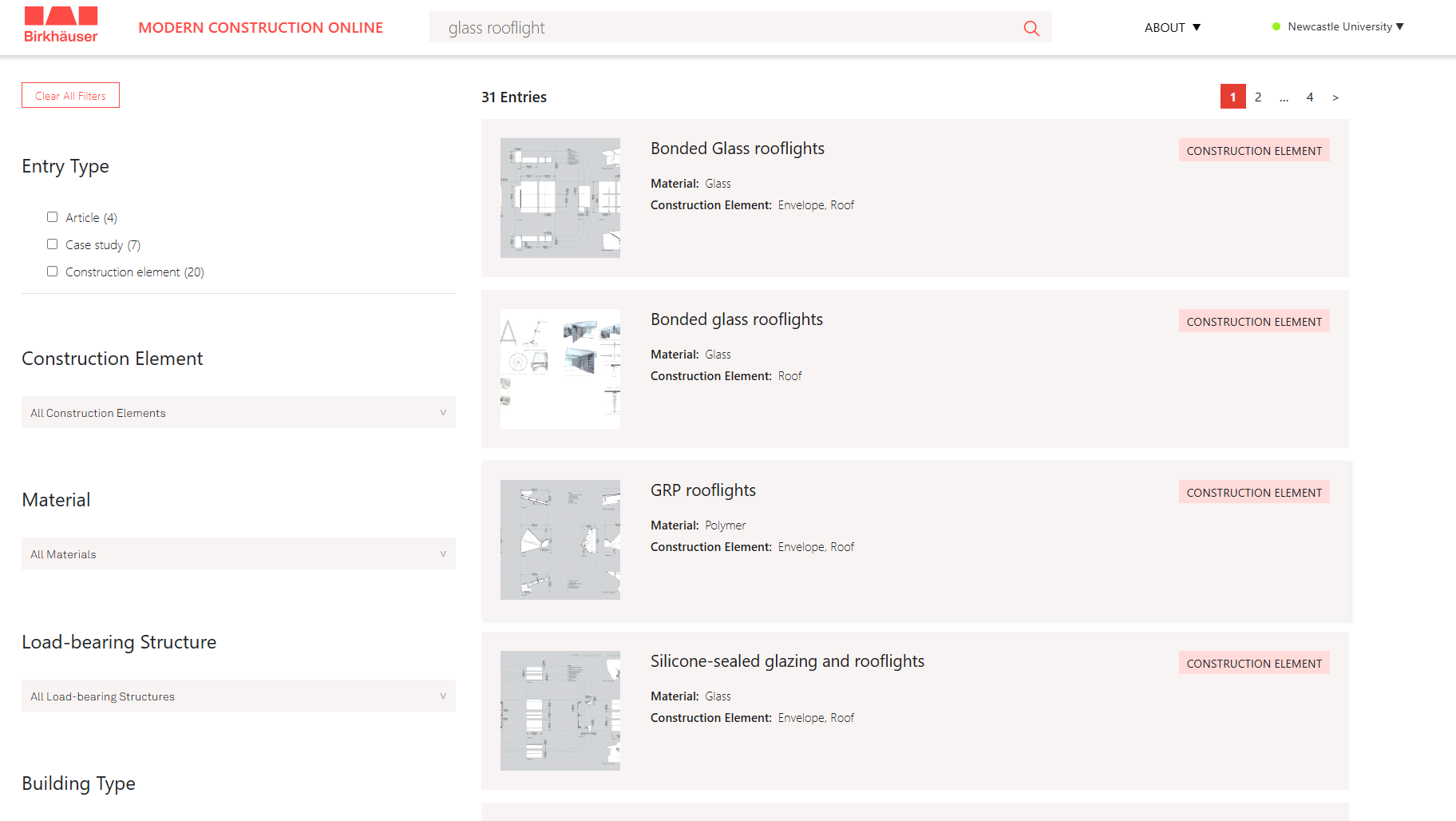
Results of a search for “glass rooflight”, showing options to filer results on the left-hand side

The Entry Type filter on the left hand side makes it easy to narrow down to articles or case studies or information about the type/use in relations to materials.
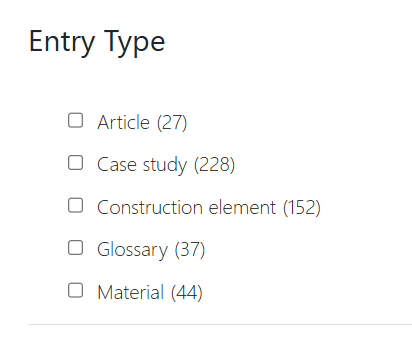
The Search Help page provided by Modern Construction Online provides guidance on making effective use of the database.

The Learning Resources provide you with an overview of key strategies, arrangements and analysis in modern construction design.

The resource is available to trial until Monday 31st March. Access Modern Construction Online via Library Search.

As the purpose of a trial is provide short term institutional access to establish whether the resource is of interest for future sustained access, unfortunately we are not able to extend or repeat trials. Please bear in mind that any links to material within the trial collections will no longer work after the trial ends, so access is temporary.

We’re keen to hear any feedback on this resource, either by posting your thoughts on this blog post below, or by getting in touch with your Liaison Librarian at libliaison@newcastle.ac.uk.


New resource: Overton

Overton logo, white text on orange background.

After a successful trial, the Library have acquired subscription-based access to the database Overton.

Overton is the world’s largest collection of policy documents, parliamentary transcripts, government guidance and think tank research.

You can restrict your searches to policy from specific regions, countries or source types. Other filters allow you to view policy that cites research from a particular university, think tank, or academic.

Overton also helps users measure their influence on government policy, both locally and internationally. If you fund, publish or produce research, Overton can show you where it has been cited in policy worldwide. 

Overton offer extensive help guides and videos to guide you in making the most of the database. Here are some of the key links and videos to get you started:

Search for policy documents that cite or mention your organisation in Overton
Search for names in Overton
Searching Overton using DOIs

Overton may be accessed through Library Search. You will be invited to create an account, which will allow you to make use of features such as saved searches and alerts.

If you have any queries on making effective use of Overton, please do contact your Liaison Librarian (libliaison@newcastle.ac.uk).

New resource trial: Orlando: Women’s Writing

The Library is currently running a short trial to Orlando: Women’s Writing, from Cambridge University Press.

Orland Women's Writing in the British Isles from the Beginnings to the Present logo

Orlando: Women’s Writing in the British Isles from the Beginnings to the Present is a highly dynamic and rich resource for researchers, students, and readers with an interest in literature, women’s writing, or cultural history more generally.

Orlando is not a text archive: it does not print the texts its subjects wrote. Instead, it provides new biographical and critical accounts of the lives and works of its subjects, together with contextual materials relevant to critical and historical readings. With about 8 million words of text and biographical and writing career profiles on over 1430 individuals, it is full of factual, critical, and interpreted material.

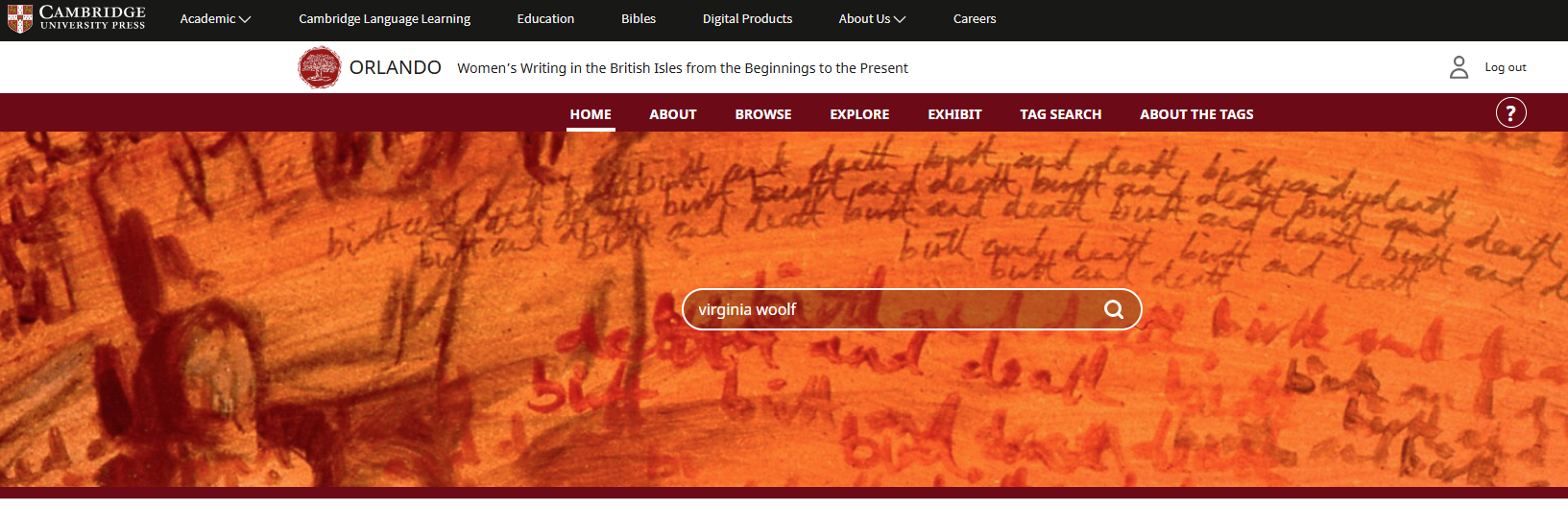
From the homepage, it is easy to keyword search for a specific person, author, work or event:

Orlando: Women's Writing homepage showing search of "Virginia Woolf"
Orlando: Women’s Writing homepage showing example keyword search of “Virginia Woolf”

Search results can be refined by fields such as historic period, genre, author nationality to support more specific retrieval. The browse functions allow researchers to explore author profiles, people, organisations, timelines, and the full bibliography of sources cited in Orlando: Women’s Writing. The Get Started guide provides extensive information on making effective use of the database.

Orlando’s content is also structured by a XML tagset, allowing researchers to conduct tag searching. More information on Tags is available here.

The resource is available to trial until Thursday 27th February. Access Orlando: Women’s Writing from Library Search here.

As the purpose of a trial is provide short term institutional access to establish whether the resource is of interest for future sustained access, unfortunately we are not able to extend or repeat trials. Please bear in mind that any links to material within the trial collections will no longer work after the trial ends, so access is temporary.

We’re keen to hear any feedback on this resource, either by posting your thoughts on this blog post below, or by getting in touch with your Liaison Librarian at libliaison@newcastle.ac.uk.
New resource trial: Policy Commons additional modules

Policy Commons logo

The Library is currently trialling additional modules within the Policy Commons platform.

We have already successfully acquired the Global Think Tanks module, however the present trial also unlocks access to the following additional modules:

  • Public Health and Social Care: Frontline health providers, hospital systems, foundations, patient groups, practitioner communities, governments, think tanks, and other organizations produce research, pilot projects, real-world evaluations, newsletters, and collaborative projects.
  • North American City Reports: Cities are on the front lines addressing climate change, immigration, racial equity, and other pressing issues. North American City Reports is the best source of current, detailed information about what happened, what was tried, and what worked. Rich in statistics and hard evidence, the reports document attitudes, actions, and outcomes—through surveys, budgets, case studies, training manuals, plans, and other records.
  • World Cities and Local Governments: Cities are on the front lines of today’s most pressing challenges and their publications document the ground truth.
  • World Governments: Governmental organsations publish debates, proceedings, reports, budgets, commissions, inquiries, audits, scientific findings, and other content. They spend billions of dollars annually on research.
  • World Cities: Cities around the world are grappling with urgent issues that transcend national boundaries—rapid urbanization, escalating climate change, pervasive inequality, and other challenges. City reports show how municipalities are tackling problems. But lack of discoverability and impermanence make these the hardest policy documents to find and cite.
  • Oceania: A major new initiative to collect, preserve, and disseminate critical research from Australia, New Zealand, and the Pacific Islands, Policy Commons: Oceania provides the region’s perspective on topics including climate change, indigenous rights, the economy, housing, healthcare, and ageing.

The resource is available to trial until Monday 31st March. Access Policy Commons from Library Search here.

As the purpose of a trial is provide short term institutional access to establish whether the resource is of interest for future sustained access, unfortunately we are not able to extend or repeat trials. Please bear in mind that any links to material within the trial collections will no longer work after the trial ends, so access is temporary.

We’re keen to hear any feedback on this resource, either by posting your thoughts on this blog post below, or by getting in touch with your Liaison Librarian at libliaison@newcastle.ac.uk.

New resource trial: The Subculture Archives

The Library are hosting a short trial to The Subculture Archives.

The Subculture Archives is an educational & cultural research resource of primary sources exploring 100 years of youth culture through the scenes, styles, and sounds that forged them. From Rave, Punk, Rockabilly to Grime. The resource is formed from the collections of the Museum of Youth Culture.

The resource is of interest to those exploring youth culture in the 20th century from a range of subjects, including Music, Fine Art, Sociology, and History.

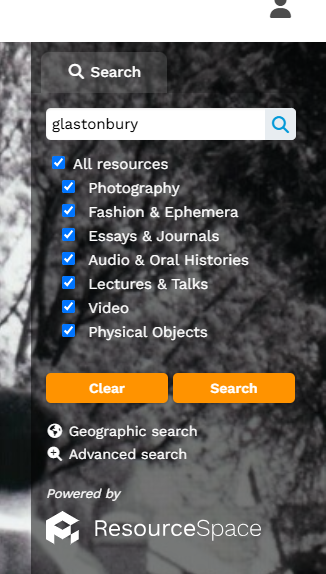
The search function allows keyword searches across the collections on the platform, with the ability to narrow searches by item type:

Subculture Archives keyword search function

Advanced Search is also available, with options to search for specific date ranges and persons, as well as media specifications. The Global Search allows for retrieval of resources within a certain defined geographical location of your choosing.

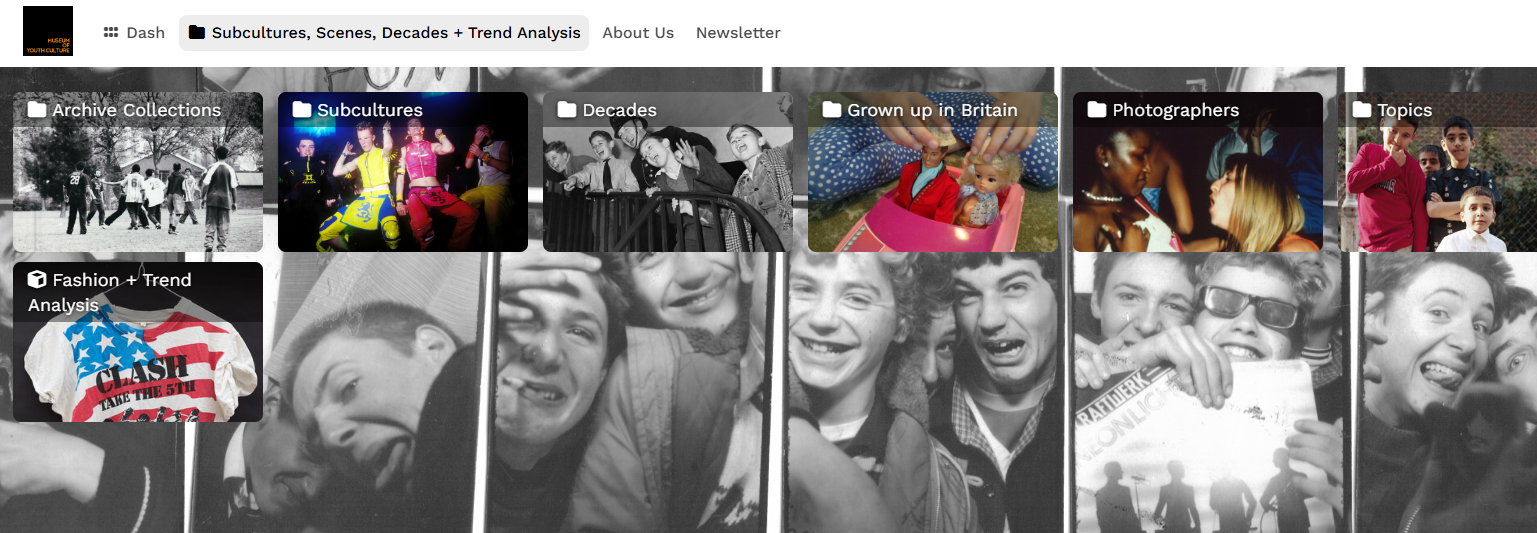
Browsing by collection, subculture, decade, photographer, and topic are all easy to achieve by selecting “Subcultures, Scenes, Decades and Trend Analysis” from the menu at the top of the dash:

Subcultures, Scenes, Decades and Trend Analysis

The resource is available to trial until Friday 28th February. Access The Subculture Archives via Library Search, then select ‘Log in via your University or Institution’, scroll down to ‘Newcastle University’ and lastly click on ‘Select’.

As the purpose of a trial is provide short term institutional access to establish whether the resource is of interest for future sustained access, unfortunately we are not able to extend or repeat trials. Please bear in mind that any links to material within the trial collections will no longer work after the trial ends, so access is temporary. Content is downloadable and accessible for internal educational use only, and be aware that copyright considerations apply.

We’re keen to hear any feedback on this resource, either by posting your thoughts on this blog post below, or by getting in touch with your Liaison Librarian at libliaison@newcastle.ac.uk.