
PubMed: Becoming familiar with controlled vocabularies


Are your literature searches run mainly in keyword-based platforms such as Google Scholar, Scopus or Web of Science?

Have you been told that you need to diversify your search, or maybe use a new database such as PubMed? Did someone mention that MeSH terms could improve your search?

If you do not know what those terms mean or where to start, you are in the right place. The following video will explain to you what controlled vocabularies are and why they are a powerful tool for retrieving relevant papers.

Now, let’s put theory into practice and demonstrate how to use Medical Subject Headings (MeSH) in PubMed. The video below will do just that.

Let’s have a look at what other controlled vocabulary databases you can use in medical sciences or if your Social Sciences student whose work crosses over with medical sciences. You can find all the databases mentioned below and others in Library Search:

Since the previous videos focus on PubMed, you might wonder what other databases you should be using. If you are unsure how to find the most relevant databases for your course, you can watch a video that will show you how to identify them.

Is Medline the database for you, but you need some help with the basics? Watch our:

Finally, please remember that this is general advice and it might not cover your particular area of interest. If you have any specific questions, please do not hesitate to contact us on Library Help, where you can email us or speak to us through the Live Chat feature.

Ovid Medline: Becoming familiar with controlled vocabularies

Are your literature searches run mainly in keyword-based platforms such as Google Scholar, Scopus or Web of Science?

Have you been told that you need to diversify your search, or maybe use a new database such as Medline, Embase or PsycInfo through the Ovid searching platform? Did someone mention that Medline’s MeSH terms could improve your search?

If you do not know what those terms mean or where to start, you are in the right place.

The following video will explain to you what controlled vocabularies are, why they are a powerful tool for retrieving relevant papers and it will demonstrate how to use Medical Subject Headings (MeSH) in Medline via Ovid.

Since the previous video focuses on Medline, you might wonder what other databases you should be using. If you are unsure how to find the most relevant databases for your course, you can watch a video that will show you how to identify them.

Is Medline the database for you, but you need some help with the basics? Watch our “Getting started with Ovid Medline” video for the basics. For a more detailed explanation on how to combine searches, watch the Combining Searches in Medline and other Ovid Databases.

Finally, please remember that this is general advice and it might not cover your particular area of interest. If you have any specific questions, please do not hesitate to contact us on Library Help, where you can email us or speak to us through the Live Chat feature.
Meet the Walton Library Team

Hello and a warm welcome from all of us here at the Walton Library!

With the beginning of the year in mind (and what a year this is looking to be!) we wanted to make sure you are familiar with at least some of our faces.

Aimee, our Deputy Medical Sciences Librarian will begin by welcoming you all and talking a little bit about her role and the role of the Walton Library Liaison Team.

Compared to previous years, we won’t get to see as many of you as we would like, but we want to assure you that we are real and still very keen to help. So, let’s hear from Helen, one of our Library Aides, who ensures that physical resources are tidy and readily available, but is also here to welcome you when you come to the library, help you find your study space and your books.

A lot of work is put in ensuring that the academic resources required for your course are available. This extends from liaising with your lecturers and putting together reading lists of essential and recommended material, to ensuring that you can access these resources, to delivering session that will help you make the most out of them, as Marian, the Assistant Librarian in the Liaison team will explain.

Our Library assistants have a huge role in the reading list process as they check, double check and triple check… and then they check again that things work well. Elizabeth has a role in all of this, but she will also explain what she does when we receive new books and they need to be sorted and catalogued.

While we do have a lot of online resources on the website that will help you teach yourself a variety of academic skills, it can be quite daunting sometimes to find your way to the correct link, on the correct page, for the correct resource. That is why we are also happy to give you one-to-one guidance and point you in the right direction and if you ever get stuck, do our best to answer your questions. Bogdan will tell you in a few words how much he enjoys this element of interacting with you all.

Remember, you can always ask for assistance via Library Help.

Freshers’ Guide to the Walton Library

Wishing a Warm Walton Welcome to all new and continuing students in the new academic year!

Just as you are settling into life at University we thought that you might benefit from this list of tips of how to make the most out of your time in the Walton Library.

Opening hours

The Library opening hours change throughout the year, but during term time, we are open normally until 22:00.

Resources

Use your Reading Lists as a great starting point for finding academic material. They can be accessed via your VLE (Virtual Learning Environment), which is either Blackboard or the MLE, depending on the course you are studying.

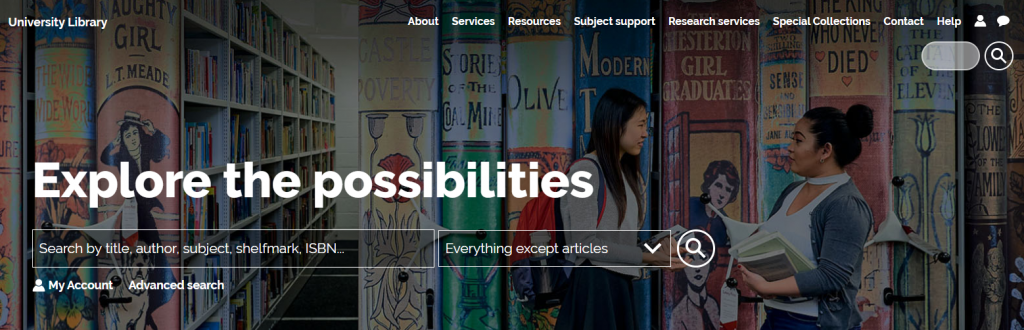
All academic resources that we purchase will be available via Library Search. It is the most prominent element on our colourful website and it will show you books, articles, journals in both physical or electronic format, databases and others.

The library website can be found here: www.ncl.ac.uk/library/

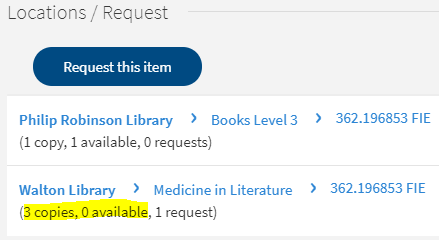
Use keywords to find the titles that you need and Library Search will tell you whether we have them or not, whether they are available on the shelves, in which library and part of which collection they are. If a book we have in stock is NOT currently available on the shelves, the best thing you can do is to log in with your student ID and password and place a reservation:

Reserving is in your best interest because this is what will prompt a current reader of the book to bring it back so that you can use it. So remember: Shy bairns get nowt.

Specialist help

There are subject-specific guides that give you information directly relevant to your course. You can find them by selecting your course in Subject Support, on the Library website.

Want to ask us a question?

Library Help is the place you seek. You can browse our FAQ database by topic or search it by using keywords. You can also send us an email or chat with us. Library Chat is monitored 24/7, so as long as you have access to the internet, wherever you are in this great, big world, you can contact us.