
New resources: Natural and Environmental Sciences

This summer we have been very busy buying new journals, databases, eBook collections and print books in hot topics of interdisciplinary interest across Science, Agriculture and Engineering. Here is what we have purchased for Natural and Environmental Sciences:

JOURNALS
EBOOKS AND DATABASES

Click here for a list of all of the new resources we have purchased for the SAgE faculty.

New resources: Mathematics, Statistics and Physics

This summer we have been very busy buying new journals, databases, eBook collections and print books in hot topics of interdisciplinary interest across Science, Agriculture and Engineering. Here is what we have purchased for Mathematics, Statistics and Physics:

Mathematics, Statistics and Physics

JOURNALS

Geophysical and Astrophysical Fluid Dynamics

EBOOKS

Click here for a list of all of the new resources we have purchased for the SAgE faculty.
New resources: Engineering

This summer we have been very busy buying new journals, databases, eBook collections and print books in hot topics of interdisciplinary interest across Science, Agriculture and Engineering. Here is what we have purchased for Engineering:

Engineering

JOURNALS
EBOOKS AND DATABASES

Click here for a list of all of the new resources we have purchased for the SAgE faculty.
New Resources: Computing

This summer we have been very busy buying new journals, databases, eBook collections and print books in hot topics of interdisciplinary interest across Science, Agriculture and Engineering. Here is what we have purchased for Computing:

JOURNALS
EBOOKS

Click here for a list of all of the new resources we have purchased for the SAgE faculty.

How to be a Fake News Ninja

As a University student it is imperative that you arm yourself against the barrage of fake news that can be found in today’s media.  To produce academically sound assignments and research, you need to be able identify and evaluate information quickly and with authority.

Here are 10 tips on how you can be a Fake News Ninja:

  1. Be aware: just simply knowing that not all information is created equal is the first step.
  2. Check the source: Where did the information come from? This can be tricky, especially on social media.
  3. Read more: don’t just rely on the piece of information that’s in front of you… go an find another reliable source and see if the facts are the same.
  4. Check the author: Do a bit of Google stalking to see if the author is credible.
  5. Check the references: does the item have references? What sources have they used? Are they credible?
  6. Check the date: watch out for re-posts old news items.
  7.  Check your biases: You own beliefs and prejudices can have an affect on how you accept information.
  8. Is it a joke?: If it sounds too good to be true, it probably is!
  9. Ask a Librarian: Librarians are the original Fake News Ninjas.  Come and ask us about any reference that you aren’t too sure about and we can help you make an authoritative decision on  the information you use for your research.
  10. Knowledge is power: Read more about Fake News and how you can win the fight. Everything you need to know is in our Fake News Guide.

Read our other blogs on Fake News to be aware of the consequences of Fake News and the history and growth of Fake News.

References
IFLA (2018) How to spot fake news. Available at: https://www.ifla.org/publications/node/11174 (Accessed: 23 March 18)

History and growth of Fake News

Fake News is nothing new and has been going on since time began!

Have at look at our timeline on our Fake News Guide for a snapshot of how Fake News has shaped history:

With the introduction of mass news with the invention of the printing press, and the massive up-rise in news being created and fed via social media, the growth of the term ‘Fake News’ and the actual production of Fake News stories has grown exponentially in recent years:

  • The term ‘Fake News’ is searched for in web browsers 70.8-118 thousand times a month.
  • #fakenews has over 251.2k mentions on Twitter
  • In 2017 Donald Trump mentioned the term ‘Fake News’ in public correspondence, 320 times!

Not only has the volume of Fake News grown, but also the speed that it spreads.  However, maybe there is a way we can slow it down:

Read our other blogs on Fake News to be aware of the consequences of Fake News and how you can become a Fake News Ninja.

References
Kiely, E. (2018) Trump’s Phony ‘Fake News’ Claims. Available at: https://www.factcheck.org/2018/01/trumps-phony-fake-news-claims/. Accessed: 23 March 2018).
Smith, R. (2017) The Numbers Behind Fake News. Available at: http://www.dailyinfographic.com/numbers-behind-fake-news. (Accessed: 23 March 2018).

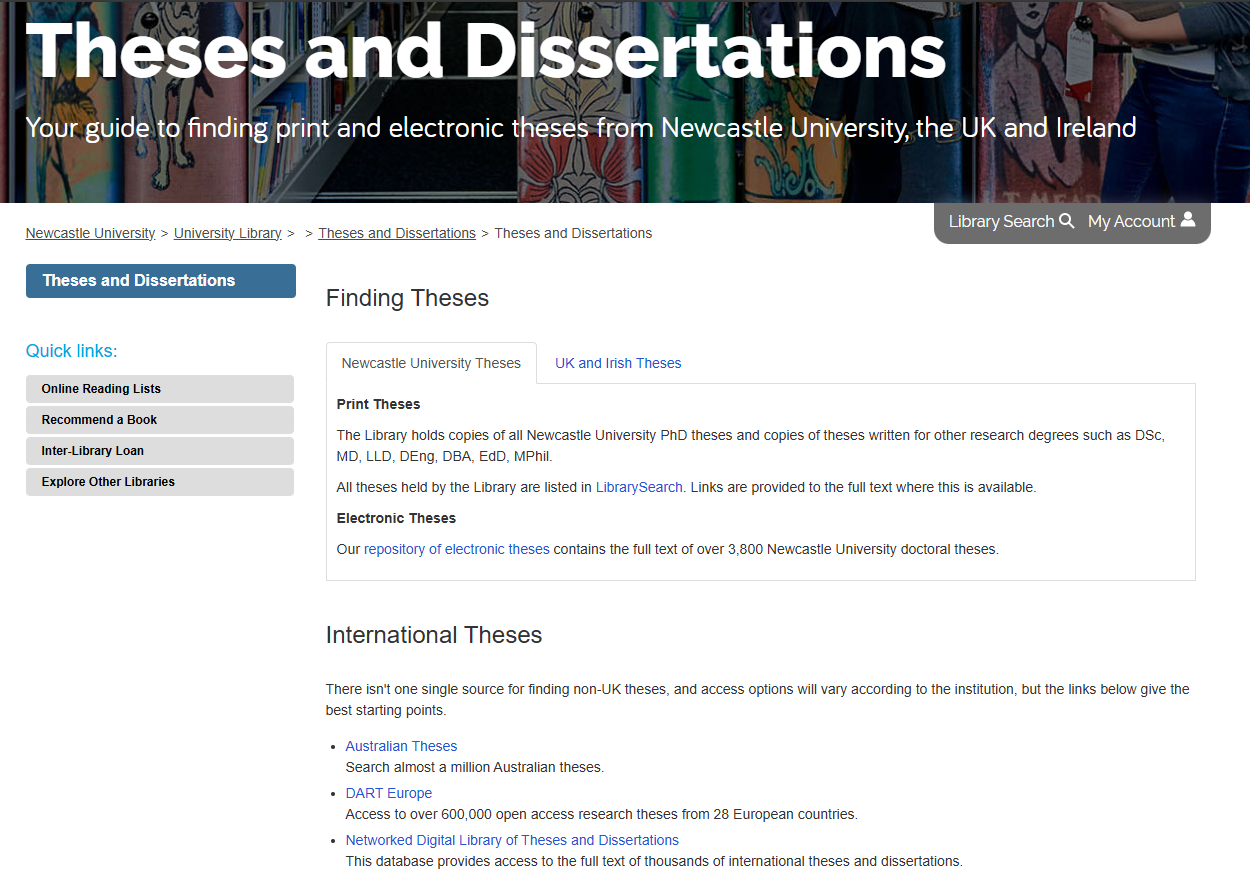
Where to find theses and dissertations?

Many of you are busy writing your dissertation right now, in the depths of your Masters project or wrestling with your PhD. If you are looking for ideas then look no further than our Theses and Dissertations Guide.

There are many reasons why you would use other theses and dissertations for your studies:

  • Has anyone else done a thesis or dissertation on my topic? If so…
  • How similar is it to my research question? Do I need to change my question slightly?
  • What references/citations did they use? Check them out, they might have used some good references that can help you.
  • Can you use this theses/dissertation as a reference for your research?
  • Inspiration! Maybe you have a vague idea what your research question is, but you want to see what’s been done already.

Our Theses and Dissertations Guide tells you what print and electronic theses NU Library holds, where to find international theses and signposts you to further information on theses/dissertation production.

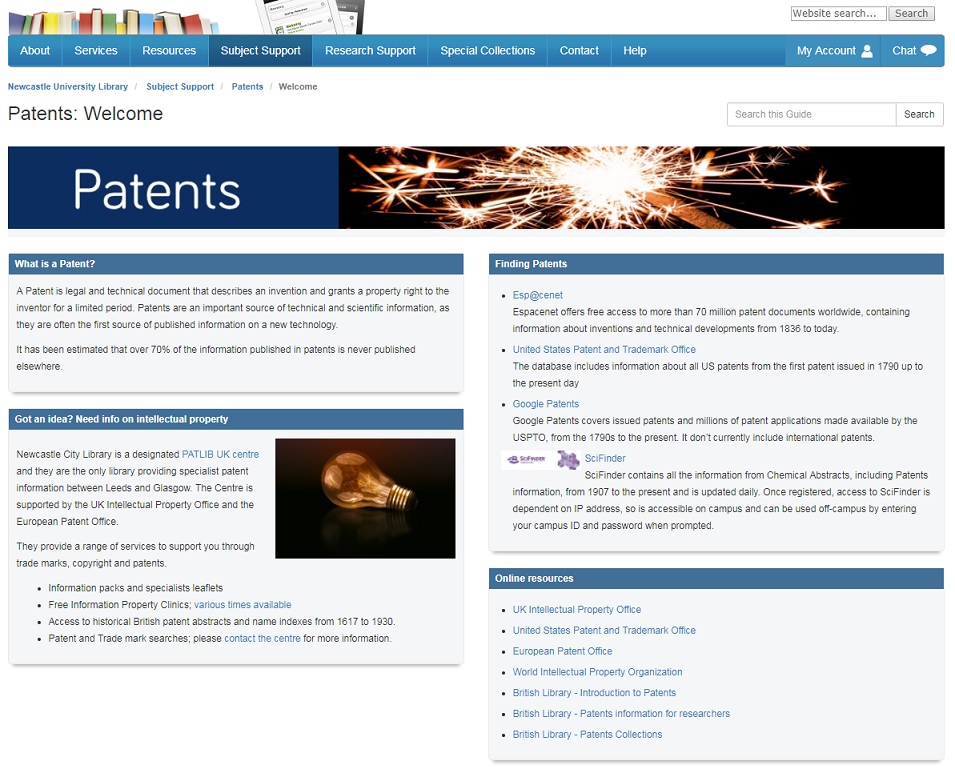
To invent, you need a good imagination and a pile of junk. – Thomas Edison

If invention is the name of your game, have a look at out Patent Guide.  Though it is small it is very mighty… explaining what Patents are, where to get help in Newcastle, links to online databases where you can search for patents and other online resources for further information on Patents.

*Please note, patents can be quite tricky to search for , so for further help we recommend that you attend one of Newcastle City Library’s FREE Intellectual Property surgeries.