Are your literature searches run mainly in keyword-based platforms such as Google Scholar, Scopus or Web of Science?
Have you been told that you need to diversify your search, or maybe use a new database such as Medline, Embase or PsycInfo through the Ovid searching platform? Did someone mention that Medline’s MeSH terms could improve your search?
If you do not know what those terms mean or where to start, you are in the right place.
The following video will explain to you what controlled vocabularies are, why they are a powerful tool for retrieving relevant papers and it will demonstrate how to use Medical Subject Headings (MeSH) in Medline via Ovid.
Since the previous video focuses on Medline, you might wonder what other databases you should be using. If you are unsure how to find the most relevant databases for your course, you can watch a video that will show you how to identify them.
Finally, please remember that this is general advice and it might not cover your particular area of interest. If you have any specific questions, please do not hesitate to contact us on Library Help, where you can email us or speak to us through the Live Chat feature.
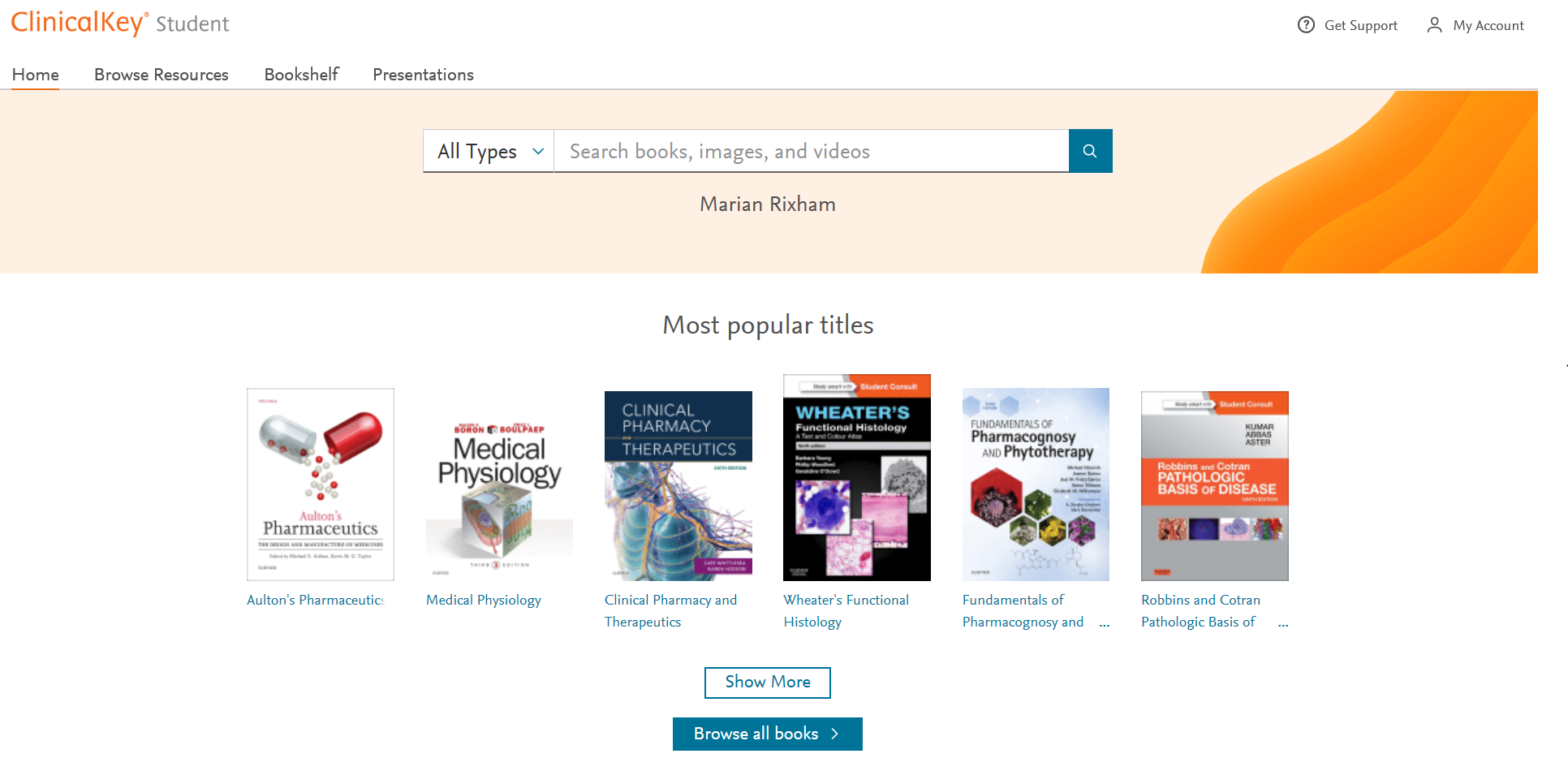
Elsevier’s Clinicalkey Student gives you electronic access to some of the most popular recommended clinical textbooks plus lots of other really useful resources including images and video. Subjects covered include medicine, dentistry and pharmacy. It allows you to add a book to your own Bookshelf, highlight text, add notes, create flashcard, make presentations and more. All of which is described below with videos to watch.
All of the eBooks available from Elsevier’s Clinicalkey can be found individually by searching for them on Library Search. To search or browse the collection go to Library Search and search for Clinicalkey.
To Login
To find out how to login and search for a book follow the instruction below or watch this video to get started.
Click on Log in via your institution on the right hand side
In the Institution search box type Newcastle University
Login using your University Username and Password
You are now ready to search for content either:
a book by title, author or keyword
a subject keyword for any content e.g. book, chapter, video available
Using the Bookshelf
To find out how to use the Bookshelf follow the instruction below or watch this video to get started.
To add a book to the Bookshelf you need to be within the content of a chapter. Search for the book by title, author or keyword
Click View book TOC
Click on the chapter you want
Click Add to Bookshelf on right hand side
If you want to see the book on your bookshelf, click Launch Bookshelf
If you click on the Home option this will show you all the books you have added to your Bookshelf
Once you have added to your Bookshelf you can go straight to it from the homepage by clicking on Bookshelf
For more details on using the Bookshelf watch this video.
Highlighting and Saving Text
When you are within the text of a chapter you can highlight any part to save it as a note for later. See instructions below and for more detail watch this video on Highlighting and Saving text.
Highlight the text you want to save
Select either green or yellow to highlight the colour
Give the note a name to show what it is
To look at all your notes click on the Notepad option on the left of the screen.
Creating Flashcards
When you are within the text of a book you can highlight any part to create a Flashcard. See instructions below and for more detail watch this videoon Creating Flashcards.
Highlight the text you want for the front of the flashcard
Choose an existing Deck or a New Deck and Create it
Highlight and select Copy to get the text for the back of the card – Paste this text into the card
Save the card
You can create as many decks as you want and as many cards you want in each deck
By clicking on the Play button in the top right hand corner of the deck you can run through the cards to test your knowledge
Creating Presentations
You can share the latest evidence-based information with colleagues by exporting images with their citation and copyright information into a PowerPoint presentation.
See instructions below and for more detail watch this video on Creating Presentations
Search or Browse for an image
Click the Add to Presentation link at the bottom of the image
Select an Existing Presentation from the drop down menu
Click Add
OR
Click Create a New Presentation
Give it a name in the Presentation Name box
Click Add
Download the presentation and save as a .ppt file. You can then add your own slides and text to complete your presentation.
Using the Clinicalkey APPs
There are two types of Bookshelf apps:
Mobile App (iOS or Android): You can download the mobile app directly in the iOS or Android app store. To find the app, search for the name of the app (Bookshelf ClinicalKey Student).
Desktop App (Windows 10+): The app name appears as ClinicalKey Student Bookshelf. During the download process, you will be prompted to install the app and agree to the terms and conditions. This will create a menu icon and add a shortcut on your Windows 10 desktop.
Desktop Apps (Mac OS): Download the Mac version and follow the steps on the screen to complete the download and install the app.
Authentication requirements depend on the app you are using: mobile or desktop.
Mobile App (iOS or Android): The first time you use the Bookshelf mobile app, you must be in your authenticated medical school’s network when you sign up or sign in. For only this first-time usage, you have to be authenticated by your medical school’s network. After this unique confirmation that your account belongs to a medical school that provides ClinicalKey Student, the app will remember this authentication, and you can use the app online (in any network) or offline.
Desktop App (Windows 10+): You do not need to be on an IP-authenticated network to access the desktop app. Use your ClinicalKey Student username and password to log in to the desktop app.
I’m not a massive podcast listener, but the ones I do listen to are entertaining, comforting and familiar. The wonderful thing about podcasts is that no matter what you are interested in, I bet there is a podcast out there on it – there is definitely something for everyone. You can also download and listen to them anywhere and anytime on your phone (and most of them are free) – I like to download them and listen whilst walking the dog or play them through the radio on long drives. How do you listen to yours?
So, this Winter holiday, download some new podcasts and get out in the fresh air to awaken all of your senses – you may even learn something along the way!
Here are some Christmassy inspired podcast episodes to get you in the mood:
99% Invisible – For those who love design and architecture, myself and my fellow Librarians can highly recommend this podcast series. 99% Invisible is about all the thought that goes into the things we don’t think about — the unnoticed architecture and design that shape our world. Here’s a couple of Christmassy themed episodes for you to enjoy:
The Truth: Santa’s Nine – The Truth create their own original short stories that are sometimes dark, sometimes funny, and always intriguing. Each episode is only 20-30 minutes long. This episode tells the tale of two best friends that take part in a Christmas Eve heist only to discover their boss isn’t who they thought he would be.
Scienceish: Christmas Special – Haven’t listened to this series before, but looks right up my street! Rick Edwards (presenter) and Dr. Michael Brooks (Editor of the New Scientist), delve into the science behind popular culture. Enjoy last year’s Christmas special from Scienceish where Rick and Michael conclude Season 2 by revisiting their favourite questions – fringe theories, spider goats, and simulated universes.
The Infinite Monkey Cage – Christmas Special: The Science of Magic – The Infinite Monkey Cage is a BBC Radio 4 comedy and popular science series, hosted by physicist Brian Cox and comedian Robin Ince. Enjoy last year’s Christmas special that looks at the science behind some of our best loved magic tricks and illusions.
Other top podcasts series to discover for any time of year:
Spark from CBC Radio – This has been one of my favourite podcasts for a few years now. The host Nora Young explores how technology, innovation and design affects our lives.
Happy Place – Fearne Cotton’s Happy Place podcast series builds on the success of the top 10 bestseller HAPPY where Fearne draws on her own experiences and shares advice from experts on how to work through feeling blue to finding joy each and every day. I need this right now!
Desert Island Discs – Another one of my go-to podcast series. Yes you can listen to many a famous celebrity on this, but what I really enjoy is learning about many interesting figures in sciences, arts, education, politics etc. Those who you will have never heard of before, but who have had very interesting lives and done some amazing things in the World.
Made of Human – Comedian Sofie Hagen chats to comedians, authors, actors, musicians, activists, medical professionals, podcasters, influencers and artists about how to do life. (Spoiler alert: no one really knows)
Table Manners with Jessie Ware – Jessie Ware hosts a podcast about food, family, and the beautiful art of having a chat, direct from her very own dinner table. With a little bit of help from her chef extraordinaire mum Lennie, each week guests from the worlds of music, culture and politics drop by for a bite and a bit of a natter. Oversharing guaranteed.
Our final Winter craft blog sees us making pom-poms with a fork and how to make tree ornaments with twigs. We are also showcasing some wonderful crafts that our Library team have been working on recently.
Fork pom poms
This is all new to me… pom poms… using a fork!? What crafting wizardry is this? This video clearly shows you how you can make super quick pom poms, and all you need is wool, a fork and scissors. Like magic!
So what can you make with your pom poms? Well, whatever you like really.
How about use white wool and make two pom poms, tie together and make a snowman? Use brown wool and make into reindeers or multicoloured wool and make pom pom garlands for your tree. Have a look on Pinterest for more inspiration.
Twig stars
Time to go out and get some fresh air for this one. All you need is small twigs, strong tape or glue (hot glue gun is perfect, but only if you have one), and twine/string. These stars can be used as decorations or, as seen in the video, as parcel toppers. Gorgeous!
Crafty librarians
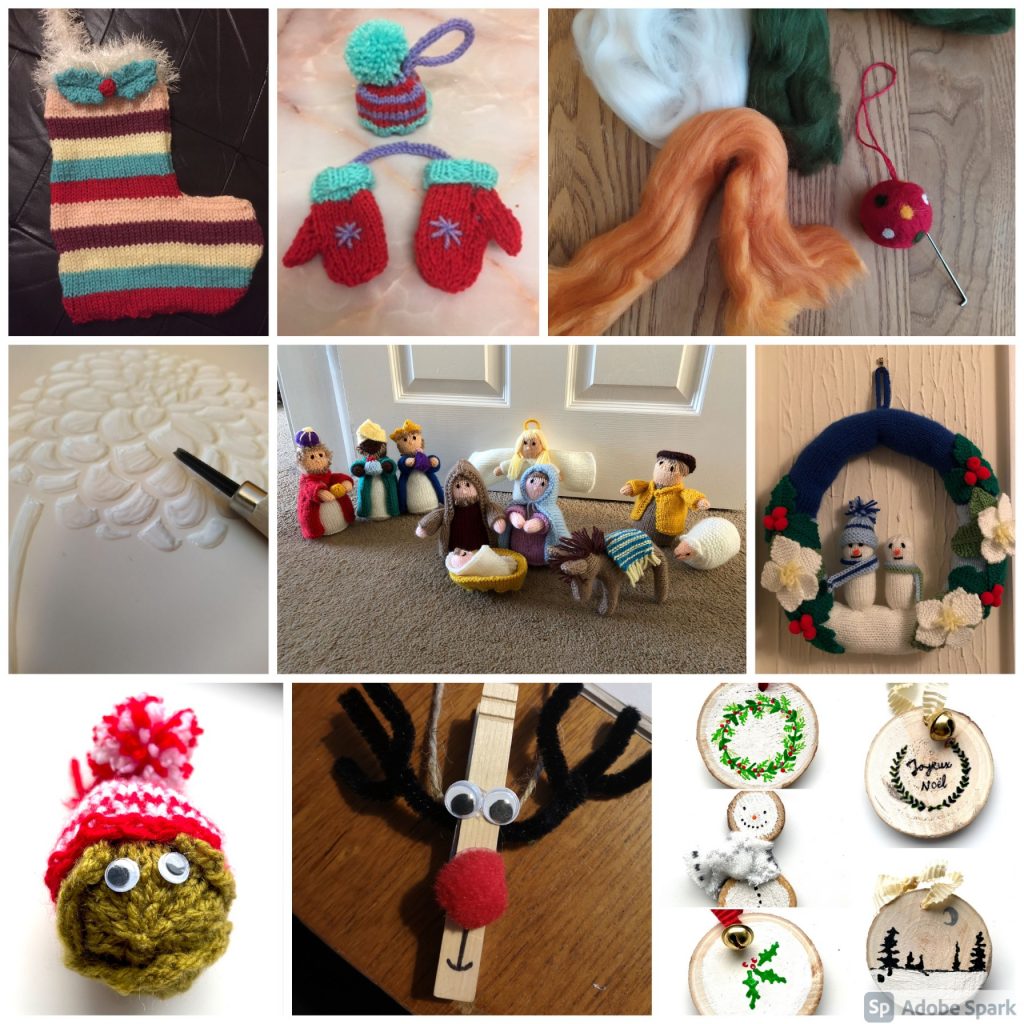
There are so many talented members of staff in our Library, so I wanted to share with you a mere tasting of the crafts that are being created this year:
Share the Joy
We would love to see your crafts, so why don’t you share a photo and tag us in Twitter, Instagram or Facebook, and use the hashtag #NULWinterCrafts2020.
I hope you have enjoyed our Winter Craft-along online blogs – Part 1 and Part 2 – and have found a pocket of time in your busy days to make something Wintery and Christmassy. I also hope it has inspired you to go out and discover other arts and crafts that you could make… because, remember, crafting is not just for Christmas 🙂
As promised, here is our next instalment of Winter crafts – so glue guns at the ready for some more crafting antics.
As in our previous blog, we are embracing all things sustainable, and challenging you to make your crafts using materials found around the house. This time you will need an old jam jar, a pair of socks and some fruit!
Glass jar lanterns
For this one you will need an old, clean glass jar and some cheap PVA glue (the video says to use Mod Podge, but cheap PVA glue works just as good), tissue paper to decorate your jar and a tea light (real or battery operated). The video shows Christmas trees and snowflakes, but let your imagination run crazy – you could do a snowman, father Christmas, a snowy scene or a nativity. Really easy, but looks so effective, and who doesn’t love tea light lanterns when the nights are dark and cold.
No-sew snowmen
This is where your old (clean!) sock can be turned into a jolly snowman. For this you will need one white sock, some elastic bands or Loom bands, uncooked rice, 4-5 buttons (I bet you have some random buttons kicking about the house?), PVA glue, a bit of scrap ribbon or some wool for his scarf and then some more wool if you would like to make him a pom-pom for his hat. I am definitely going to have a go at making this – so easy, but looks so good.
Dried fruit garlands
I’ve been meaning to have a go at making these for ages, not only do they look good, but I bet it makes your house smell amazing! For this one you will need some citrus fruit – this can be oranges, limes, lemons, or even grapefruit – maybe you have some sitting in your fruit bowl that have seen better days and could be given a new lease of life? You can also use cloves and press them into the slices before you pop them in the oven, to make them smell so good. In the video is says the temperature in Fahrenheit – all of the blog and instructions I have read it just says to set your oven at the lowest temperature available on your oven. Cook low and slow and make sure you turn them over half-way through. You will also need string or twine to string them up. I have seen them on Christmas wreaths and as Christmas tree decoration – have a play and see what you can make with them.
Share the Joy
We would love to see your crafts, so why don’t you share a photo and tag us in Twitter, Instagram or Facebook, and use the hashtag #NULWinterCrafts2020.
Look out for our final blog with a couple more crafts for you to try and inspiration from our Library staff.
For a few years now the Library has hosted Crafts at Christmas – a wonderful event that brings together staff and students into our Libraries for a time to unwind and focus our creative energies on some Winter crafts. Sadly this year we are unable to host our usual event, so instead we have created a series a blogs highlighting some excellent, but very simple, crafts that you can do in the comfort of you own home.
Our sustainability challenge
This time of year can be not only expensive but full of waste. So our challenge to you is to make these Winter crafts from as many materials that you have lying around the house as possible, such as old wrapping paper, last year’s Christmas cards, or old balls of wool lying around etc.. You’ll be amazed what beautiful crafts you can make out of the stuff you normally recycle or throw away.
3D paper snowflake
Last year I made these stunning 3D paper snowflakes out of the paper packing you get in your Amazon delivery! We make these snowflakes every year in our Crafts at Christmas events – they look really complicated, but are really easy. Why don’t you give them a go. All you need is paper, scissors, a stapler and sticky-tape…
Origami paper box
Another really simple paper craft, but instead of buying origami paper why don’t you make them out of old wrapping paper or even old, thin Christmas cards. These wee boxes are great for holding sweet treats for a loved one.
Recycled paperback folded Christmas tree
This is another super easy and very effective paper craft that you can do using an old book or magazine or catalogue. You don’t need any other materials other than the pages of the book, but you can decorate the tree afterwards if you like (I made origami lucky stars for the top of my tree):
Paper ball decorations
These are so pretty and all you need is string, glue and paper – we suggest using magazines and leaflets that you have had through the front door. Takeaway menus are great for it!
Share the Joy
We would love to see your crafts, so why don’t you share a photo and tag us in Twitter, Instagram or Facebook, and use the hashtag #NULWinterCrafts2020.
Look out for Part 2 and Part 3 with even more crafts for you to try.
We have all heard it said that languages spoken in northern arctic regions have considerably more words for snow than those spoken in southern climates. When dealing with something in detail every day it is often helpful to categorise and clarify its nuances.
A common mistake made in academic referencing is grouping all sources found online under the overarching category of a website. However, your aim should be to reference the information you have in front of you rather than where it was sourced. Grouping all items found online as a website would be the equivalent to referencing a book only by the publisher details, rather than the author and title. Or, by referring to both a snowball and a snowflake as simply snow.
For example, a government publication found online would be referenced like this in Chicago:
United Kingdom. Department for Education. Cloud computing: how schools can move services to the cloud. London: The Stationary Office, 2016. Accessed: November 4, 2019. https://www.gov.uk/government/publications/cloud-computing-how-schools-can-move-services-to-the-cloud.
An electronic journal article might appear like this in APA:
Gillum, J. (2012). Dyscalculia: Issues for practice in education psychology. Educational Psychology in Practice, 28(3), 287-297. doi:10.1080/02667363.2012.684344
While a video posted on the Tate website would look something like this in Harvard:
TateShots (2016) Grayson Perry: think like an artist. Available at: https://www.tate.org.uk/whats-on/tate-modern/talk/what-makes-artist-grayson-perry-conversation-sarah-thornton (Accessed: 11 November 2019).
Identifying the type of information you are using, as well as the source, is an essential evaluation skill which helps in developing a greater critical approach to information. In many cases you will be unconsciously using your judgment to assess the value of information for your purpose. So when you are using any source of information, ask yourself what it is you are looking at, what details are recorded about it, and whether it measures up as a quality piece of information. You’ll find more guidance about evaluating information on our Evaluating Information guide.
You’ve ran your information search and looked at your
results with a critical eye only to find that they’re not quite working for you
– what can you do now?
In this blog we’ll be looking at the top three problems encountered
when searching for information and how to improve your search to get the
results you need:
Finding too much
If your search has brought back thousands of results and you’re getting overwhelmed with the options:
Search a more specialised resource
Using a subject-specific database will help narrow the focus of your search to your particular areas of interest. Take a look at your Subject Guide to find databases and eBook collections tailored to your subject area.
Apply limits
Make use of the ‘refine’ options usually found on the left-hand side of Library Search or your subject database. Limit your results by date, subject area or information type. Remember, you may need to justify your limits to your supervisor so think carefully about your choices.
Combine search terms with ‘AND’
AND is a Boolean operator, a term you can use to have more control over your search. If you want to find information that must contain two different keywords (or phrases), place a capitalised AND operator between them. Your search engine or subject database will only find information that features both, narrowing your results. The more search terms you combine with AND, the narrower your search will be.
Finding too little
If your search has brought back a handful of useful articles but you need a wider range of results:
Combine terms with ‘OR’
OR is another Boolean operator that helps you to control your search more effectively. Use OR with your search terms that have synonyms or related terms. Your search engine or subject database will find information that features either word or phrase, significantly broadening your results.
Try controlled vocabulary
If you’re not getting enough results, it may be that your search terms or keywords aren’t quite working for you. Controlled vocabulary are a standardised list of words and phrases used on some databases to ensure that searches retrieve all relevant results, even when authors use different terms. Examples of databases that use this technique include ERIC, PsycInfo, CAB abstracts, Compendex and Medline. If these apply to you and your discipline, you’ll find out how to use them on your Subject Guide.
360 Searching
If you’ve found some useful articles, one simple way to find more relevant material is to take a look at the references used by the authors. This will lead you to find older material that was published before your original article which may also be useful. Library Search and some subject databases including Google Scholar and Scopus also allow you to see who has cited the articles you have found in their work (look for the ‘cited by link’). This is called citation searching and allows you to find more up-to-date analysis of your topic. By looking back at the references and forward at the citations, you get a 360 degree view of the research.
Finding nothing useful?
If your search has brought back results that aren’t relevant to your research question or you are finding it difficult to find the right search terms or databases to use, you might find it helpful to book a one-to-one appointment with your Liaison Librarian.
When it comes to finding academic information, there are a few things you need to think about before you start your search, such as where to actually look for information and the types of information you want to find in your search. Another thing that is worth taking the time to think carefully about is keywords.
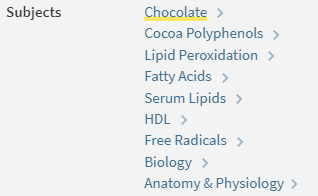
Keywords, sometimes called subject terms, are simple words and phrases that describe information; you can see them in the item record on Library Search and in Subject Databases.
An example of keywords from an article on Library Search
The results that your search returns are based on this information – if your keywords match an item’s keywords, that item will appear in your results.
To get the best results, then, you’ll need to develop a
balanced list of targeted keywords – these keywords may come from your essay
title or research question, from your subject knowledge or wider reading – you can
even borrow them from the subject terms you find on relevant articles!
As ideas and topics can be expressed in different ways you’ll
also need to think about synonyms and terms related to your keywords to make
sure you can find all of the relevant information.
To find out more about keywords, synonyms and searching take
a look at this short video:
There are some useful tricks you can use with your keywords to save you time when you search, take a look at the Academic Skills Kit to learn about Boolean, wildcards and truncation!
In our previous blog we explored how looking for information in the right place can help save you time and effort. However, sometimes, the right place to look can depend on what type of information you’re looking for.
While you’re probably familiar with books and you may have been introduced to journal articles, these are just two of the types of academic information available to you. Depending on your research question or essay title you might also find it useful to explore, for example, conference proceedings, maps, company information or newspapers.
Each type of information has its particular use; books provide an in-depth overview of a topic; journal articles are more specialised and focus in-depth on a particular area of a topic, and newspapers give you a useful perspective on events. While Library Search can help you find a large range of information types, some types of information are only available in special databases or archives. Before you start your search, it’s therefore important that you decide what types of information you will need to complete your assignment most effectively. You can find out more about different information types on our Finding Information Guide and in the video below:
When you know which types of information you need for your assignment or project take a look at our Resource Guides, which provide useful links and guides to appropriate sources.