
Hello and a warm welcome from all of us here at the Walton Library!
With the beginning of the year in mind (and what a year this is looking to be!) we wanted to make sure you are familiar with at least some of our faces.
Aimee, our Deputy Medical Sciences Librarian will begin by welcoming you all and talking a little bit about her role and the role of the Walton Library Liaison Team.
Compared to previous years, we won’t get to see as many of you as we would like, but we want to assure you that we are real and still very keen to help. So, let’s hear from Helen, one of our Library Aides, who ensures that physical resources are tidy and readily available, but is also here to welcome you when you come to the library, help you find your study space and your books.
A lot of work is put in ensuring that the academic resources required for your course are available. This extends from liaising with your lecturers and putting together reading lists of essential and recommended material, to ensuring that you can access these resources, to delivering session that will help you make the most out of them, as Marian, the Assistant Librarian in the Liaison team will explain.
Our Library assistants have a huge role in the reading list process as they check, double check and triple check… and then they check again that things work well. Elizabeth has a role in all of this, but she will also explain what she does when we receive new books and they need to be sorted and catalogued.
While we do have a lot of online resources on the website that will help you teach yourself a variety of academic skills, it can be quite daunting sometimes to find your way to the correct link, on the correct page, for the correct resource. That is why we are also happy to give you one-to-one guidance and point you in the right direction and if you ever get stuck, do our best to answer your questions. Bogdan will tell you in a few words how much he enjoys this element of interacting with you all.
Remember, you can always ask for assistance via Library Help.
If you’ll be studying for resits this August, there’s lots of help available from your Library during the summer vacation. Even though the Library buildings have yet to fully open, there’s still a lot of services ‘on hand’ to assist with your studies. Read on to find out how we can work together to ensure you have the best possible revision and resit experience.
What’s available
First and foremost, Library services are still operational during the lockdown summer vacation, they’re just functioning differently right now. You’re still able to organize an online one-to-one appointment with your Liaison librarian or request that the Library purchase an e-book to assist your revision.
If you’re in Newcastle, you may also like to use the Library’s new click & collect service. Request up to 10 books from the shelves, book a collection slot and then pick up your desired items from the Philip Robinson Library foyer. How good is that?
If you’re looking for online resources via Library Search, you might like to filter your search to show results that are ‘full text online’. This will limit your search to eBooks, journals, databases, e-theses and other electronic resources.
To find electronic resources, change your search to “Full Text Online” in the ‘Availability’ section of the filters bar.
You can also search for electronic articles by changing the search parameter from “Everything except articles” to “Everything” on the Library Search bar (see below).
Changing your search to “Everything” will bring up electronic articles for you to browse.
The Academic Skills Kit (ASK) is full of helpful advice, covering all aspects of study from how to manage your time effectively to reading and note-taking. There’s also guidance on exams and revision, including where to go for academic advice or personal support. ASK also has lots of resources covering online examinations. These are broken down into helpful categories: how to revise for an online exam, what to do before an online exam and exam technique.
We probably sound like a broken record by now but you’re
unlikely to revise successfully without establishing positive habits. These
include:
Working in an area of your home that’s best
suited to your needs. If possible, choose to work in an area that has plenty of
natural light and is well-ventilated.
Building a realistic revision planner with
plenty of breaks factored in.
Practising good self-care, such as getting
plenty of fresh air, staying hydrated and eating a balanced diet.
This time of year is normally one of the busiest for the Libraries on campus. Instead, the Libraries are currently physically closed and both revision and exams are taking place at homes across the country (and possibly further afield!). While this ‘new normal’ might seem overwhelming at first, in many ways, it’s business as usual. Read on to find out how we can all work together to ensure you have the best possible revision and exam experience.
Your subject-specific
guide also contains links to useful journals, databases and eBook
collections that are tailored for your course. You may also find it helpful to
browse through a list of newly-acquired
online resources that the Library have purchased to better enable your
studies from home.
There are a number of MCQ (multiple choice question) books available
to read online to complement your revision. They cover subjects including:
paediatrics, neurology and physiology.
Library Help remains available 24/7 to assist with your queries – please send them in via email or live chat. We are also regularly updating Library FAQs to bring you the most up-to-date information. (Hint: if you filter the FAQs to show ‘remote services temporary FAQ’, you’ll only be shown the newest Library FAQs.)
Following the announcement of lockdown, ASK have made some
new resources to assist with online examinations. These are broken down into
helpful categories: how
to revise for an online exam, what
to do before an online exam and exam
technique. While you will get details from your School about the specific
changes to your exam(s), these pages have really helpful advice on preparing
for and succeeding in online assessment.
Choose an area in your home to work in that’s best suited to your needs. This might be a bedroom, kitchen or office space. You may want to consider making some adjustments to your existing desk (or kitchen table!) to avoid causing an injury. If possible, choose to work in an area that has plenty of natural light and is well-ventilated.
Build yourself a realistic revision planner, with plenty of breaks factored in. You won’t be able to revise everything in one day so breaking down topics into manageable chunks is essential. Regular exercise, a balanced diet and a good night’s sleep are also key to revision success.
Remember to take regular study breaks to stay hydrated, get
fresh air and clear your mind. You’re unlikely to revise effectively without
regular breaks and time away from your work. There are a number of activities and resources
on the Library’s website for things you can do while taking a break. These
include seated desk yoga, colouring in sheets and mindfulness exercises.
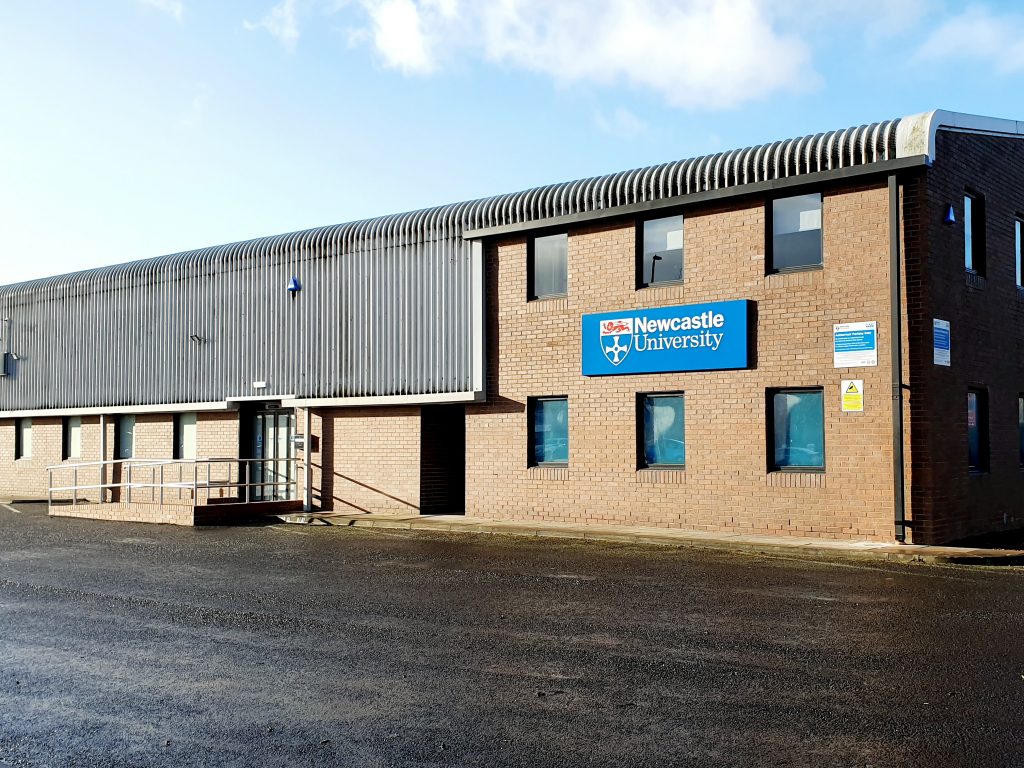
The exterior of the Research Reserve facility in the Team Valley.
The eagle-eyed amongst you may have noticed a curious thing on Library Search. Where normally you would expect to see the name of one of the libraries next to an item’s shelfmark, occasionally you’ll see “Research Reserve”.
If you’ve ever wondered just what exactly the Research Reserve is, this is the blog for you, discover here exactly what the Research Reserve can offer you and your studies.
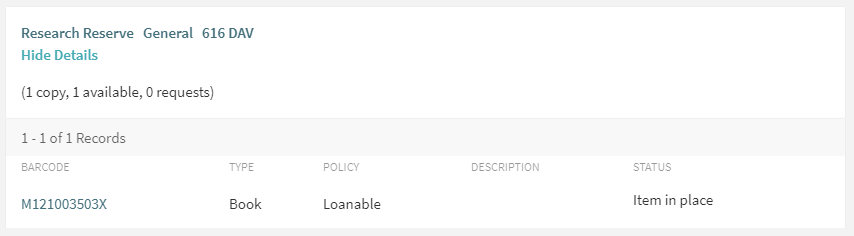
Before an item’s shelfmark is its location. This book is held off-site at the Research Reserve facility in the Team Valley.
The Research Reserve is the Library’s stores, located throughout campus and including a state-of-the-art storage facility in the Team Valley. These facilities allow the Library to keep less-used material for much longer than other academic libraries. These combined storage facilities provide over 29 kilometres of storage space, which is used to house old editions of journals and books which are consulted infrequently.
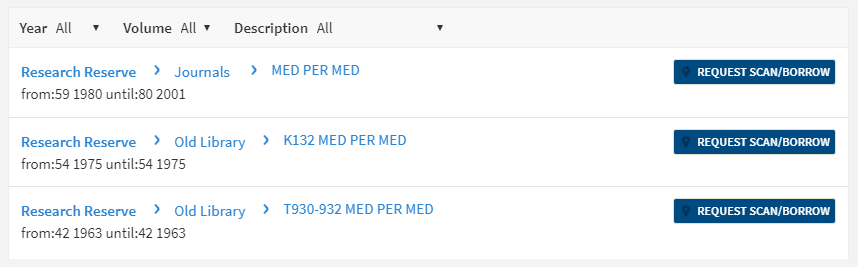
If you’d like to request items from the Research Reserve facilities, click the “Request Scan/Borrow” button once you’ve located the item on Library Search.
You can loan a variety of materials from the Research Reserve,
including: books, theses and journal volumes. These can be requested from Library
Search. Simply log
in using your campus ID, find the item you are looking for and then click
the blue “Request Scan/Borrow”
button. You’ll get a choice of pickup locations (either the Walton or Philip
Robinson libraries).
There are request forms to complete if you’d like to borrow
a thesis
or an entire volume
of a journal.
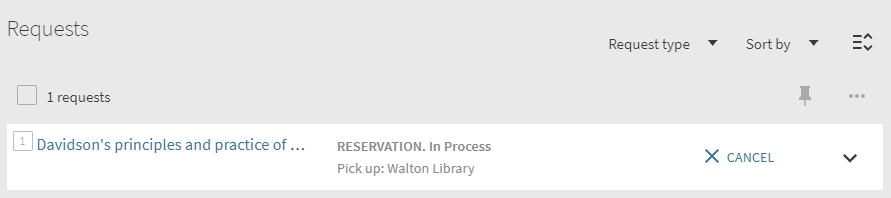
Requests can be viewed by going to “My Account” in Library Search and clicking on “My Requests” from the drop down menu. If you’d like to cancel your request, simply click the blue cancel hyperlink (as seen below). You’ll receive an email confirming your cancellation shortly afterwards.
You can cancel requests for Research Reserve items by clicking the blue ‘Cancel’ hyperlink, as shown above.
There is a collection service that runs between the Research
Reserve and the various libraries (weekdays only, not on bank holidays) and
your request will be generally be fulfilled within 24 hours. Anything requested
on a Friday or over the weekend will be delivered on the following Monday
afternoon.
Once your item has arrived at your chosen library, you’ll receive an email letting you know it’s available to loan. The item will be kept on the reservations shelves for five days before being returned to the Team Valley, or passed on to the next person in the reservation queue. Items from the Research Reserve are issued in the same way as standard long loan items, either using the self-issue machines or at the service desk. Once you’ve finished with the item, simply return it as normal.
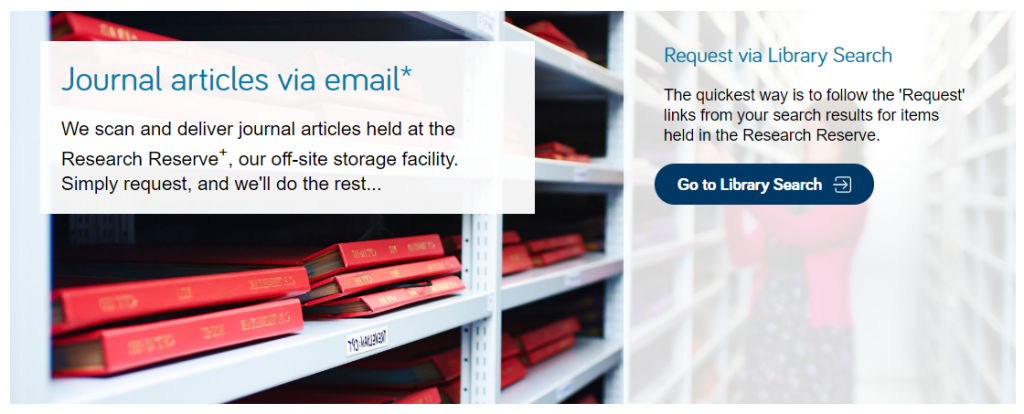
The Desktop Delivery Service (DDS) allows you request a
scanned article from a journal held in one of the Library’s stores. Articles
can be requested via Library Search (same as a book) or by filling out the relevant request form. Please try and include
as much detail as possible on your request form. This helps Library staff
locate your article and fulfil your request quicker.
You are only able to request one scanned article per journal
issue. The scanned article will be delivered to your University email address,
where it can be downloaded and printed off. Requests are generally fulfilled
within 24 hours, although this may take longer over the weekends or on bank
holidays. You have 30 days to download your article before it is ‘archived’ and
no longer available.
We do not scan items that are available electronically or
can be borrowed.
If you have any other queries about the Desktop Delivery Service, read the FAQs.
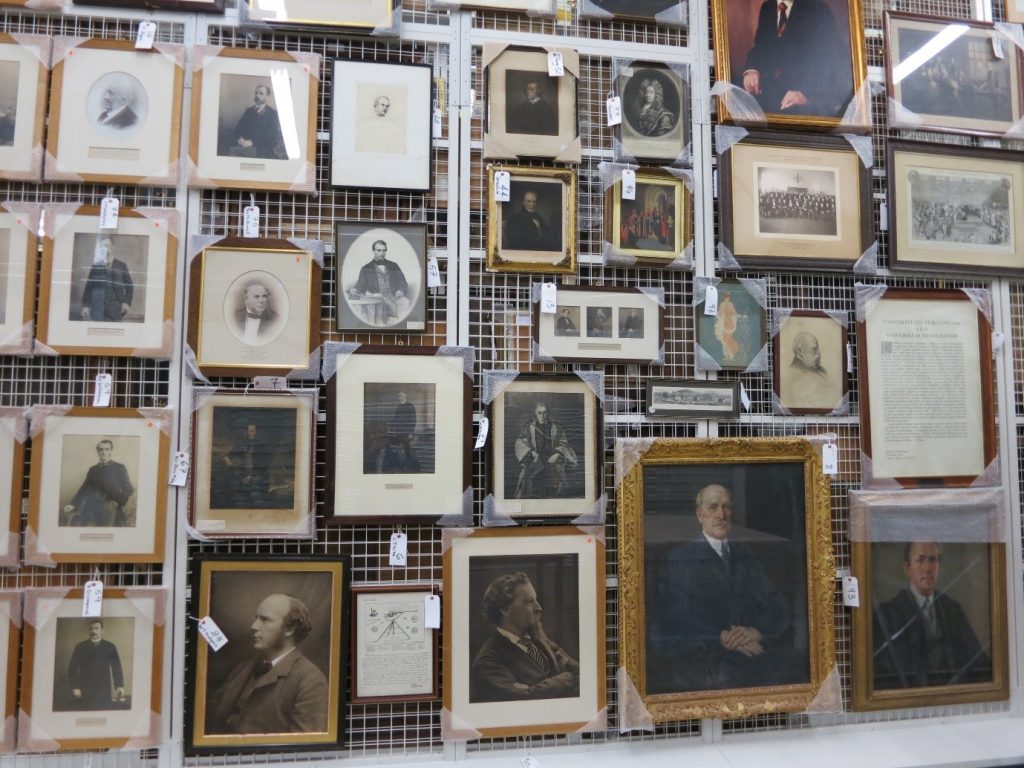
Just some of the amazing treasures held at the Research Reserve facility in the Team Valley.
You can also visit the off-campus Research Reserve facility in the Team Valley. Daily access is available by appointment only with the Research Reserve team, weekdays between 10AM and 4PM. Access outside of these hours can be organised given sufficient notice. There is a large car park available at the facility and buses stop nearby.
Full contact information, directions and opening hours for the Team Valley facility are available via the Library website.
Exams are a tricky time. Often you will be juggling different exams themselves, on top of other deadlines. However, we want you to know that you aren’t alone at this crazy time of year. We are here to help you through.
But how exactly can we help? Sadly, we can’t take go into the exam with you, or magically freeze time to give you more hours in the day, but do make the most of the following:
Library Help – the place to go when have a question via chat, email, text, twitter, Facebook. Or alternatively search our Frequently Asked Question (FAQ) database.
Librarians – yes you heard right. Book a one-to-one appointment to get the best out of the University Library resources. Also remember our staff in every library are friendly and approachable. There is no such thing as a silly question, so ask away!
Study Space– The University Library has a range of different study rooms and spaces to suit your needs.
24/7 – The Philip Robinson Library is open 24/7 during the exam period. We want you to sleep and get enough rest, but if you do need to study through the night, we are here.
Subject guides – we have a range of subject guides put together by expert librarians which draw together all the main resources for your studies.
Be well@NCL collection – we don’t just have books for study. This new collection includes tried and tested books that support your wellbeing.
Returning to University in January means one thing: it’s time to start revising for your exams. Study Well @ NCL is a campaign run by the Library, NUSU (Newcastle University Students Union) and NUIT (Newcastle University IT Service) advocating a responsible approach to studying and encouraging positive behaviours in study spaces. We all know it can be stressful at this time of the year – but we’re here to make things easier. So, what exactly are we doing?
Extended Opening
Hours
Here in the Walton Library from 6th – 24th January, 2020 we’ll be extending our opening hours opening from 8:30 until midnight, Monday to Friday and 10AM until midnight on weekends. You can check our extended opening times here on the Library website.
Noise Alert Service
We’ll be monitoring our Noise Alert phone very closely during this time. Wherever you are in the Walton, you can text us at 07891 484764 and we’ll investigate the source of the noise issue as soon as possible. You can also contact us on Library Help to report a noise complaint.
Housekeeping
During busy periods staff will be checking to see:
where seats are available (and clearing unattended desks after 30 minutes of inactivity).
that bins are emptied.
that bathrooms are clean.
that walkways are kept clear.
How you can help
Choose a study space suited to your preferred choice of
study. There are silent, quiet and collaborative study spaces to choose from. Please
be considerate of fellow Library users.
Do be mindful of the food and drink policy within your
chosen study area. Remember, you can only eat hot and strong smelling food in
the café area.
Let staff know if there’s something that’s been missed. It’s not always possible for us to know if there’s a shortage of towels in the bathroom or if a waste bin needs emptying. Please contact us if you notice something and we’ll do our best to fix it straightaway.
Looking after
yourself
We encourage all Library users to take regular study breaks. Taking the time to get a drink of water or some fresh air can make all the difference to your study session. Why not stop by our display table (located near the main entrance) and pick up a Sudoku puzzle or desk yoga instructions? However, to be fair to all Library users, we’re asking that breaks away from your study space are no more than 30 minutes.
Colour your Campus
On lighter note, we’ll be providing pens, pencils and colouring sheets for you to relax and unwind with. Hand your completed sheet in to a member of Library staff with your name or Twitter handle on the back and we’ll display it in the Library and enter your masterpiece into a draw to win some fabulous Library prizes.
Off The Shelf
Sue Spencer returns to the Walton Library on Thursday 16th January (3-5PM) to dispense personalised poetry pick-me-up’s designed to soothe and inspire. Take a study break, chat with Sue and receive your own poetry prescription. You can find out more about Off The Shelf here.
We hope that Study Well @ NCL provides you with a peaceful
and productive study environment and allows you to achieve maximum studying
satisfaction. We welcome feedback on how we can change or improve Study Well @ NCL.
You can ‘Tell Us
What You Think’ online or get a form in the Walton Library.
Do you need help to understand your mental health and wellbeing?
Are looking to understand your subject from a different point of view?
Then take a look at the collections below. These will get you reading around and outside of your subject and could benefit your health and wellbeing. Both collections can be found in the Quiet Study area of the Walton Library.
Be well@NCL is a collection of books designed to help manage and understand common mental health conditions and wellbeing. Reading a book by someone who understands what you are facing can help you start to feel better. The books within the collection are recommended by professionals and are available to borrow. The Philip Robinson and Walton libraries have the same collection of books.
Content
of the collection
The collection offers books that can help with
a wide range of issues and concerns. The collection includes titles that offer
more healthy ways of thinking, such as practicing mindfulness and challenging
unhelpful thought patterns. There are also books about common feelings,
experiences, and issues, such as:
Anger
Anxiety – including health anxiety and social anxiety
Bereavement, loss and grief
Body image issues and Body Dysmorphic Disorder
Caring for someone with a mental health issue
Depression – including postnatal depression
Eating disorders and eating distress
Low self-esteem
Mood swings
Obsessive-compulsive disorder
Phobias and panic
Sleep problems
Stress
If you find the book you are reading is not helping, please contact your GP or health professional. If you are a student you can also contact the University’s counselling team.
If the book you want is out on loan then please make a Reservation. If there is high demand for a book this alerts library staff to potentially order more.
Pick up a Be well@NCL postcard from the Walton Library desk or find out more here.
The Medicine in Literature collection captures the complexities of what it means to be human through a wide range of literary genres. Representations of illness, dis-ease, healing and health are interwoven themes that give voice to a diversity of perspectives and experiences. If you are interested in exploring your subject from a different viewpoint or simply want to broaden your reading, dive right in! The collection includes books and DVDs.
Topics covered include:
Alzheimer’s
Anxiety
Autism
Bipolar Disorder
Brain Disorders
Cancer
Coma
Cystic Fibrosis
Dementia
Depression
Eating Disorders
Epilepsy
HIV/AIDS
Leukaemia
Locked-In Syndrome
Mental Illness
Motor Neurone Disease
Obsessive-Compulsive Disorder
Parkinson’s
Polio
Schizophrenia
Stroke
Go and have a look at both of these collections in the Quiet Study area of the Walton Library.
The official blurb on EndNote is
that it is “…the industry standard software tool for publishing and managing
bibliographies, citations and references.”
Have you drifted off yet? Don’t – read on!
EndNote takes a little getting used to
and we recommend you familiarise yourself with it at the start of your research
process. But as Library Staff, we wouldn’t spend a
significant amount of time demonstrating and training our academic staff and
students on what EndNote is, and how to use it, if we didn’t think it was
valuable. It will save you a huge amount of
time in terms of writing up your assignments.
Essentially, you can use EndNote to
create and organise a personal library of resources relevant to your research.
You can import references from Library Search, and a huge range of databases such
as Scopus, Web of Science, IEEE Xplore and Business Source Complete. You can ask EndNote to locate
the full-text PDFs of the resources you are going to use in your research, and
you can annotate them as you wish too. Did you know you can instruct Google Scholar to
import references into EndNote? No? Try
it. Finally, if you already have materials stored in your home
folder (H:\) then you can attach them to a manually-created
reference within EndNote, bringing all your research together in one place.
In addition to organising your references (and this is the clever bit) you can then get EndNote to ‘talk’ to your word processing software, e.g. Microsoft Word, and insert the citations into your work for you in your chosen referencing style, e.g. Cite Them Right Harvard, Vancouver, APA or MLA. If you don’t want to do that, then EndNote will also allow you to create an independent bibliography of your references, saving you an awful lot of typing.
Using EndNote
Intrigued? You should be. Take a look at our EndNote Guide. It contains all the introductory information you need, step-by-step workbooks to train yourself on the use of EndNote (the Desktop and Online versions), videos, useful FAQs, and contacts for help, should you need it.
Finally, Newcastle University
provides support for EndNote but it is not compulsory to use. You may
prefer Mendeley, Zotero, RefWorks or another piece of bibliographic
management software. That’s fine, whatever makes your referencing lives easier. Go on, give them a try.
A common mistake made in referencing is grouping all sources
found online under the category and reference type of a website. Your aim
should be to reference the information you have in front of you rather than
where it was sourced. Simply grouping items found online as a website would be
the equivalent of referencing a book by the publisher details rather than the
author and title.
For example, a government publication found online would be referenced like this in Chicago:
United Kingdom. Department for Education. Cloud computing: how schools can move services to the cloud. London: The Stationary Office, 2016. Accessed: November 4, 2019. https://www.gov.uk/government/publications/cloud-computing-how-schools-can-move-services-to-the-cloud.
An electronic journal article might appear like this in APA:
Gillum, J. (2012). Dyscalculia: Issues for
practice in education psychology. Educational Psychology in
Practice, 28(3), 287-297. doi:10.1080/02667363.2012.684344
While a video posted on the Tate website would look something like this
in Harvard.
TateShots (2016) Grayson Perry: think like an artist. Available at: https://www.tate.org.uk/whats-on/tate-modern/talk/what-makes-artist-grayson-perry-conversation-sarah-thornton (Accessed: 11 November 2019).
Identifying the type of information you are using as well as the source, are essential skills of evaluation and developing a critical approach to information. In many cases you will be unconsciously using your judgment to assess the value of information for your purpose. So when you are using any source of information, ask yourself what it is you are looking at, what details are recorded about it and whether it measures up as a quality piece of information. You can find more information on evaluating information on the Academic Skills Kit.
These DNA models are part of the Walton’s clinical skills equipment collection. Ask at the desk to loan one today.
While exams may seem a long way away, it’s important to be prepared for them. You can minimise stress and maximise efficiency with a good revision timetable and organised notes.
You can also find helpful material to aid your revision at the Walton Library. Your subject support guide is full of information and resources, tailored to suit your programme of studies. There are boxes of flash cards covering a number of subjects available to borrow from our long loan collection – ask at the service desk if you are interested in loaning a set. You may also find it helpful to broaden your revision from notes and textbooks to include clinical skills equipment and books from our MCQ (Multiple Choice Question) section. This could be the difference between a good and a great exam result! You’ll find more information about both of these collections in this blog post, as well as where to find them and how to loan them.
Multiple Choice Question (MCQ) books
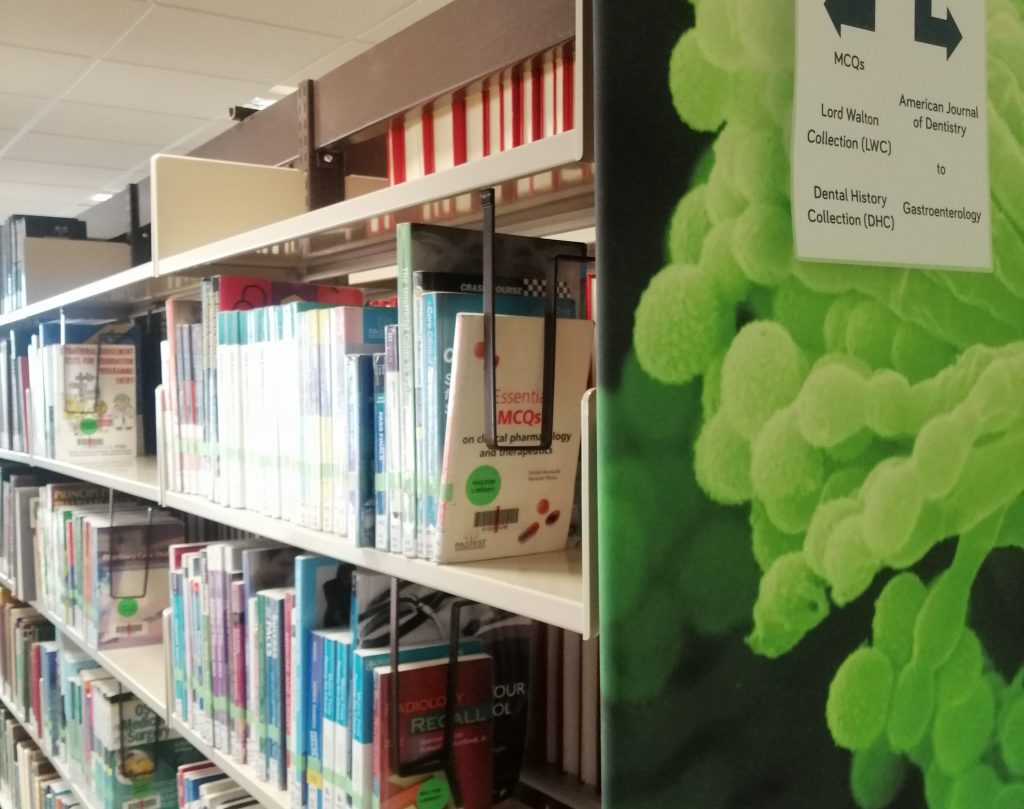
Books in the MCQ collection are located in the quiet study area. You can identify them by the green stickers on the book spines.
There are a variety of topics covered in our Multiple Choice Question (MCQ) section. Within the collection, you’ll find books to on a number of subjects from anaesthesia to surgery. There are also books to aid revision for specific exams – including OSCEs, PACES and MRCS.
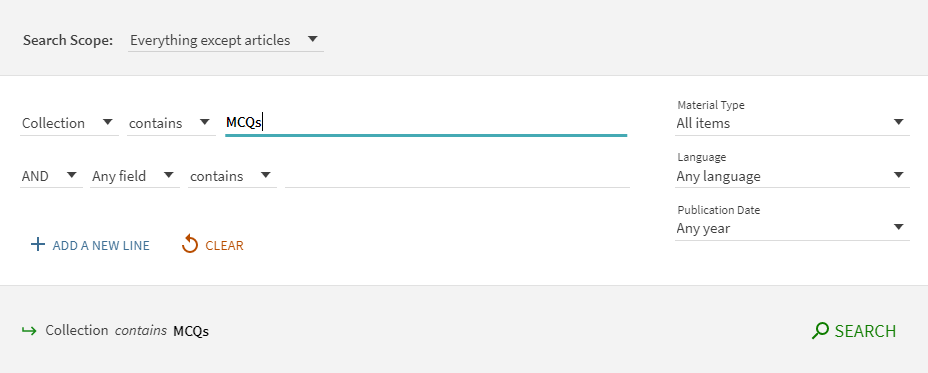
If you’d like to browse the MCQ collection, go to Library Search. You’ll need to click the ‘Advanced Search’ link and then change the “Any field” drop down menu to say ‘Collection’. In the text space, enter “MCQs” and you can view the entire collection. You can narrow down your search by adding a subject, author or title if you’re interested in a specific topic.
You can search the entire MCQ collection by changing the search filters to “Collection” and adding MCQs in the text bar.
You can find the MCQ collection in the quiet study area of
the Walton Library. They’re easily identifiable by the green stickers on the
book’s spine.
The books are long loan – meaning you can have them for up to 20 weeks, providing they’re not requested by another Library user. If the MCQ book is already on loan, follow these instructions to place a request.
If there is a book you think would help your exam revision, use our Books on Time service and recommend it. Find out more about this service here.
Clinical skills equipment
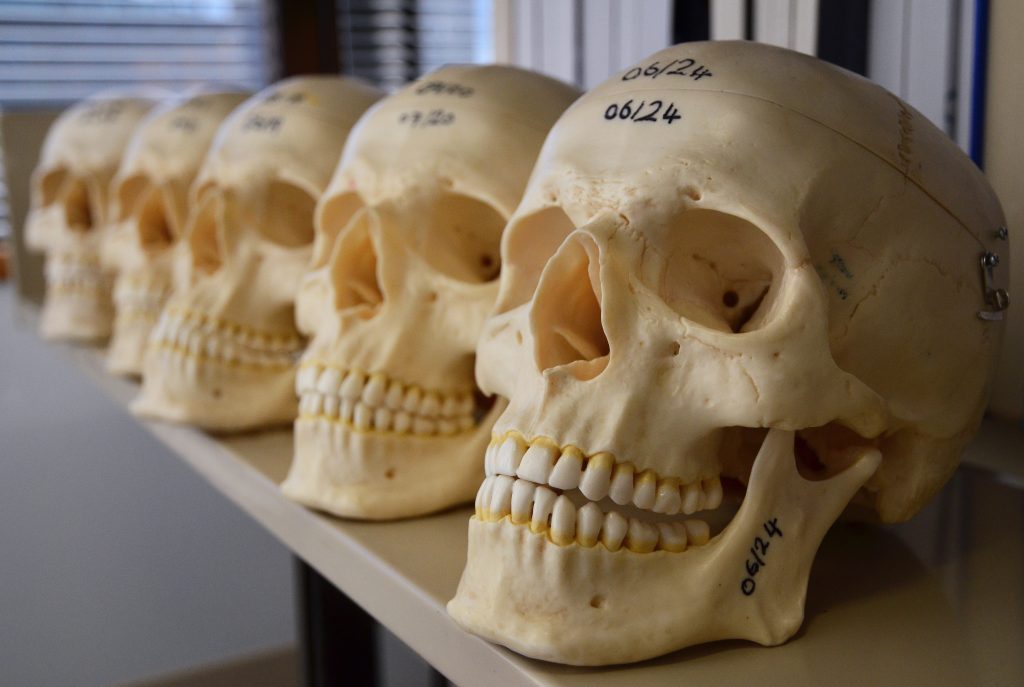
At the Walton Library, there is a wide selection of clinical skills equipment available to loan. There are medical tools, like tendon hammers, sphygmomanometers and otoscopes. Anatomical models, such as skulls and teeth. Plus eye charts, DNA models and even a spine! (A model one, that is.)
You can borrow a skull from the service desk or the STC room at the Walton Library!
The main bulk of clinical skills equipment is located behind the service desk at the Walton Library. Ask a member of staff and they’ll retrieve it for you. You can have up to three clinical skills items on loan at any time. Unfortunately, you can’t place requests on the items if they’re all out on loan.
There are also a small number of skulls available to loan
from the Student Texts Collection (STC) room. You can loan them using the
self-issue machine in the STC.
You may have also noticed a collection of anatomical models on a table in the collaborative study area. These models are free to use within the Library for as long as you like – but they can’t be taken out of the Library.
Clinical skills equipment items are available as a next day loan. This means that if you borrow a skull at 9AM on a Monday morning, it needs to be returned before the Walton Library closes on Tuesday. Items in the clinical skills equipment collection are non-renewable.
Beyond the Walton, there is exam and revision assistance available from the wider Library services and the University. You may find it useful to check out the Academic Skills Kit (ASK) to learn more about different revision strategies and exam techniques. You can also use ASK to find out about available counselling and chaplaincy services to help combat exam stress. Follow this link to ASK!