Writing an essay: step-by-step guidance from the Academic Skills Development Team

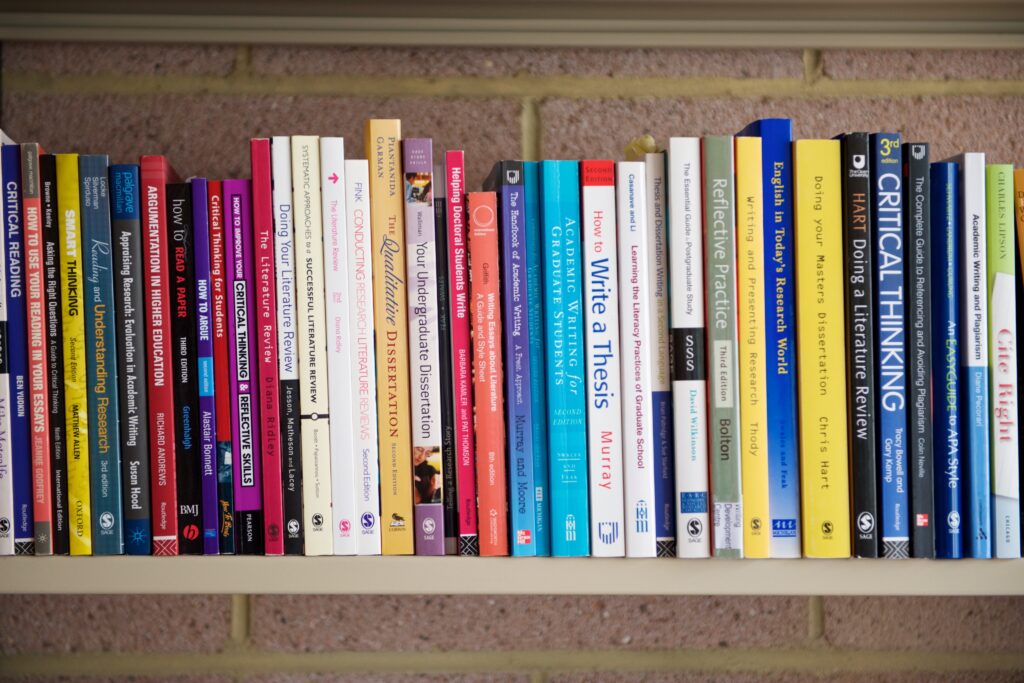
A selection of books on academic skills.

Not sure about how to start writing an essay?

One of the most frequently asked questions in the academic skills drop-ins in the Walton Library is about how to write an essay.

If you are feeling a bit overwhelmed with how to begin a piece of assessed written work, it is worthwhile thinking about writing as a process as opposed to a final product. Thinking about it in this way means that you break the task down into smaller manageable chunks, but you can also review, reflect, and edit your work as you go along which helps you to meet the marking criteria.

It is important to remember that although we call it a process, you are likely to move back and forward between stages reviewing, evaluating, revising, and editing as you go along.

A student in the Law Library.

The first stage in the process is planning, this includes looking over the marking scheme as well as the questions, this will give you a clear idea of what the marker is looking for, you can then begin generating ideas, this will lead you to begin the research process.  It is worth reading broadly at first to get an overall picture of your topic, here you’ll use the materials you’ve been taught in lectures, look at your reading list as well as other resources you’ve been directed to. At this stage (and throughout your work) it is a good idea to have the assignment question to hand so that you can refer to it, this will help you keep focussed on the task you’ve been set. You’ll then be in a position to decide how you want to respond to the assignment question, this will then help you source more detailed texts. Deciding on your position at the planning stage will help make your writing focussed and coherent. Once you’ve decided on your position, you can begin to map out a rough plan.

It is important to have a plan because this gives you a clear overview of what you’ll write about, it will guide you as you work through the assignment and will help you ensure that you’ve included everything and addressed the task fully. The plan doesn’t need to be detailed, even a list of headings and subheadings can be helpful to guide you. Regardless of how you plan your work out, this process will enable you to organise your argument and the evidence you’ll use to support this, you can also establish connections between points. It will also help you read with a clear purpose, as you’ll be looking for material to support your point, as opposed to summarising relevant texts and adding them to your work.

Image courtesy of Glenn Carstens-Peters

After the planning stage you’ll move onto the composition of the assignment. Here you’ll use the rough plan as a guide, and you’ll begin formatting ideas and incorporating references to support your points.  You’ll think about how to structure and the composition of each paragraph and add the appropriate references. Remember it is important to integrate sources when you are writing, not simply summarise one text per idea.

Then you’ll go over what you’ve written and review it, you should evaluate what you’ve written thinking about the evidence you’ve found and your argument throughout the essay, and as you look through your work you are likely to revise and edit what you’ve got. This process will continue until you have completed your assignment.

Reviewing, evaluating, revising, and editing your work is likely to occur in several cycles. Eventually you’ll have a completed draft. At this stage it is worth ensuring that you read the whole piece of work to ensure flow throughout, you can also check for any language, structural, referencing, style or grammar issues. If possible, take a break from writing so that when you do your final checks you are looking at your work with fresh eyes and therefore will be more likely to spot any potential errors.

Our video illustrates this process and can help get you started on tackling a piece of work you’ve been given. Don’t forget that we’ll be able to answer your questions about essay writing and much more when we visit the Walton Library for our drop-ins, the next one is scheduled for Wednesday 16th from 11:00-13:00.
We’ll add more dates after the Easter break, however, in the meantime if you’ve got any academic skills queries, we’ve now got a Live Chat widget on all the Academic Skills Kit pages, it’s live from 12:00-16:00 Monday to Friday.

We always love to hear from students, if you’ve got any feedback or questions about our support or resources please get in touch! AcademicSkills@newcastle.ac.uk

PubMed: Becoming familiar with controlled vocabularies


Are your literature searches run mainly in keyword-based platforms such as Google Scholar, Scopus or Web of Science?

Have you been told that you need to diversify your search, or maybe use a new database such as PubMed? Did someone mention that MeSH terms could improve your search?

If you do not know what those terms mean or where to start, you are in the right place. The following video will explain to you what controlled vocabularies are and why they are a powerful tool for retrieving relevant papers.

Now, let’s put theory into practice and demonstrate how to use Medical Subject Headings (MeSH) in PubMed. The video below will do just that.

Let’s have a look at what other controlled vocabulary databases you can use in medical sciences or if your Social Sciences student whose work crosses over with medical sciences. You can find all the databases mentioned below and others in Library Search:

Since the previous videos focus on PubMed, you might wonder what other databases you should be using. If you are unsure how to find the most relevant databases for your course, you can watch a video that will show you how to identify them.

Is Medline the database for you, but you need some help with the basics? Watch our:

Finally, please remember that this is general advice and it might not cover your particular area of interest. If you have any specific questions, please do not hesitate to contact us on Library Help, where you can email us or speak to us through the Live Chat feature.

Ovid Medline: Becoming familiar with controlled vocabularies

Are your literature searches run mainly in keyword-based platforms such as Google Scholar, Scopus or Web of Science?

Have you been told that you need to diversify your search, or maybe use a new database such as Medline, Embase or PsycInfo through the Ovid searching platform? Did someone mention that Medline’s MeSH terms could improve your search?

If you do not know what those terms mean or where to start, you are in the right place.

The following video will explain to you what controlled vocabularies are, why they are a powerful tool for retrieving relevant papers and it will demonstrate how to use Medical Subject Headings (MeSH) in Medline via Ovid.

Since the previous video focuses on Medline, you might wonder what other databases you should be using. If you are unsure how to find the most relevant databases for your course, you can watch a video that will show you how to identify them.

Is Medline the database for you, but you need some help with the basics? Watch our “Getting started with Ovid Medline” video for the basics. For a more detailed explanation on how to combine searches, watch the Combining Searches in Medline and other Ovid Databases.

Finally, please remember that this is general advice and it might not cover your particular area of interest. If you have any specific questions, please do not hesitate to contact us on Library Help, where you can email us or speak to us through the Live Chat feature.

Elsevier’s Clinicalkey Student

Getting Started

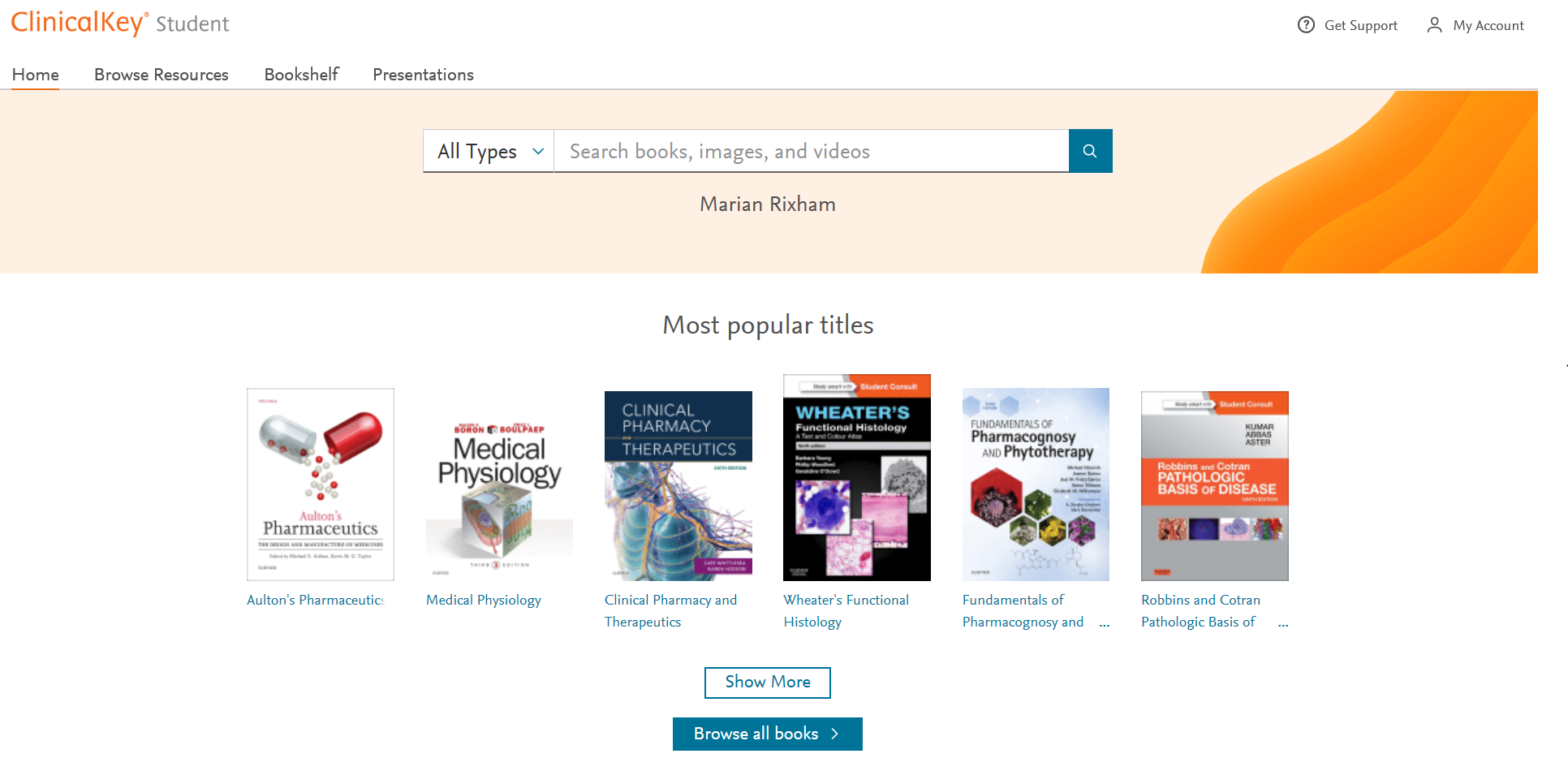
Elsevier’s Clinicalkey Student gives you electronic access to some of the most popular recommended clinical textbooks plus lots of other really useful resources including images and video. Subjects covered include medicine, dentistry and pharmacy. It allows you to add a book to your own Bookshelf, highlight text, add notes, create flashcard, make presentations and more. All of which is described below with videos to watch.

All of the eBooks available from Elsevier’s Clinicalkey can be found individually by searching for them on Library Search. To search or browse the collection go to Library Search and search for Clinicalkey.

To Login

To find out how to login and search for a book follow the instruction below or watch this video to get started.

  • Click on Log in via your institution on the right hand side
  • In the Institution search box type Newcastle University
  • Login using your University Username and Password

You are now ready to search for content either:

  • a book by title, author or keyword
  • a subject keyword for any content e.g. book, chapter, video available

Using the Bookshelf

To find out how to use the Bookshelf follow the instruction below or watch this video to get started.

To add a book to the Bookshelf you need to be within the content of a chapter. Search for the book by title, author or keyword

  • Click View book TOC
  • Click on the chapter you want
  • Click Add to Bookshelf on right hand side
  • If you want to see the book on your bookshelf, click Launch Bookshelf
  • If you click on the Home option this will show you all the books you have added to your Bookshelf
  • Once you have added to your Bookshelf you can go straight to it from the homepage by clicking on Bookshelf

For more details on using the Bookshelf watch this video.

Highlighting and Saving Text

When you are within the text of a chapter you can highlight any part to save it as a note for later. See instructions below and for more detail watch this video on Highlighting and Saving text.

  • Highlight the text you want to save
  • Select either green or yellow to highlight the colour
  • Give the note a name to show what it is

To look at all your notes click on the Notepad option on the left of the screen.

Creating Flashcards

When you are within the text of a book you can highlight any part to create a Flashcard. See instructions below and for more detail watch this video on Creating Flashcards.

  • Highlight the text you want for the front of the flashcard
  • Choose an existing Deck or a New Deck and Create it
  • Highlight and select Copy to get the text for the back of the card – Paste this text into the card
  • Save the card
  • You can create as many decks as you want and as many cards you want in each deck
  • By clicking on the Play button in the top right hand corner of the deck you can run through the cards to test your knowledge

Creating Presentations

You can share the latest evidence-based information with colleagues by exporting images with their citation and copyright information into a PowerPoint presentation.

See instructions below and for more detail watch this video on Creating Presentations

  • Search or Browse for an image
  • Click the Add to Presentation link at the bottom of the image
  • Select an Existing Presentation from the drop down menu
  • Click Add

OR

  • Click Create a New Presentation
  • Give it a name in the Presentation Name box
  • Click Add

Download the presentation and save as a .ppt file. You can then add your own slides and text to complete your presentation.

Using the Clinicalkey APPs

There are two types of Bookshelf apps:

  • Mobile App (iOS or Android): You can download the mobile app directly in the iOS or Android app store. To find the app, search for the name of the app (Bookshelf ClinicalKey Student).
  • Desktop App (Windows 10+): The app name appears as ClinicalKey Student Bookshelf. During the download process, you will be prompted to install the app and agree to the terms and conditions. This will create a menu icon and add a shortcut on your Windows 10 desktop.
  • Desktop Apps (Mac OS): Download the Mac version and follow the steps on the screen to complete the download and install the app.

Authentication requirements depend on the app you are using: mobile or desktop.

  • Mobile App (iOS or Android): The first time you use the Bookshelf mobile app, you must be in your authenticated medical school’s network when you sign up or sign in. For only this first-time usage, you have to be authenticated by your medical school’s network. After this unique confirmation that your account belongs to a medical school that provides ClinicalKey Student, the app will remember this authentication, and you can use the app online (in any network) or offline.
  • Desktop App (Windows 10+): You do not need to be on an IP-authenticated network to access the desktop app. Use your ClinicalKey Student username and password to log in to the desktop app.

Studying for resits? We’re still here to help!

Photo by Marten Bjork on Unsplash

If you’ll be studying for resits this August, there’s lots of help available from your Library during the summer vacation. Even though the Library buildings have yet to fully open, there’s still a lot of services ‘on hand’ to assist with your studies. Read on to find out how we can work together to ensure you have the best possible revision and resit experience.

What’s available

First and foremost, Library services are still operational during the lockdown summer vacation, they’re just functioning differently right now. You’re still able to organize an online one-to-one appointment with your Liaison librarian or request that the Library purchase an e-book to assist your revision.

Your subject-specific guide also contains links to useful journals, databases and eBook collections that are tailored for your course. There are a number of MCQ (multiple choice question) books available to read online to complement your revision. They cover subjects including: paediatrics, neurology and physiology.

If you’re in Newcastle, you may also like to use the Library’s new click & collect service. Request up to 10 books from the shelves, book a collection slot and then pick up your desired items from the Philip Robinson Library foyer. How good is that?

If you’re looking for online resources via Library Search, you might like to filter your search to show results that are ‘full text online’. This will limit your search to eBooks, journals, databases, e-theses and other electronic resources.

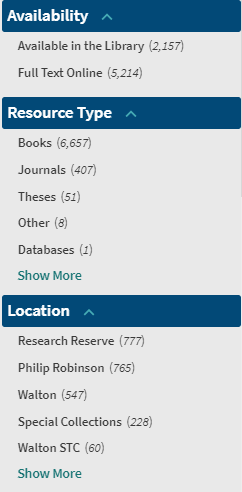
To find electronic resources, change your search to “Full Text Online” in the ‘Availability’ section of the filters bar.

You can also search for electronic articles by changing the search parameter from “Everything except articles” to “Everything” on the Library Search bar (see below).

Changing your search to “Everything” will bring up electronic articles for you to browse.

Virtual appointments via Zoom are still available with tutors from the Writing Development Centre (WDC). Their website also contains tons of helpful advice about preparing for exams, and what to do during them.

Library Help remains available 24/7 to assist with your queries – you can send them in via email or live chat, or browse the Library’s FAQs.

The Academic Skills Kit (ASK) is full of helpful advice, covering all aspects of study from how to manage your time effectively to reading and note-taking. There’s also guidance on exams and revision, including where to go for academic advice or personal support. ASK also has lots of resources covering online examinations. These are broken down into helpful categories: how to revise for an online exam, what to do before an online exam and exam technique.

Helpful hints

Photo by Prateek Katyal on Unsplash

We probably sound like a broken record by now but you’re unlikely to revise successfully without establishing positive habits. These include:

  • Working in an area of your home that’s best suited to your needs. If possible, choose to work in an area that has plenty of natural light and is well-ventilated.
  • Building a realistic revision planner with plenty of breaks factored in.
  • Practising good self-care, such as getting plenty of fresh air, staying hydrated and eating a balanced diet.
  • Getting plenty of sleep.

If you are feeling overwhelmed, please contact the University Student Health and Wellbeing services or the Student Union’s Mental Health & Wellbeing site. These services are still available despite the University being physically closed.

From all of us in the Library, good luck and study well!