The guides group together all the main library subscriptions we have for that specific type of information, as well as linking out to key external links and resources too. Wherever possible we also include guidance and help on how to get the best out of the databases and links and group the information together into a logical and helpful way. We know how busy life is and we simply want to save you time!
So what you are waiting for, go and check out our fabulously named Resource Guides, because they do exactly what they say on the tin!
Exams are a tricky time. Often you will be juggling different exams themselves, on top of other deadlines. However, we want you to know that you aren’t alone at this crazy time of year. We are here to help you through.
But how exactly can we help? Sadly, we can’t take go into the exam with you, or magically freeze time to give you more hours in the day, but do make the most of the following:
Library Help – the place to go when have a question via chat, email, text, twitter, Facebook. Or alternatively search our Frequently Asked Question (FAQ) database.
Librarians – yes you heard right. Book a one-to-one appointment to get the best out of the University Library resources. Also remember our staff in every library are friendly and approachable. There is no such thing as a silly question, so ask away!
Study Space– The University Library has a range of different study rooms and spaces to suit your needs.
24/7 – The Philip Robinson Library is open 24/7 during the exam period. We want you to sleep and get enough rest, but if you do need to study through the night, we are here.
Subject guides – we have a range of subject guides put together by expert librarians which draw together all the main resources for your studies.
Be well@NCL collection – we don’t just have books for study. This new collection includes tried and tested books that support your wellbeing.
Searching should be easy, right? We do it all the time in our day to day lives and with Google so ingrained into our existence, we don’t give it much thought. We type some words into the search engine and most of the time we find what we are looking for. Nothing to it!
However, while this approach certainly works for checking out cinema times or booking flights, it lets us down where research is concerned. We have high expectations that information will be quick and easy to come by and that it will be neatly organised in one place, rather than having to search in multiple locations, using different techniques. We imagine that the time consuming part of our research will be the analysing, synthesizing and the writing of it and we often don’t even think about the searching side of things.
The reality though is quite different. Without investing in our searching techniques and the development of a search plan, we can often find ourselves overwhelmed by information and not being able to see the wood from the trees. Our stress levels rise and our frustrations explode. Surely finding information shouldn’t be this hard!
The good news is, is that there is help to be had. Our job as Liaison Librarians is to equip you with the skills you need to create that all-important search plan and to encourage you to pause and stop before you dive straight into finding information for your research. We have a fantastic range of online tools for you to do this, not least an interactive search plannerthat you can keep adding to throughout your search and which you can even email to yourself, your supervisor, or us as a Liaison team for feedback. The Academic Skills Kit has lots of advice on how to start a search, including how to break your concept down into manageable chunks and how to identify keywords and synonyms.
You can also check out this short video to get you started…….
Keep your eyes peeled for our next blog installment of how to find particular resources. See you then!
“Should I use EndNote as a way to manage my references?” is often a question we get asked. We wish that there was a simple answer to that question, but there isn’t! It all depends on how many references you have, how you like to work and if you are willing to make time to learn how to use EndNote properly. You see, while EndNote is tool that can make your academic life easier (for example, it can help you build a collection of references, insert references into your work and create bibliographies), it will only save you time, if you invest time NOW.
So if you’re using the OSCOLA referencing style and weighing up whether to use EndNote or not, then you might want to consider the following:
You need to have a good grasp of the OSCOLA fundamentals before you even start with EndNote. If you need a refresher on OSCOLA, then check out the OSCOLA referencing guide first before even looking at EndNote.
EndNote will not do EVERYTHING for you. You will still need to manually input and amend your references to ensure your footnotes and bibliography comply with OSCOLA.
Have you got the time to invest in EndNote before using it? We strongly recommend that you make a start using EndNote from the beginning, rather than in the middle or at the end, of your research.
How do you want to use EndNote? Some people decide to use it simply as a storage place for their references and PDFs and leave it at that. Others use it both as a storage place, as well as a tool to help them cite.
Still not sure? Watch the video below to see how to use OSCOLA style and the Cite While You Write feature in Word. Then take a look at the OSCOLA and EndNote guide and see if it’s something you’d like to start using.
The Oxford University Standard for Citation of Legal Authorities (OSCOLA) is the standard referencing format used by law students and anyone writing in a legal field. It allows for exact referencing of cases, journals and statutes meaning that sources can be found quickly and accurately.
HELP!!!!!
OSCOLA can be a bit daunting at first, especially if you are unused to referencing, but don’t worry, we have a lot of help available. Here are some top tips for getting to grips with OSCOLA from scratch or if you just need a refresher:
Start by going to our library guide, where you will find tips and resources to build your knowledge up.
Have a look at our OSCOLA and referencing slideshowto understand the importance of referencing and to get a brief overview of OSCOLA.
Set some time aside and work through the Citing the Law Tutorial from Cardiff University. This will show you how to cite cases, legislation and secondary sources, as well as how to identify authors and quote.
Can you remember life before Google? It is such a huge part of our lives that even those of us who can remember a time before it (hmmm, yes I am that old!) can’t imagine life without it now. It is a great place to find the latest cinema listings or who won last night’s football match, but what about finding information for your latest assignment or research?
There is a time and a place to use Google, but you need to be aware of its limitations. Google, after all, is a business. It earns the majority of its money from advertising, and it will not reveal how it ranks its search results (every wonder how Wikipedia always appears at the top of every search you do?). A search that we do today and repeat tomorrow for a piece of research could give us hugely different results, with no explanation of why. We are also often bombarded with millions of search results and the reality of our searching habits mean that we rarely look beyond the first or second page. Admittedly, advanced search features on Google and the use of Google Scholar can really help us to become a smarter and effective Google users, but is it enough for our own research? Are we finding everything that is out there?
We need to think about our information needs before we work out where it will be best for us to search. Imagine, for a moment, that we are want to buy a particular local cheese, which we love. Would we go to a general shop or would we go to a specialist deli? We are probably going to need to go to a deli. It is just the same when searching for information. Google may be great for some background information or a starting point of a project, but it may simply not give us the high quality, niche information that we need to give us top marks for an assignment. So what are the other options?
Aimee Cook, a Liaison Librarian here at Newcastle University, explains more.
So next time you think about googling something for an assignment, stop and check out Library Search and your subject guide first for the books, eBooks and specialist databases that are available to you. If you are going to use Google, make use of the advanced search features and get to grips with Google Scholar. Happy searching!
We have access to a wide range of digitised British historic newspaper archives, which you can access through various different platforms (see the historic section of our Newspaper Resource Guide for more detail). If you want to search across many historic newspapers at once, we would recommend using Gale Primary Sources.
Gale Primary Sources searches across 15 different archives, including major titles such as The Times, The Daily Mail, Financial Times and The Economist (all dating from their very first issue) together with historic collections of regional titles. You can select to search as many of the archives as you require.
Watch this short introductory video to help you get the best out of searching Gale Primary Sources. If you want information on how to access current, business, and international news, then visit the Newspapers Guide.
Ovid enables researchers, clinicians, students and other healthcare professionals find medical information to make critical decision, improve patient care, enhance ongoing research, and fuel new discoveries. The Ovid platform gives access to a collection of databases.
Database Guides Once you have accessed OVID through the above methods, you will see an initial selection window. To find out more about a specific resource, click on the Information icon at the right hand side of the page (see example below):
Once you have decided on which database to search within OVID, then all you need to do is to tick the box next to the database you would like to search and then select ‘OK’.
Want to know more?
Each database in OVID has different subject headings and thesauri, however there are tips and tricks that you can learn that are common to searching all the databases on OVID. So why not check out the Advanced Searching Techniques or watch some of the help videos we have on our YouTube Channel.
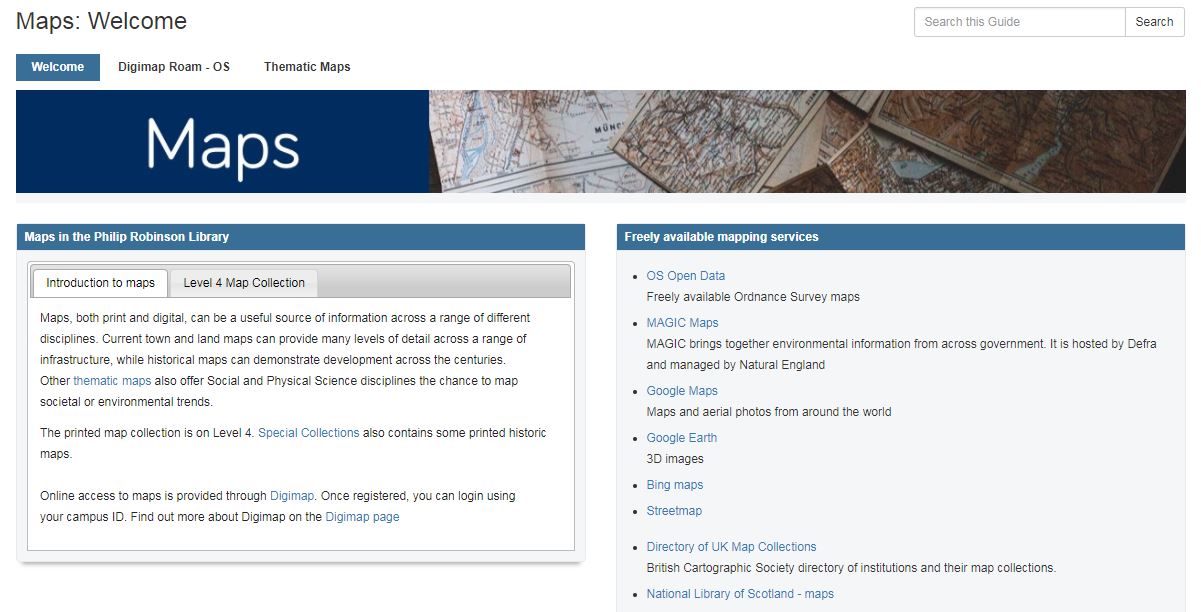
What comes into your head, when someone says ‘maps’? I think we often presume that if we aren’t studying geography, earth sciences, archaeology or architecture for instance then they aren’t for us. But think again! Maps can be applied to a variety of different ways in research and we have put together a Maps Resource Guide to explain what resources we have and potentially how they can be used.
The Maps Guide outlines the different ways you can access both physical and online maps and gives you an overview of how you can use our online Digimap ROAM subscription. With this tool, you can not only get up-to-date OS Maps, but also historic maps which can help track both infrastructure development, as well as social and environmental changes too. And if you want to directly compare different-aged maps against each other, Digimap lets you toggle between the two on your screen.
Thematic mapsand a database of case studies to see how Digimaps have been applied to research can also be found on the Maps Guide. Here is just a taster to whet your appetite:
Mapping the victims of Jack the Ripper using Historic Roam
Conducting a national fox survey using Environment Roam
Studying garden history and landscape in the 18th Century
Designing housing in Byker for an Artists in Residence project.
So…..before you rule out maps as not relevant for your research, why not take a minute and have a look at our Maps Guide to see if there is potentially something for you!
N.B. If you’re wanting to be the next Sherlock, just remember you need to plan your investigations in advance and register with Digimap at least 24 hours before you need to start using the resource.






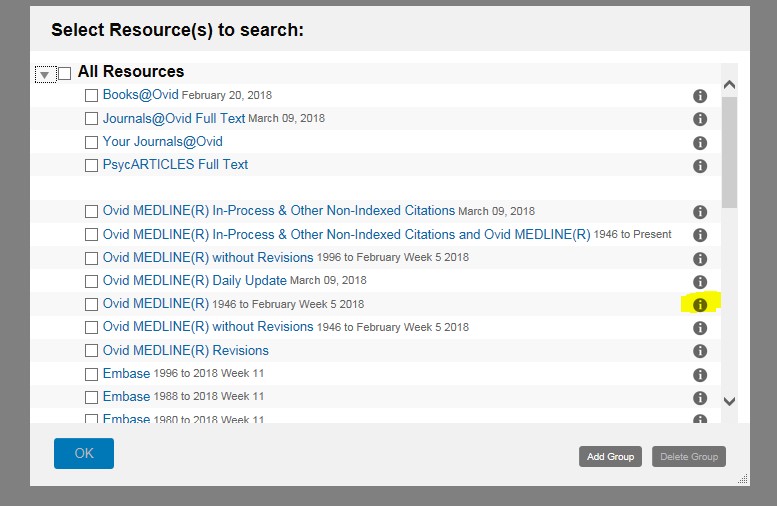 Once you have decided on which database to search within OVID, then all you need to do is to tick the box next to the database you would like to search and then select ‘OK’.