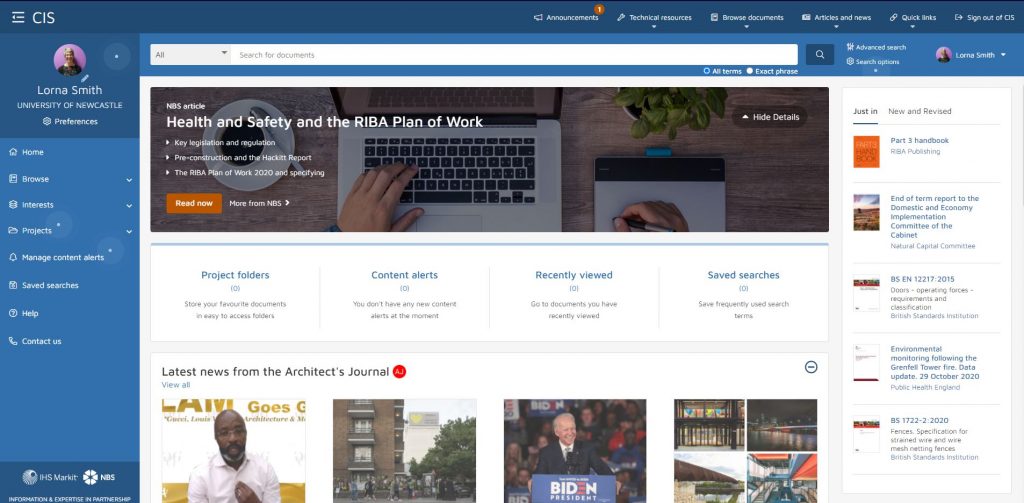
CIS is produced jointly with the National Building Specification (NBS) especially for architects, civil and structural engineers, building control officers, building services engineers and other professionals in the construction industry. CIS provides fundamental industry information and legislation, as well as additional sector material. The extensive range of full-text documents cover all aspects of the building, engineering, design and construction process in the United Kingdom and Republic of Ireland.
The Construction Information Service (CIS) is a comprehensive online collection of over 28,000 construction related standards, regulations, technical advice and articles from 500+ publishers. Content is updated weekly, neatly organised into topic based supplements and delivered through a function rich and easily accessible online portal.
This collection is an invaluable resource if you are studying:
Many of our Engineering courses
Architecture, Landscape and Planning
Geography
Subjects covered include:
Building regulations
Environmental/land Planning
Planning control
Urban planning
Waste/water management
Earthworks/foundations
Land drainage
Law/legislation
Transport facilities/planning
Tunnelling and underpinning
Engineering
Materials
Groundwater control
Roads
loads/stresses
…and much, much, much more!
Searching
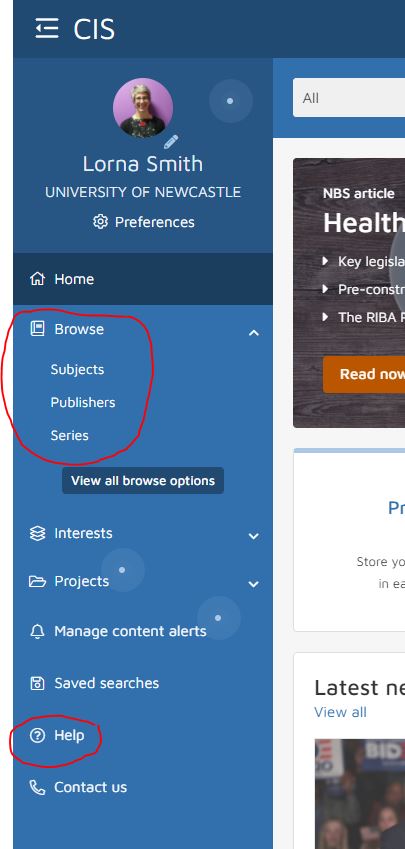
Within the CIS search box you can enter your keywords or browse by subject in the left-hand menu. There is also an Advanced Search option. There is also plenty of help with how to use CIS under the Help option on the left-hand menu:
Access
CIS is available through our catalogue, Library Search. If you are on campus no password is required. If you are off campus you will need to log in using your University campus ID and password. You can also find it under the Journals and Database tabs in our Subject Guides, and on our Standards Resource Guide.
Copyright
Every document in The Construction Information Service has copyright permission from the publisher. Some publishers do not allow use of their documents or will only give permission for certain titles. Publishers who do give permission can also place an embargo on certain documents, resulting in a delay between publication and inclusion in CIS.
We now subscribe to the Manchester University Press Hive International Relations e-book collection. The collection provides 65 e-books written by leading names in the field covering key issues and debates on global issues such as foreign policy, gender, global ethics, environmental politics and terrorism..
Manchester International Relations aims to explore and analyse the critical approaches to the study of global issues – from authority; citizenship; foreign policy, gender, war and peace to global ethics; human rights; media; environmental politics and international law.
This online resource will help you understand contemporary international relations and the forces that are reshaping global politics in the 21st century by examining international political systems, international political theory, and developments in contemporary global politics throughout Europe, the USA, Latin America, Asia, Africa and the Middle East.
We have recently subscribed to Fortune Magazine Archive – an extensive cover-to-cover collection of the long-running business magazine dating from its very first issue in February 1930 through December 2000.
Subjects Covered in this magazine:
American business
International business
Economics
Industry
Technology
Published monthly by Time Inc., Fortune Magazine sought to provide news and analysis of both American and, later, international business, economics, technology, and industry. Each issue featured vivid color illustrations and photographs, as well as high-quality feature articles, published at a time when most business magazines were merely black and white compendiums of statistics and figures.
Articles and cover pages are fully indexed and advertisements are individually identified, ensuring researchers and readers can quickly and accurately locate the information they seek. Fortune Magazine Archive is valuable to researchers of 20th-Century current events, politics and culture, as well as those interested in the history of business, advertising, and popular culture.
We now subscribe to the Manchester University Press Hive political studies e-book collection. The collection provides 165 books written by leading names in the field covering political events, ideas, movements, roles of government, voters, parties and leaders and the way these elements shape society as a whole.
This online resource will help you to understand contemporary political problems in their historical perspective and will cover key themes such as political thought, concepts and theory, international politics, globalisation and democracy through the ages.
Key features & benefits
A wide-ranging, authoritative coverage of the history of politics, edited and authored by key figures in the field
Cuts across boundaries of political science, public administration, anthropology, social policy studies and development studies and facilitates a conversation across disciplines
Includes extensive original research on recent and ongoing political events, such as Brexit
We have online access to the International Encyclopedia of Human Geography. This reference collection gives you an authoritative and comprehensive source of information on the discipline of human geography and its constituent, and related, subject areas. The Encyclopedia includes over 1,000 detailed entries on philosophy and theory, key concepts, methods and practices, biographies of notable geographers, and geographical thought and praxis in different parts of the world.
This online copy of the Encyclopedia features extensive browsing, searching, and internal cross-referencing between articles in the work, plus dynamic linking to journal articles and abstract databases, making navigation flexible and easy.
As a globally recognised market analyst, Mintel produces hundreds of reports into UK-specific consumer markets every year. Each report provides a unique overview of a market’s dynamics and prospects, giving you the knowledge to devise informed and profitable marketing strategy. Mintel is also one of the many Business specialist databases that we subscribe to here at Newcastle University, which you can access via Library Search, or along with many other of our resources via our Business Subject Guide.
Mintel also produce an excellent podcast, A Little Conversation Podcast, on YouTube which covers ideas and new perspectives on how we eat, drink, shop, groom and think – from the key issues impacting society to trends in food, beauty, tech and retail, they discuss what consumers want and why.
So if you are looking for an alternative resource in market research, have a look at these podcasts. You can subscribe to their podcast via their website or where you normally download your podcasts.
Here’s their latest podcast which is looking consumer behaviour of upcoming holiday shopping:
One of my good friends is the middle child of three siblings – born between two siblings with strong identities of “the eldest” and “the youngest”- and feels that she gets “forgotten about” or “neglected” by her parents (but of course she never is).
You could compare second year at University to feeling like the second child – not as exciting and ‘new’ as the youngest new-born (first year) nor as distinguished and knowledgeable as the eldest (final year at University) – but definitely never to be forgotten about.
Research conducted by Liverpool John Moores University found that second year students can suffer from ‘underperformance and withdrawal’ (Thompson et al., 2013) and that ‘around a third of undergraduates experienced a slow down in their academic progress during second year’ (Milsom, 2015). So don’t worry if you are feeling a bit overwhelmed and disengaged as you enter your second year of studies, you are definitely not alone.
So how can you get out of your slump?
The research by Liverpool John Moores University highlight the importance of recognising the challenges faced by second year students and identify support that can help you rise to meet them (Thompson et al., 2013).
The Library have definitely not forgotten about our much loved second years, and we’ve been thinking about how we can help – here are our top three ways that the Library and our resources can support you during your second year and how you can hopefully kick-start your engagement with the Library and your studies…
1. Find inspiration
As a second year, you may often feel disengaged, so take some time to remember what you love about you subject; explore your reading lists and Subject Guide(s) to find some wider reading on your favourite topics in your subject area – this may help you build your subject knowledge, help you think about what you want to focus on in third year and remind you why you chose this subject in the start.
The reading lists for your modules is an excellent places to start any refresh. Watch this short video (2:44min) on how to find and use your reading lists:
Another place to re-engage with your subject is our Subject Guides. These guides are created by our ingenious Librarians (*ahem) and are collections of subject specific resources to help you discover reliable and authoritative information for your studies. Remember, if your studies are interdisciplinary, you might have to use multiple guides to ensure find relevant resources.
2. Refresh and build on your skills
Second year is a great time to take some time to refresh or build on your information and academic skills, so you are prepared for your studies becoming more challenging and intense as the year progresses and then transitioning into third year.
Boost your motivation this year by setting yourself small and achievable goals. These could be to improve a mark from last year, to read more widely or to refresh a skill that would be useful for employment. Our Skills Checker is an excellent tool to help you identify an area of information skills to work on.
Once you have identified the areas to work on, check out the Academic Skills Kite for help and has advice on developing your academic skills. It is your guide to where you can go for support on all aspects of your academic life. With online resources to help you with your academic and study skills, covering topics such as academic integrity and referencing, exams and revisions, learning online and academic writing, you will find the support you need to study successfully.
Also discover our Resource and Subject Guides for help on finding, evaluating and managing information and useful guides on subject such as how to use EndNote, how to create an academic poster or how to identify fake news.
Our Employability Guide is another superb guide to show how developing your information and digital literacy skills can help prepare you for your future careers, and don’t forget, Newcastle University’s award-winning Careers Service provide expert advice regarding your future plans.
3. Ask for help
The Library is always here to help, so contact us by email, chat, phone or by social media 24/7 to ask any question regarding the Library services and resources.
The Library Liaison team and the Academic Skill Team are also available to meet (via Teams) for a one-to-one appointment to help you on any aspect of Library and academic skills that you need help with. You can book an appointment via Library Help.
I hope we have reassured you that you lovely second years are definitely not forgotten and that we are here to help you on your academic journey every step of the way (*oh so cheesy). These are difficult times but with a bit of grit and determination we have confidence that you will succeed in every way.
ACM Digital Library is a full-text, online collection of all publications by the Association of Computing Machinary, including journals, conference proceedings, technical magazines, newsletters and books. Publications run from 1936 to present day, with 2,807,672 publications and 576,689 of these available for download.
Top topics include:
Artificial Intelligence, Machine Learning, Computer Vision, Natural language processing.
Networks and Communications.
Society and the Computing Profession
Human Computer Interaction.
Data science.
Applied computing.
Security and Privacy.
Hardware, Power and Energy.
…plus much more.
Though the topics are primarily computing, it would definetly be a collection worth having a look at if you are in Electrical Engineering or studying/researching an interdiciplinary topic which contained elements of computer science.
ACM have just recently updated it’s interface and search function (thanks goodness!), making it much easier to search and discover a range of invaluable resources.
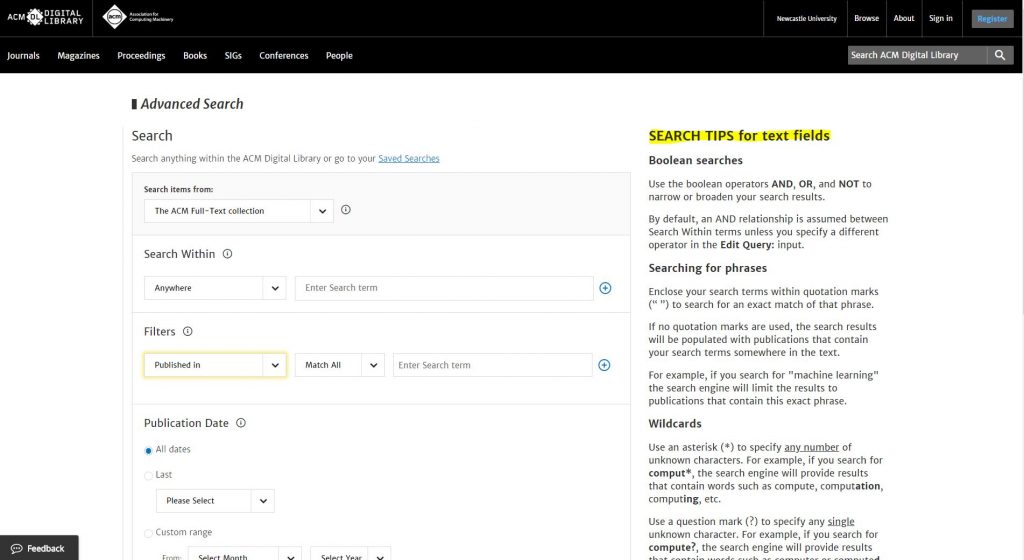
You can now browse by topic or type (book, journal etc.), search by simple keyword or use its advanced search:
Loving their ‘Search tips’ on the right hand side in Advanced Search – wish all databases had this. Would help us all so much!
So, go and explore ACM – a definite ‘must’ for all Computing students. You can either find the ACM eJournal collection in your Computing Subject Guide (under Journals and Databases/eJournal Collections) or you can search for ‘ACM Digital Library’ in Library Search. Remember, if you find anything that doesn’t have full text, first check Google Scholar, then if still no luck you can request an interlibrary loan. If you need further help with any Computing or Engineering resources, please feel free to make an appointment with your Librarian.
Librarians have been warning people about ‘Fake News’ for many, many, many, many years – how to find and select reliable, authoritative, quality resources is at the heart of any good library teaching session. In a way we librarians have to thank Mr Trump for making Fake News a popular term; he has made everyone aware that there are fake stories out there and that there has been for centuries (see our historical time-line of Fake News).
2019 is NU Library’s third year of promoting awareness of Fake News, and by looking at the large number of visits to our Fake News Guide over these three years (4,672 visits in total), and again thanks to Mr Trump, it’s not something that’s going away anytime soon. So we Librarians will continue our quest of highlighting all information that is fake for the greater good.
Until I went to Librarian’s Fake News conference last year, I hadn’t heard of the terms ‘Filter Bubble’ and ‘Echo Chambers’ in relation to Fake News. However, once explained hopefully it will make you more aware of what information/news stories you read via the likes of Google, Facebook and Twitter, and how they could potentially be fake. So here is the low-down on what these terms mean and how you can avoid falling into their traps; we’ve also offered the alternative view that they’re a load of old nonsense so you can decide for yourselves…
What is a ‘Filter Bubble’?
A Filter Bubble is when you are in a virtual bubble on social media – you only encounter information and opinions that agree with or reinforce your own beliefs. Your ‘personalised’ online experience is the result of algorithms that work away in the background and dictate what you see/read online. Google, Facebook, Pinterest, Netflix, YouTube and many more all do this.
These Filter Bubbles in turn create Echo Chambers…
What are ‘Echo Chambers’?
When information within a closed system online is only giving you (‘echoing’) back your opinion and beliefs and establishing confirmation bias (only accepting information that confirm your own opinion and beliefs).
What are the dangers?
As much as I enjoy Facebook fuelling my love of funny dog videos by suggesting similar videos and articles, being aware of why and how Facebook is doing this helps when it comes to more serious topics such as the news, social issues and politics.
Regarding Fake News, confirmation bias is particularly worrying as you will start believing fake news stories that confirms your opinions and beliefs. I know I have done this, which is really scary to realise.
Watch this short TedTalks video from Eli Pariser on the dangers of Filter Bubbles:
You could argue that this type of ‘personalisation’ is editing the web – only showing you one half of the story. So what can you do to pop the bubble?
What can you do to stop the bubbles and echoes?
There are a few simple things you can do to stop this and open yourselves up to a wider web:
Read news sites, websites and blogs that offer a wide range of perspectives, such as the BBC.
Use Incognito browsing, delete search histories and try and resist the temptation of logging into your accounts every time you go online.
Deleting or blocking browser cookies – these cookies hold the algorithms that determine what we see.
Turn off your curated feed in Facebook.
Click ‘Like’ on everything! – This will tell the AI that you are into everything – all politics, all news etc.
Don’t clink on links, especially politics and social issues – will stop fuelling the algorithms.
Tell everyone else to turn off their curated feed!
Is it all a myth?
Below are a few articles that claim Filter Bubbles and Echo Chambers are myths and that it’s not the technology at fault, but rather the user. I’ll let you decide:
Or maybe you like being in your own little bubble? The safety and comfort in knowing what information you are going to be presented with – nothing that offends or upsets your online world. I know I will carry on being fed humorous dog videos.
There are some interesting thoughts and opinions on the Social Network Bubble – the pros and cons – on this Radio 4 programme:
Farnam Street (2017) How filter bubbles distort reality: everything you need to know. Available at: https://fs.blog/2017/07/filter-bubbles/. (Accessed: 27 March 2019).