Will you be working on a dissertation or project this summer or next year? Worried that the Library might not have access to the specialist books and other resources which you need? Wondering how you can find out about resources relating to your research topic which are held in other libraries?
Wonder no more! There are three main ways you can find and access books and other resources held elsewhere:
1. Search
You can search the catalogues of over 100 UK and Irish academic libraries, national libraries and other major research libraries via COPAC. For a more in-depth and up to date search, you can also search individual academic library catalogues online. Need to look further afield? Search library catalogues internationally via WorldCat.
2. Visit
We have more information about how you can visit other libraries, locally and nationally, here. The SCONUL Access Scheme enables students to use other academic libraries around the country, but you need to register online first (and be sure to check the access arrangements for any library you are planning to visit, as they may alter during the year).
3. Obtain
If we haven’t got the book you want, you can ask us to consider buying or borrowing it, via our Books on Time service. If you need a copy of a journal article to which we don’t have access, please apply via our inter library loan service.
Pharmaceutical Substances is a one-stop source of information relating to the industrial synthesis and commercial applications of every licensed drug of significance. It provides ready access to syntheses, patents, and applications for more than 2,600 active pharmaceutical ingredients (APIs), including intermediates from the six most important markets.
Professors Axel Kleemann, Jürgen Engel, Bernhard Kutscher, and Dr. Dietmar Reichert present highly evaluated information collected from all the relevant literature and commercial patent data.
Pharmaceutical Substances is aimed at:
Researchers and process chemists
Teaching in the field of medicinal and pharmaceutical chemistry
Everyone involved in design, discovery, development, evaluation, and marketing of drugs
Please explore and if this resource would support your education or research activities then contact your Liaison Librarian with details.
Have you tried using UbuWeb yet? You’ll be surprised at the amount of ‘stuff’ in there!
First of all, what is UbuWeb? UbuWeb is a completely independent resource dedicated to all strains of the avant-garde, ethnopoetics, and outsider arts. It hosts a wide range of texts and audio-visual materials. A few examples include:
Conceptual Writing:
“Poetry expresses the emotional truth of the self. A craft honed by especially sensitive individuals, it puts metaphor and image in the service of song.” Read how Craig Douglas Dworkin continues his explanation of ‘The UbuWeb Anthology of Conceptual Writing’ and have a look at examples such as John Baldessari’s text “I will not make any more boring art”
Outsiders:
Here’s how the editors describe this section: “Formerly known as UbuWeb’s Found + Insane section, we’ve redesigned and renamed it Outsiders, reflecting broader cultural trends toward the legitimization of Outsider work, be it in the visual, musical, or literary arts. Beginning with the mainstreaming of Folk Art (now known as Outsider Art) and the work of Jean Dubuffet in the mid-twentieth century, and moving into the present with the recent well-received museum retrospectives of visionary art of the insane (Adolf Wolfli and Henry Darger), there appears to be an insatiable hunger for this raw and emotionally-charged work”
UbuWeb Contemporary:
Read about the works presented by over 100 (to date) contemporary practitioners including one of our own Fine Art graduates, http://www.ubu.com/contemp/copeland/index.html who’s also listed among UbuWeb’s Top Ten!
Podcasts:
Produced by the Poetry Foundation, listen to podcasts of, for example: interviews with artists; the sound of Fluxus; women of the Avante-garde; the malady of writing, to name but a few.
Why not give UbuWeb a try – you’ll be surprised at how much ‘stuff’ there is!
(You can get to UbuWeb from the Fine Art Subject Guide http://www.ubu.com/).
You’ll find links to the relevant Library resources below.
As time is limited, your handout gives you suggestions as to which sections you may find it useful to explore, and what sort of feedback we’d welcome, but please feel free to explore as you wish!
Aimed at PGRs: please explore the new online format for our HSS8002 information and library skills module. We’ve created a dummy version of HSS8002 for today’s workshop. You should be able to access the dummy course directly via this link. If not, log in to Blackboard, click Courses, and then type HSS8002 in the search box. Now click on the link to HSS8002conference.
Librarians have been warning people about ‘Fake News’ for many, many, many, many years – how to find and select reliable, authoritative, quality resources is at the heart of any good library teaching session. In a way we librarians have to thank Mr Trump for making Fake News a popular term; he has made everyone aware that there are fake stories out there and that there has been for centuries (see our historical time-line of Fake News).
2019 is NU Library’s third year of promoting awareness of Fake News, and by looking at the large number of visits to our Fake News Guide over these three years (4,672 visits in total), and again thanks to Mr Trump, it’s not something that’s going away anytime soon. So we Librarians will continue our quest of highlighting all information that is fake for the greater good.
Until I went to Librarian’s Fake News conference last year, I hadn’t heard of the terms ‘Filter Bubble’ and ‘Echo Chambers’ in relation to Fake News. However, once explained hopefully it will make you more aware of what information/news stories you read via the likes of Google, Facebook and Twitter, and how they could potentially be fake. So here is the low-down on what these terms mean and how you can avoid falling into their traps; we’ve also offered the alternative view that they’re a load of old nonsense so you can decide for yourselves…
What is a ‘Filter Bubble’?
A Filter Bubble is when you are in a virtual bubble on social media – you only encounter information and opinions that agree with or reinforce your own beliefs. Your ‘personalised’ online experience is the result of algorithms that work away in the background and dictate what you see/read online. Google, Facebook, Pinterest, Netflix, YouTube and many more all do this.
These Filter Bubbles in turn create Echo Chambers…
What are ‘Echo Chambers’?
When information within a closed system online is only giving you (‘echoing’) back your opinion and beliefs and establishing confirmation bias (only accepting information that confirm your own opinion and beliefs).
What are the dangers?
As much as I enjoy Facebook fuelling my love of funny dog videos by suggesting similar videos and articles, being aware of why and how Facebook is doing this helps when it comes to more serious topics such as the news, social issues and politics.
Regarding Fake News, confirmation bias is particularly worrying as you will start believing fake news stories that confirms your opinions and beliefs. I know I have done this, which is really scary to realise.
Watch this short TedTalks video from Eli Pariser on the dangers of Filter Bubbles:
You could argue that this type of ‘personalisation’ is editing the web – only showing you one half of the story. So what can you do to pop the bubble?
What can you do to stop the bubbles and echoes?
There are a few simple things you can do to stop this and open yourselves up to a wider web:
Read news sites, websites and blogs that offer a wide range of perspectives, such as the BBC.
Use Incognito browsing, delete search histories and try and resist the temptation of logging into your accounts every time you go online.
Deleting or blocking browser cookies – these cookies hold the algorithms that determine what we see.
Turn off your curated feed in Facebook.
Click ‘Like’ on everything! – This will tell the AI that you are into everything – all politics, all news etc.
Don’t clink on links, especially politics and social issues – will stop fuelling the algorithms.
Tell everyone else to turn off their curated feed!
Is it all a myth?
Below are a few articles that claim Filter Bubbles and Echo Chambers are myths and that it’s not the technology at fault, but rather the user. I’ll let you decide:
Or maybe you like being in your own little bubble? The safety and comfort in knowing what information you are going to be presented with – nothing that offends or upsets your online world. I know I will carry on being fed humorous dog videos.
There are some interesting thoughts and opinions on the Social Network Bubble – the pros and cons – on this Radio 4 programme:
Farnam Street (2017) How filter bubbles distort reality: everything you need to know. Available at: https://fs.blog/2017/07/filter-bubbles/. (Accessed: 27 March 2019).
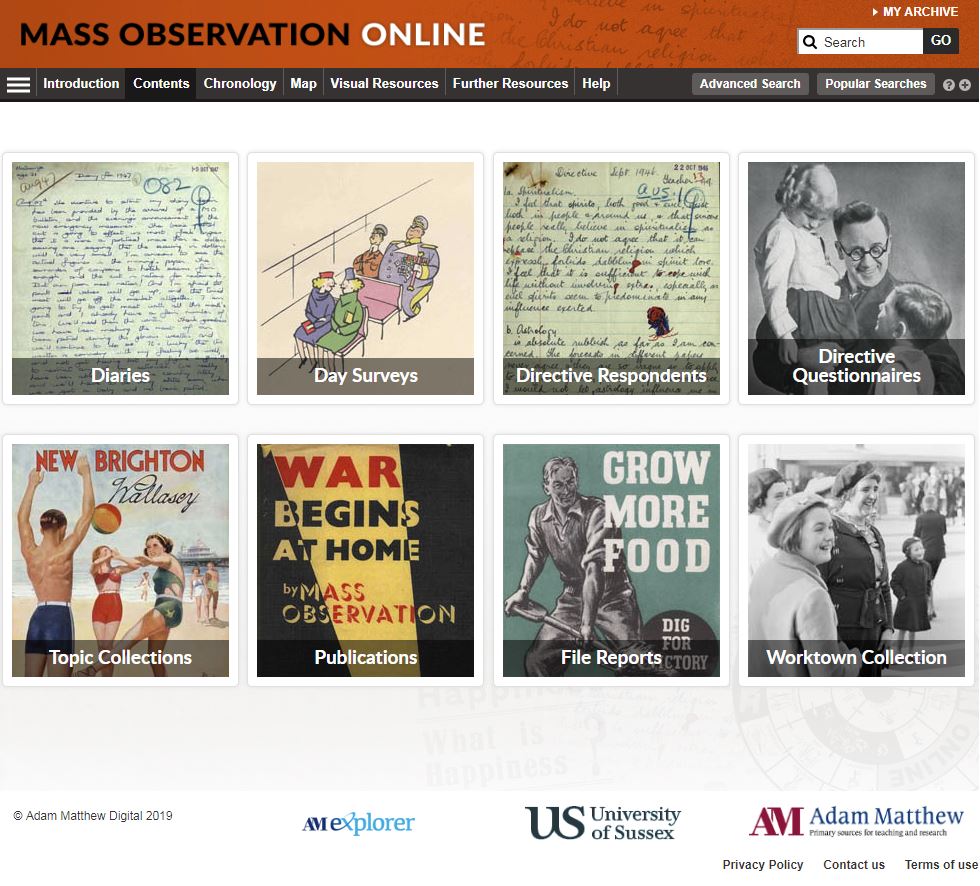
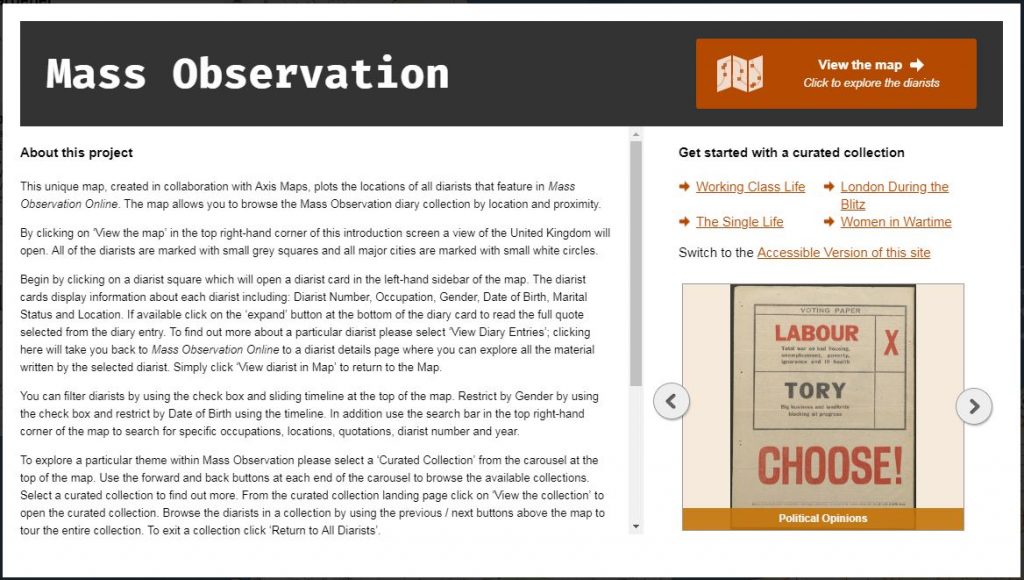
Mass Observation. Wow, sounds intriguing, doesn’t it? It should!
This resource offers revolutionary access to one of the most important archives for the study of Social History in the modern era. You can log in using your Newcastle University Campus ID and password to explore original manuscript and typescript papers created and collected by the Mass Observation organisation, as well as printed publications, diaries, photographs and interactive features dating from 1937 to 1972.
If you’re interested in learning more about the topics currently influencing our lives, it would do no harm to research the social history topics available within Mass Observation such as anti-Semitism, the economy, austerity, education, women at work, religion, mining, news, the Government, smoking, drinking, sexual behaviour, propaganda, unemployment and writing (to name just a few!).
If you want to know more about Mass Observation and to see some samples from the collection, then you could take a look at the Mass Observation Twitter feed, or there is a recorded webinar available for you to watch via YouTube in order to get the best out of the resource.
Hoping to get some revision done during the Easter Vacation?
Here are some tips to get you started:
1. Have a look at our MCQ collection in the Quiet study area of the Walton Library. This collection has books with MCQs, EMQs, SBAs, OSCEs and other self assessment and answer questions on many different subjects including; anatomy, medicine, physiology, surgery and more. Look out for the green stickers on the spines of the books.
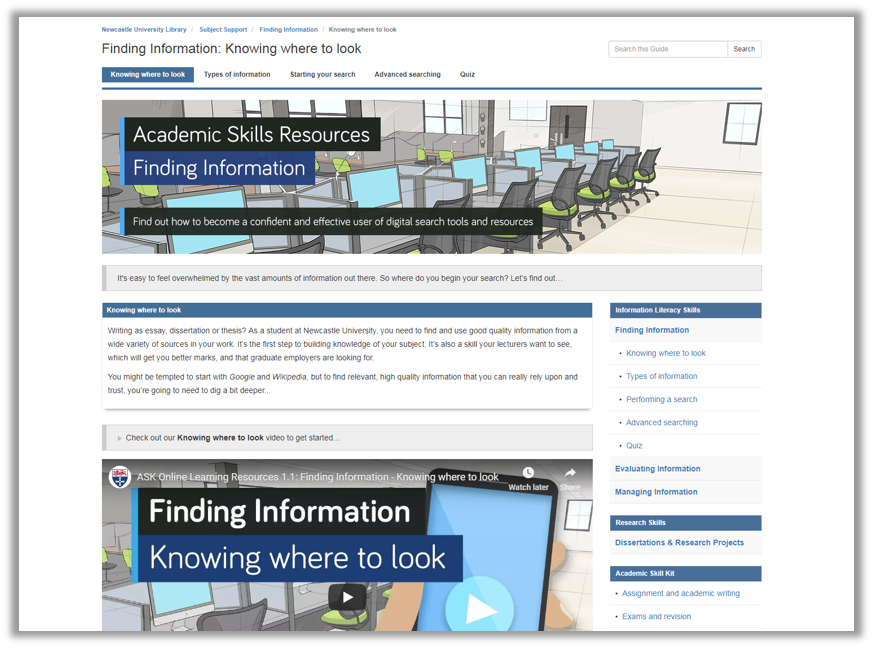
2. Check out the the Exams and Revision Section on the ASK (Academic Skills Kit) webpages for more help.
3. Remember to take regular breaks.
4. Stay well hydrated, eat properly and get some exercise.
5. Remember to check the date, time and place of your exam well in advance of the day, make sure you know where you are going.
Have a good Easter Vacation. Happy revising and Good Luck in the exams when you get back.
Medical Humanities or Narrative Medicine is a popular academic discipline that explores the crossroads between medicine and the arts.
Our Medicine in Literature collection captures the complexities of what it means to be human through a wide range of literary genres.
These resources range from fiction, non-fiction including medical history, ethics and memoir, graphic novels, poetry and prose or medicine as metaphor, to films. Representations of illness, dis-ease, healing and health are interwoven themes that give voice to a diversity of perspectives and personal experiences of the human condition.
If you’re interested in exploring your subject field from a different viewpoint or simply want a break from revision this Easter, dive right in! The physical stock is located in the Quiet Study area of the Walton Library or you can browse the collection from our Library Guide.
You already know that referencing is important – it not only gives credit to the original creator of a work you have used but also helps to highlight your skills as a researcher; showing that you have read around your topic, found relevant information, applied it to your arguments and used it to develop your own ideas.
However, when it comes to referencing, all of those punctuation rules, different styles and the vast array of document formats can seem overwhelming. Happily, we’ve got a great resource to help you work out your references in three easy steps!
Cite Them Right:
‘Cite Them Right’ is a fantastic referencing guide that provides clear instructions and examples for how to reference a wide range of documents including books, journals, websites and audio-visual materials. Available as both a physical textbook and an online tool, ‘Cite Them Right’ helps you to format your references correctly using Harvard, American Psychological Association (APA), Modern Humanities Research Association (MHRA), Modern Languages Association (MLA), Oxford Standard for the Citation of Legal Authorities (OSCOLA), Vancouver or Chicago referencing styles.
(Remember to always use the referencing style recommended by your school.)
Three steps to an accurate reference:
Search for the type of document you want to reference on Cite Them Right online using the search box at the top right of the screen or by browsing the drop down menus at the top of the page.
Select the referencing style you need from the drop down menu at the top of the page. This defaults to Harvard (author-date).
Follow the example references given, copying the format to create your own reference in the ‘You Try’ box.
Why not have a go and create a reference for this blog post!
If you need some more advice on how to reference, take a look at our video:
Passport is a global market research database that gives us statistics, analysis and reports on global markets, economies and consumers. As well as being able to search for statistics and analysis using keywords, browse by country, industry and economy, Passport highlights what they call Megatrends which are the major issues influencing consumer behaviour in today’s market.
Megatrends for the UK right now include population changes, healthy and ethical living, and middle class retreat. You can access the full reports from the Passport homepage while they give useful summaries on their YouTube channel.
To access the Newcastle University subscription to Passport and our other market research resources, visit our Market Research resource guide.