
Exams: we are here to help

Woman throwing books up in the air

Exams are a tricky time. Often you will be juggling different exams themselves, on top of other deadlines. However, we want you to know that you aren’t alone at this crazy time of year. We are here to help you through.

But how exactly can we help? Sadly, we can’t take go into the exam with you, or magically freeze time to give you more hours in the day, but do make the most of the following:

  1. Library Help – the place to go when have a question via chat, email, text, twitter, Facebook. Or alternatively search our Frequently Asked Question (FAQ) database.
  2. Librarians – yes you heard right. Book a one-to-one appointment to get the best out of the University Library resources. Also remember our staff in every library are friendly and approachable. There is no such thing as a silly question, so ask away!
  3. Study Space – The University Library has a range of different study rooms and spaces to suit your needs.
  4. 24/7 – The Philip Robinson Library is open 24/7 during the exam period. We want you to sleep and get enough rest, but if you do need to study through the night, we are here.
  5. Subject guides – we have a range of subject guides put together by expert librarians which draw together all the main resources for your studies.
  6. Be well@NCL collection – we don’t just have books for study. This new collection includes tried and tested books that support your wellbeing.
  7. Additional support – don’t suffer and please don’t be shy. You can seek additional support from your NUSU, Student Wellbeing Service, Nightline and the University chaplaincy.

So remember……pace yourself, access the help you need and believe that you can do this!
Waltzing with EndNote

What is EndNote?

The official blurb on EndNote is that it is “…the industry standard software tool for publishing and managing bibliographies, citations and references.”

Have you drifted off yet? Don’t – read on!

EndNote takes a little getting used to and we recommend you familiarise yourself with it at the start of your research process. But as Library Staff, we wouldn’t spend a significant amount of time demonstrating and training our academic staff and students on what EndNote is, and how to use it, if we didn’t think it was valuable. It will save you a huge amount of time in terms of writing up your assignments.

Essentially, you can use EndNote to create and organise a personal library of resources relevant to your research. You can import references from Library Search, and a huge range of databases such as ScopusWeb of ScienceIEEE Xplore and Business Source Complete. You can ask EndNote to locate the full-text PDFs of the resources you are going to use in your research, and you can annotate them as you wish too. Did you know you can instruct Google Scholar to import references into EndNote? No? Try it. Finally, if you already have materials stored in your home folder (H:\) then you can attach them to a manually-created reference within EndNote, bringing all your research together in one place.

In addition to organising your references (and this is the clever bit) you can then get EndNote to ‘talk’ to your word processing software, e.g. Microsoft
Word
, and insert the citations into your work for you in your chosen referencing style, e.g. Cite Them Right Harvard, Vancouver, APA or MLA. If you don’t want to do that, then EndNote will also allow you to create an independent bibliography of your references, saving you an awful lot of typing.

Using EndNote

Intrigued? You should be. Take a look at our EndNote Guide. It contains all the introductory information you need, step-by-step workbooks to train yourself on the use of EndNote (the Desktop and Online versions), videos, useful FAQs, and contacts for help, should you need it.

Finally, Newcastle University provides support for EndNote but it is not compulsory to use. You may prefer MendeleyZoteroRefWorks or another piece of bibliographic management software. That’s fine, whatever makes your referencing lives easier. Go on, give them a try.

Resource in Focus: Henry Stewart Talks Business; Management Collection

HS Talks Logo
HS Talks Logo

HS Talks – The Business & Management Collection includes 1,200 online multi-media videos, online lectures, case studies and case study interviews by leading experts in academia, industry and commerce. Topics cover a whole range of business education including Finance, Accounting & Economics; Global Business Management; Management Leadership & Organizations; Marketing & Sales; Strategy; Technology & Operations.

The collection is categorised into 6 broad subject areas and further organised into 90 series, each overseen by an editor who is a key expert in the field. Speakers are chosen based on their expertise and each talk is produced together with the speaker especially for the collection. The collection is reviewed and updated monthly. Once you have selected a subject area or applied your keyword you might like to filter using some of the options such as length of video or date published.

Academics can also easily embed into the VLE for students to access. You can either do the whole video or sections. HS Talks provide a in-depth guide to take you through this step by step. 

There are different types of videos on HS Talks. These include :

  1. Traditional format lectures with high quality graphics: the lectures are primarily designed to deliver ‘information’. The lectures have multiple associated features including printable slide handouts and speed-up/slow down options.
  2. Extended form case studies: accounts of real world experience describing what was done, how, when and with what consequences.
  3. Bite-size case studies: these short descriptions of real world commercial activities come with suggested topics for consideration and discussion.
  4. Case Study Interviews: interviews with experts from commerce and industry, from start-up entrepreneurs to large corporation executives, confront the challenges they encounter. Each interview is accompanied by suggested topics for discussion and individual and group projects.

Some of the talks come with additional PowerPoints which can be download, along with transcripts of the interview. Viewers can also enable close captions.

There is a quick start guide available from HS

Strictly Referencing: When is a website not a website?

A common mistake made in referencing is grouping all sources found online under the category and reference type of a website. Your aim should be to reference the information you have in front of you rather than where it was sourced. Simply grouping items found online as a website would be the equivalent of referencing a book by the publisher details rather than the author and title.

For example, a government publication found online would be referenced like this in Chicago:

United Kingdom. Department for Education. Cloud computing: how schools can move services to the cloud. London: The Stationary Office, 2016. Accessed: November 4, 2019. https://www.gov.uk/government/publications/cloud-computing-how-schools-can-move-services-to-the-cloud. 

An electronic journal article might appear like this in APA:

Gillum, J. (2012). Dyscalculia: Issues for practice in education psychology.  Educational Psychology in Practice, 28(3), 287-297. doi:10.1080/02667363.2012.684344

While a video posted on the Tate website would look something like this in Harvard.

TateShots (2016) Grayson Perry: think like an artist. Available at: https://www.tate.org.uk/whats-on/tate-modern/talk/what-makes-artist-grayson-perry-conversation-sarah-thornton (Accessed: 11 November 2019). 

Identifying the type of information you are using as well as the source, are essential skills of evaluation and developing a critical approach to information. In many cases you will be unconsciously using your judgment to assess the value of information for your purpose. So when you are using any source of information, ask yourself what it is you are looking at, what details are recorded about it and whether it measures up as a quality piece of information. You can find more information on evaluating information on the Academic Skills Kit.

Hip-hop your way around the Harvard style

Harvard at Newcastle is the most frequently used referencing style and if your school does not have a preferred style, it is the one that we would recommend. This is because there is the most comprehensive guidance available for Harvard and it is a style that can manage referencing all types of information. Whether you are referencing a book, news article, Instagram or market research, the Harvard at Newcastle style has got you covered.

There are many variations of Harvard but the one used at Newcastle can be found in Cite Them Right. Harvard uses an in-text citation (Millican, 2018, p.12) inserted in the text, coupled with a reference list at the end of the document, which provides the key. Cite Them Right  is available as a published book to borrow from the library and Cite Them Right Online provides the same comprehensive guidance in a searchable interface that can be accessed anywhere online. It includes guidance about how to reference just about every type of information you can think of, including the more tricky online sources such as social media.

You will find the Harvard at Newcastle style in EndNote on campus PCs and through the RAS, and are able to download the style from our EndNote guide if you are using it locally on your own device. We’ve also included some useful tips and advice about getting to grips with Harvard on the Academic Skills Kit.

It’s all a matter of style

There are lots of different referencing styles, but which one is right for you?

Once you start creating citations and references, you need to consider referencing styles. There are hundreds of them out there and each has a slightly different set of rules about how citations and reference lists should appear in your text.

Most Newcastle University students use the Cite them Right Harvard style, but there is also Vancouver, IEEE, OSCOLA, Chicago, and many more. Your lecturers will expect you to use one specific style and all of your citations and references should conform to that style accurately and consistently; same punctuation, same capitalisation, same everything. 

We have lots of help about using some of the popular referencing styles Academic Skills Kit. The Cite Them Right website is also a valuable online resource that will show you how to hit all of the right steps on your way to mastering an individual referencing style.

Referencing – why is it snow important?

Photo by Aaron Burden on Unsplash

When walking in the snow we need the right footwear, and to keep warm, a scarf, hat, and gloves are also of great help. By doing so, we are adapting to the environment and using the right tools at the right time for the job at hand.

The same is true when adapting to academic writing where referencing is a key tool.

When you are writing a piece of work and you use someone else’s thoughts, words or ideas, you must reference them. But why do we talk about referencing so much at University, and why is it so important? Why should you bother spending time on ensuring that your references are consistent, accurate and correct?

It all comes down to why we reference in the first place:

  • To make your contribution clear by showing which words and ideas are yours, and which have come from your reading.
  • To acknowledge the work of others and to demonstrate how you have built on the knowledge that you’ve gained from your reading.
  • To ensure that the reader can follow up on your references for themselves.
  • To avoid being wrongly accused of plagiarism.

Watch our short video to find out a little more about why we should bother with referencing.

Find out more on the Academic Skills Kit.

Spotlight on OECD iLibrary

OECD iLibrary is the online library of the Organisation for Economic Cooperation and Development (OECD) it contains a vast collection of books, papers and statistics, some of which date back to the 1960s, it is the gateway to OECD’s analysis and data. OECD content covers over 100 countries.

Every year around 300 new titles are published, associated with the following themes:

  • Agriculture & Food,
  • Development,
  • Economics,
  • Education,
  • Employment,
  • Energy
  • Environment
  • Finance and Investment
  • Governance
  • Industry and Services
  • Nuclear Energy
  • Science and Technology
  • Social Issues / Migration / Health
  • Taxation
  • Trade
  • Transport
  • Urban, Rural and Regional Development

You can browse by theme, country, or choose the type of content you require (for example, books, papers, statistics). You can also carry out simple or advanced searches.

If you’re looking for Statistics and Indicators?

OECD iLibrary contains all of the publications and datasets released by International Energy Agency (IEA), Nuclear Energy Agency (NEA), OECD Development Centre, PISA (Programme for International Student Assessment), and International Transport Forum (ITF) since 1998 – present.

It presents all content so users can find and cite tables and databases as easily as articles or chapters in any available format: PDF, WEB, XLS, DATA, ePUB,READ.

For a quick introduction to OECD i Library, including how to search the database and how to use advanced features and find statistical information and indicators, take a look at the user guide.

You can  find details on other sources of statistics on our Statistics Guide.


Identify resources for your research project

A strong research project such as an essay, dissertation or thesis will always be supported by good quality information from a wide range of sources.  There are a huge variety of resources available to you and being able to make appropriate choices when selecting materials to include in your project and explain why you have chosen them, is an important academic skill that demonstrates a good awareness of your subject and an ability to think critically about ideas and research.

Of course, not all information resources will be relevant to your particular research.  You will have to think about the type of information you need then identify the type of resource that will provide that kind information.

For example:

Books will offer an in-depth overview of popular ideas, theories, and opinions in your subject area and are likely to be broader in scope than a journal article or conference paper.

While a conference paper will often discuss ‘work-in-progress’, and therefore can be an ideal way of finding out about up to date research and ideas.

For more information on different resource types, including standards, patents, maps, newspapers and more, take a look at our range of Resource guides.

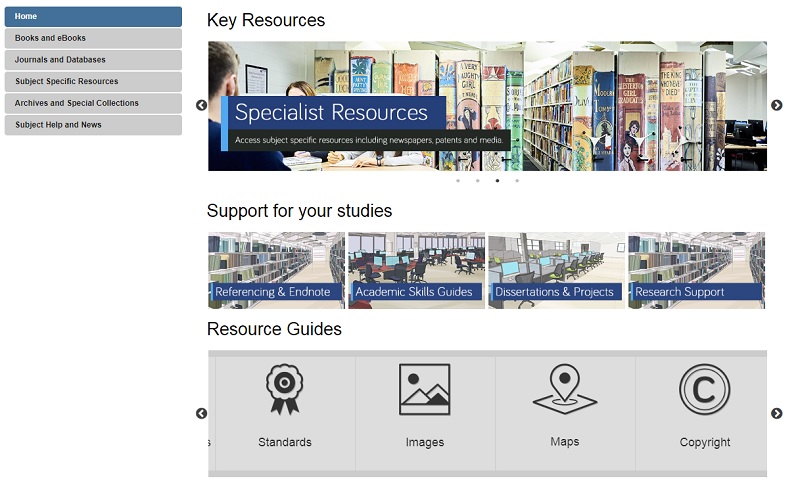
Your Subject Guide can also help you identify useful sources of information for your research as it contains a carefully curated list of resources that are tailored to your subject area.  Here you’ll  find useful lists of online reference books, eBook collections and recommended databases for finding relevant journal articles and conference papers.  Also, under the Subject Specific Resources tab, you’ll discover a further host of specialised materials relevant to your subject such as audiovisual media, data-sets or professional organisation’s websites.

Screen capture of a Library Subject Guide, showing various tabs and resource links.

Depending on your research topic, you might also want to explore the Special Collections tab to see materials held in our Library archives that are relevant to your subject area specifically.

For more advice on finding and evaluating resources for your research take a look at our Finding Information and Evaluating Information Guides.

Brush up on your search skills

A pot of paint brushes

Searching should be easy, right? We do it all the time in our day to day lives and with Google so ingrained into our existence, we don’t give it much thought. We type some words into the search engine and most of the time we find what we are looking for. Nothing to it!

However, while this approach certainly works for checking out cinema times or booking flights, it lets us down where research is concerned. We have high expectations that information will be quick and easy to come by and that it will be neatly organised in one place, rather than having to search in multiple locations, using different techniques. We imagine that the time consuming part of our research will be the analysing, synthesizing and the writing of it and we often don’t even think about the searching side of things.

The reality though is quite different. Without investing in our searching techniques and the development of a search plan, we can often find ourselves overwhelmed by information and not being able to see the wood from the trees. Our stress levels rise and our frustrations explode. Surely finding information shouldn’t be this hard!

The good news is, is that there is help to be had. Our job as Liaison Librarians is to equip you with the skills you need to create that all-important search plan and to encourage you to pause and stop before you dive straight into finding information for your research. We have a fantastic range of online tools for you to do this, not least an interactive search planner that you can keep adding to throughout your search and which you can even email to yourself, your supervisor, or us as a Liaison team for feedback. The Academic Skills Kit has lots of advice on how to start a search, including how to break your concept down into manageable chunks and how to identify keywords and synonyms.

You can also check out this short video to get you started…….

Keep your eyes peeled for our next blog installment of how to find particular resources. See you then!

Photo by Debby Hudson on Unsplash