New ebook collections for arts and humanities

Image by Free-Photos from Pixabay

The Library has invested in thousands of new ebooks since March, to help widen our collections and enable access for students, wherever you are based.

As well as purchasing individual titles, we have also bought several specialist collections of particular interest to arts and humanities, including the following:

  • Bloomsbury collections in Education, Film and Media, Law, Linguistics and Literary Studies (535 titles in total)

In addition, we have leased access to multidisciplinary academic collections from the following publishers:

All the new titles are individually catalogued on Library Search, or you can browse the books available to us on the publisher’s platform (make sure you are logged in with your Newcastle University username and password).

Getting the most out of e-books

Woman reading on an eReader device.

We have over 0.7 million e-books accessible through Library Search, including titles that feature on your reading lists, or those that have been recommended by staff and students. Sometimes we buy them through large bundle deals with specific publishers so we gain access to lots of research titles all at once.

Why use e-books?

e-books are incredibly useful resources as they are available 24/7 from any location, work with most devices and some come with snazzy features such as keyword searching, annotation options, links to other relevant information, and reading aloud facilities to name but a few.

How do e-books work?

As we get e-books from different platforms and providers you might see a different layout each time you access one of our titles but the logic is the same. You can navigate using a toolbar, you can normally turn pages using little arrows at the top or side of the page, you can jump to specific chapters and in some cases, print or download all or some sections of the e-book to read offline.

Unfortunately, one thing you can’t do with e-books is download and save offline a copy of the book to keep forever, there are usually some download restrictions. This is because we have subscriptions or licence access to titles but we don’t own the title. There is something called Digital Rights Management where publishers can control the copying, pasting and downloading of their content, this is linked to issues with privacy and copyright.

How do I access e-books?

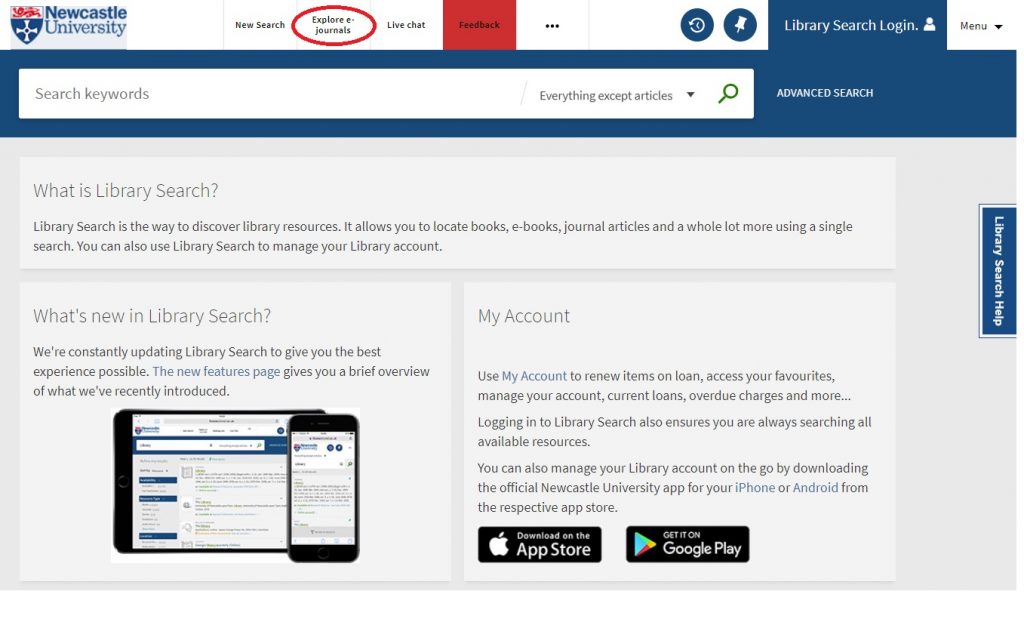
Simply navigate to Library Search and enter your keywords to look for a book title as usual. Library Search is the best way to access resources whether you’re on or off campus as it makes sure you’re logged in correctly and can access resources simply and quickly.

Watch this short video to begin searching for books and e-books.

From your search results, choose an e-book which looks relevant e.g. Essentials of Business Research Methods by Hair, which we know is popular book for Business students doing dissertations. If you are off campus, you will need to sign in with your University ID and Password.

Once the e-book has loaded on the screen, hover over the functionality buttons to see what they do. For example; the search option will be useful if you’re looking for specific topics; use the Table of Contents to navigate straight to a chapter you’ve been told to read, or select the paint pallet to change the colour of the background to help with your reading.

Not all titles are available in eBook format for an institutional library to purchase, but if you’d prefer a title in electronic format we can certainly investigate. Just let us know by recommending a book.

Library Search: (the secret stuff?)

You know Library Search. You use it every day when you’re at University. Why are you going to read a blog post on it? Well, we’re wondering if you’re using Library Search to its full potential. Not sure? Then read on.

Library Search is Newcastle University Library’s discovery tool – essentially it’s how you find resources on the library shelves and access those invaluable resources online. But what else can it do?

An image of the Library Search login function.

Log in. Using your usual Campus ID and password, you can open up the full functionality of Library Search by telling it who you are. It allows you to:

  • Log into your library account to see what books you have on loan (which you may be finished with and could return to any library site), those requests you’ve placed and any books you have on loan that may have been requested by someone else. The standard library stuff, but it’s important too.

An image of Library Search's My Account function.

  • Save items you want to come back to (that’ll save you writing them down somewhere else). Find that favourite item and ‘pin’ it to your record. You can then access a list of your favourite books, journals or journal articles and label (or tag) them as to why you may need them, e.g. Herbology, Professor Snape’s essay, or Field Trip to Hogsmeade. That makes it easy to see what you need to use for each lecture, seminar or assessment.

An image of the Library Search Favourites tool.

  • Permalink. You can share an item with someone if you want to – copy the permalink to the clipboard and send it to someone you know may be interested.

An image of Library Search's permalink tool.

  • Save your search. If you need to repeat your search then save it within Library Search so you don’t need to remember the keywords and connectors (AND, OR, NOT) sequence. This is important if you are scoping a search and need to record or change your approach. You can also ‘Personalise’ your results to a particular discipline – give it a try!

Animage of the Library Search Save Search and Personalise tool.

  • Set up a RSS Feed (yes, really!). The Rich Site Summary function allows you to be informed of changes to results in your saved searches. Handy, eh? Go to your Saved Searches and simply click the RSS icon.

An image of Library Search's RSS feed tool.

  • Receive an email alert when there are new results for your saved search. This can save you time in your research as Library Search will inform you if there is a new publication available which matches your search terms. Switch it off when you move onto a new subject area by accessing your Favourites list and deselecting the alarm bell icon.

An image of Library Search's email notification tool.

Finally, if you’re writing up your assignment and can’t remember the essential elements of a reference, then use Library Search for guidance. The Citation tool will allow you to view a suggested citation and to copy it to your clipboard for use in your work.*

An image of Library Search's Citation tool.

*BUT (you knew that was coming, didn’t you) ensure you choose the correct style and check your citations for accuracy before including them in your work. It pays to know your required referencing style and not to rely on automated or generated references. If you want to learn more about referencing then see our Managing Information guide and Cite Them Right. Cite Them Right is a great resource which will remind you of the importance of referencing, how to reference and will give guidance on how to cite those more tricky materials such as conference papers, newspaper articles, social media posts and more. Finally, there’s a new tutorial with lots of interactive questions so you can test yourself too.

If you know of any tips or tricks in Library Search that aren’t mentioned here, then leave us a comment and share them!

Resource in focus: OUP Law Trove

This Oxford University Press resource contains most of the essential, recommended and background reading titles you would normally find listed in your Newcastle Law School module handbooks and on the Law Library shelves.

If you’re asking if you need to buy your course texts for 2020/21 then we can’t answer that question for you, as the answer depends on you. Ask yourself: can you work with e-books? Do you prefer to have your own copy of a book so you can fold pages, write notes in the margins or use a highlighter to annotate the text (*librarians across the world gasp in horror!*). Can the University Library provide a copy of the book you need to use via the Click+Collect service? We certainly can’t provide a copy of every book to every single student even when we want to. We do advise you to try OUP Law Trove and see how easy it is to access, and how versatile it can be (including annotating the text!). It may just save you spending money on books where you don’t need to.

Read on, or you can take a tour of the resource before diving in. OUP have released a YouTube playlist for you to watch to make the most of OUP Law Trove too.

An image of the OUP Law Trove home screen.

Logging in
You can access OUP Law Trove directly via Library Search (log in with your Campus ID and password), via your Reading Lists in your Canvas modules, and directly too. You can go to OUP Law Trove and use the ‘Sign in via your institution’ option in the left-hand login box on the homepage, and follow the instructions.

An image of the direct sign-in option on OUP Law Trove's homescreen,

Further guidance on logging in is provided by OUP in this video (1:26 mins):

Searching
You can search OUP Law Trove by author, title or keyword. You can narrow your search to those titles available to us alone by selecting Show titles in my subscription (left-hand menu). Select those that are unlocked or free.

You can further narrow your results by refining by subject using the options available in the left-hand menu.

A screenshot showing a composite of different search types in OUP Law Trove.

Further guidance on navigating and searching is provided by OUP in this video (2:55 mins):

Personalisation
You can create a Personal Profile to experience the full functionality of OUP Law Trove, including bookmarking and annotating (without writing on your books!). Click the ‘Sign in’ button on the top menu bar and follow the instructions.

An image showing the location of the Personal Profile Sign in option on OUP Law Trove's home screen.

Further information on the benefits of creating and using the Personal Profiles features is provided by OUP in this video (0:58 mins):

Reading Lists and Handouts
You may find your module teaching staff are using the DOI: for a specific book or chapter from your Reading List or module handout. What’s a DOI? A Digital Object Identifier. It’s a ‘permalink’ (permanent link) to the specific materials you need to read and looks like a weblink (which it is, essentially). If it doesn’t directly link to OUP Law Trove then add https://dx.doi.org/ to create the full DOI link. You will still be asked to login using your Campus ID & password to gain access to the materials.

An image showing the DOI for a Law Trove book and book chapter.

Tips
Search OUP Law Trove directly for your resources if you can. Library Search and your Reading Lists are linking to most of the books, and some of the chapters available, but not all. You may find more resources by performing a keyword search; the results could show a useful chapter in another book that you would never have thought to search in.

You have access to some good study skills information in OUP Law Trove too. Whether you are wondering what academic writing actually is, how to write a case note, how to prepare for a moot or dealing with an exam, there are materials in Trove to assist you alongside the Academic Skills Kit made available to you by the University, the University Library and the Writing Development Centre.

Further information on the online resources, including MCQs, is provided by OUP in this video (2:12 mins):

We think you will find this resource very useful in supporting your studies at Newcastle Law School. If you have any feedback or questions, please leave a comment or contact libraryhelp@ncl.ac.uk.

New resource: Westlaw Edge UK

Westlaw Edge UK. Is this a new resource? Possibly not by definition, but it is most certainly a significant enhancement within the existing Westlaw UK service.

https://youtu.be/K2hiP_AsLag

Westlaw Edge UK (not to be confused with the Microsoft Edge browser) is available via the Law Subject Guide and Library Search within Westlaw UK. Once logged in with your Newcastle University Campus ID and password you will find the tools available to help you keep currently aware and able to anticipate change – skills which are incredibly important to develop as a law student to be carried into your legal career.

These tools include:

An image showing the Westlaw Edge UK tools to enable current awareness.

With inclusion of an interactive precedent map within Case Analytics to easily locate relevant cases…

An image of the precedent map associated with Donoghue v Stevenson (snail in a bottle case).

…and the UK-EU Divergence Tracker to assist with analysing the legal implications of Brexit, it’s even easier to carry out effective and efficient legal research.

https://youtu.be/RIo7_d54VDY

You can go beyond search results lists with AI-suggested relevant research and resources tailored to your needs. Skynet hasn’t got a look in. Go on, don’t be slow. Lose yourself in Westlaw Edge UK and get ahead.

A photo of a snail in a glass bottle. Photo by Rodion Kutsaev on Unsplash.

Resource in focus: Literary Print Culture

Love books? We hope so. Do you want to know more? Take a journey into the history of the book with Literary Print Culture.

Literary Print Culture: the Stationers’ Company Archive, 1554-2007 is a resource which will show you the primary source documents from the City of London archives. Covering the history of the book, publishing history, the history of copyright and the workings of the early London Livery Company, explore the variety of documents to uncover the story of the role the Stationers’ Company played in the history of the book trade.

An image of the Arms of The Worshipful Company of Stationers and Newspaper Makers.
Arms of the company [1], c.1700-1900, © The Worshipful Company of Stationers and Newspaper Makers

This archive contains a huge range of primary sources, showcasing a diverse range of material from the archive of the Stationers’ Company archive including:

  • Constitutional Records
  • Court Records
  • Membership Records 
  • Financial Records
  • Trade Records
  • General Administrative Records
  • Charities and Property Records 

Before you begin, we’d recommend clicking Introduction, in which you can learn more about its scope and features.

An image of the Literary Print Culture resource homepage.

The primary sources are supplemented by contextual essays and other commentary to give you ideas for interpreting and exploiting the archive.

You can browse or search the archive contents by clicking Documents (to browse) or one of the two Search buttons. You can filter your search in various ways, e.g. by document type, year or theme.

For some of the documents in the archive, you can now use handwritten text recognition to enable you to search the handwritten items effectively. Split-screen viewing enables you to view a document and its index simultaneously.

Have you used Literary Print Culture? Please feel free to post your comments and experiences by clicking Leave a comment below.

GUEST POST – OFF THE SHELF

Off the Shelf poster

Hi! I’m Caitlin, a final year law student and law library aide – and by now I’m used to the stress of exams and deadlines.

I tried the ‘poetry-pick me up’ after going into the common room for a revision break.

I stumbled across Sue (@kind_curious) in the Law School Student Common Room, where she asked, ‘do you want a poem?’. Not really knowing what to expect, I had to overcome a bit of social awkwardness! I was surprised by Sue’s passion and love of poetry, which was clear in the way she spoke about how she’d used poetry in the NHS before and it was what she enjoyed most.

I was asked questions about my current stress levels and how I was feeling with exams, and how I dealt with stress. I told her that when I get stressed I talk even more than usual, which for anyone who knows me sounds like I’m going at a million miles an hour, and she suggested something that would relax me.

I laughed as I saw no signs of chocolate or Netflix – my usual go to relaxation strategies.

Instead she said I needed something like a lavender bubble bath – again I saw no sign of a bubble bath in the Law School and I’d yet to find one in the Dungeon.

She picked out two poems that would make me feel like the relaxing in lavender: she suggested ‘Sonnet’ by Elizabeth Bishop and Shennagh Pugh’s ‘What if This Road’.

What if this road reminded me of Robert Frost’s ‘A Road Not Taken’, and was great for me as a an indecisive person. It was matched perfectly to the questions that Sue had asked me, as I read it as a  ‘roll with it’ approach to life, which is definitely needed to cope with exams and deadline stress.

The second poem, Bishop’s ‘Sonnet’, had great visualisation techniques, almost like a meditative poem – which was spot on to turn off the stress and slow everything down!

The experience was a great switch off from deadline stress, and a great use of the 10 minutes which I’d usually scroll through twitter or Instagram. It was something different, and really quite unique and relaxing, which I would definitely recommend to help have a break from any exam and deadline stress!

Resource in focus: Historic Digimap

Who doesn’t like maps?

Historic Digimap is an online map and data delivery service, available to all staff and students of Newcastle University. It delivers access to historical Ordnance Survey maps of Great Britain dating from 1846-1996 across various scales, including 1:25,000 and 1:10,650.

If you are a first time user of Digimap then you will need to complete a brief registration form and agree to the license agreements for each collection, but that takes seconds and then you’re ready to go!

Viewing historic maps (3:36 min)

If you want to ‘roam’ through the ages in an area, then you can use the timeline tool to see how the landscape has developed through the years, or view two maps side-by-side to compare and contrast your findings. Imagine looking at the Newcastle University Campus and seeing what used to be on the site before buildings such as the Henry Daysh Building, Stephenson Building and Philip Robinson Library graced us with their facilities!

Once you have your area of interest, the Roam service will allow you to view, annotate and print the map in PDF format. Data Download will allow you to download OS data for use in GIS/CAD (if you wish!).

The full scope of what Historic Digimap (and the other collections available to you including Ordnance Survey, Geology, Marine, Environment, Aerial, Lidar and Improvement Service) are covered in EDINA’s comprehensive Help service:

(Improvement Services is an organisation dedicated to the improvement of local government services in Scotland. This data collection comprises of 37 local authority datasets, such as planning applications, green belts and school catchment areas. A wealth of information, who’d have thought.)

Go on, give it a try! But please do read EDINA’s Digimap FAQs on what you are permitted to do with the data you use, to ensure you comply with the educational use licence.

Exams: we are here to help

Woman throwing books up in the air

Exams are a tricky time. Often you will be juggling different exams themselves, on top of other deadlines. However, we want you to know that you aren’t alone at this crazy time of year. We are here to help you through.

But how exactly can we help? Sadly, we can’t take go into the exam with you, or magically freeze time to give you more hours in the day, but do make the most of the following:

  1. Library Help – the place to go when have a question via chat, email, text, twitter, Facebook. Or alternatively search our Frequently Asked Question (FAQ) database.
  2. Librarians – yes you heard right. Book a one-to-one appointment to get the best out of the University Library resources. Also remember our staff in every library are friendly and approachable. There is no such thing as a silly question, so ask away!
  3. Study Space – The University Library has a range of different study rooms and spaces to suit your needs.
  4. 24/7 – The Philip Robinson Library is open 24/7 during the exam period. We want you to sleep and get enough rest, but if you do need to study through the night, we are here.
  5. Subject guides – we have a range of subject guides put together by expert librarians which draw together all the main resources for your studies.
  6. Be well@NCL collection – we don’t just have books for study. This new collection includes tried and tested books that support your wellbeing.
  7. Additional support – don’t suffer and please don’t be shy. You can seek additional support from your NUSU, Student Wellbeing Service, Nightline and the University chaplaincy.

So remember……pace yourself, access the help you need and believe that you can do this!

Shades of Grey [Literature]

Grey literature. Black Literature.

Did you even know they existed? Possibly not.

Depending upon your source, “black literature” can be defined as books and peer-reviewed published journals. This is the familiar material you will source and use through your University Library and its catalogue.

Grey literature is something else entirely. Grey literature is research or material that is not produced by commercial publishers. It may be wholly unpublished or published in a non-commercial form. Think along the lines of industry-related materials, academic publications, government publications and think tank papers.

GreyNet, the Grey Literature Network Service has more detailed information on this vital research resource.

Grey Literature can be unique and an important source of information. There is a range of grey literature you may need to consult to ensure your research is complete. Examples of these materials include:

  • Working papers
  • Conference proceedings
  • Theses and dissertations
  • Government and official publications, including Green and White Papers, Select Committee papers, legislation
  • Policy statements
  • Research reports
  • Newsletters
  • Fact sheets
  • Blogs
  • Transcripts
  • Pre-prints and post-prints of articles
  • Technical reports
  • Professional guidelines
  • Patents
  • Standards
  • Market research
  • Data, e.g. Census, economic data, statistics

Most databases, available via your Subject Guide, will allow you to limit your search by document type, including grey literature, which does improve accessibility to this type of material.

Other resources include:

  • Bielefeld Academic Search Engine

    Operated by Bielefeld University Library this search engine indexes open access academic literature. The Advanced Search option allows you to search for specific types of grey literature.
  • Box of Broadcasts

    Box of Broadcasts provides access to over two million programmes from over 65 TV and radio channels, including most of the UK’s freeview network, all BBC TV and radio content from 2007, and several foreign language channels. You can view archived programmes, record new ones, create clips and playlists and see transcripts. (This resource is not available outside the UK.)
  • Digital Education Resource Archive (DERA)

    The Institute of Education Digital Education (University of London) Resource Archive (DERA) is a digital archive of all documents published electronically by government and related bodies in the area of education.
  • Open Grey

    The System for Information on Grey Literature in Europe provides open access to over 700,000 bibliographical references.
  • Teachers TV from Education in Video

    Provides access to all 3,530 globally-acclaimed instructional videos produced in 2008 by the United Kingdom’s Department of Education to train and develop teachers’ skills through demonstrations and commentary by teachers, administrators, and other educational experts.
  • Newcastle University Theses and Dissertations Guide

    Newcastle University theses are available in the eTheses Repository. Other UK theses may be available via EThOS. There is not one single source for locating non-UK theses. The Guide will give you some starting points.
  • UK Legislation

    UK Legislation is freely available online but be aware there may be delays of up to 2 weeks before any updates appear. Use your subscribed databases available via the Law Subject Guide.

The list can go on…

Once you have located your grey literature, do question it using the CRAAP testcurrency, relevance, authority, accuracy, purpose. Consider what is publicly available versus a subscribed (or paid for) resource. It may be biased and you should include that assessment in your work.

And finally, don’t forget, not everything is available online!