
Walton Library: Reading Lists and the STC

Hopefully you are feeling settled at the Walton Library and finding your way around.  During your induction session you may have heard Library staff mention reading lists and STC books. This blog post breaks these terms down to help you get the most out of the Library.

What are reading lists?

When it comes to reading lists, the clue is in the name. They are materials your lecturer(s) have selected to help you understand your subject – and are not necessarily books! Reading lists can contain journal articles, websites and other media, such as podcasts and videos. The material on your reading list is broken down into essential, recommended or background reading for your convenience.

Not all reading lists look the same. Some lists are divided into the above categories, and some are divided into weekly or even daily reading. Speak to your lecturer if you have a query about the content on your module’s reading list.

Where are they?

There’s more than one way to access your reading list. If you use the Medical Learning Environment (MLE), you can access your reading list from the “Reading” tab on the “Learning Materials” window. These are embedded in each Case. See below for reference:

A reading list on the Medical Learning Environment (MLE).

You can click on the items within the reading list and it’ll take you directly to Library Search, where you will be able to see the item’s location and availability.

If you use Blackboard, once you’ve logged in, you will see that the “Reading Lists” link is on the “Overview” page for each module you’re registered on. See below for reference:
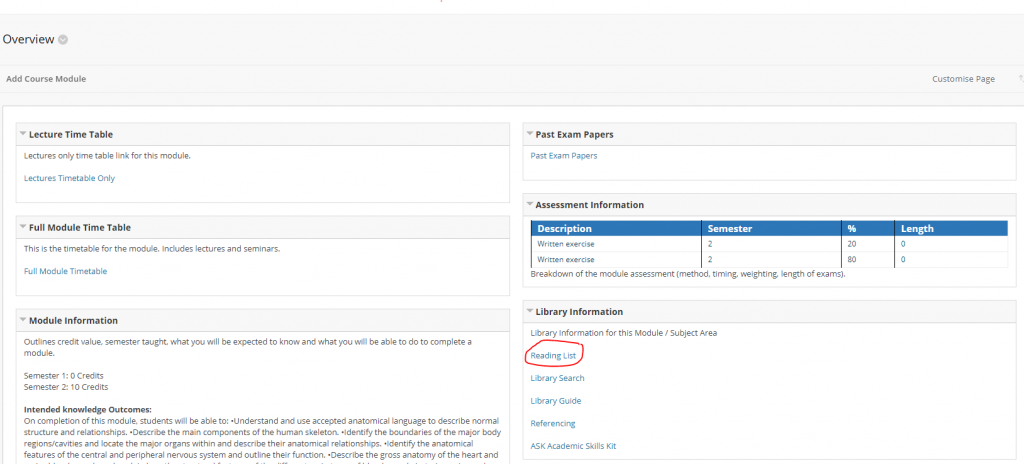
The location of a module’s reading list on Blackboard.

You can also access your reading lists from the Library homepage. Follow this link and click the green “More information for students” button.

If you’re having a technical problem when using your reading list, email: med-reading-lists@ncl.ac.uk and we’ll investigate the problem for you.

What is the STC?
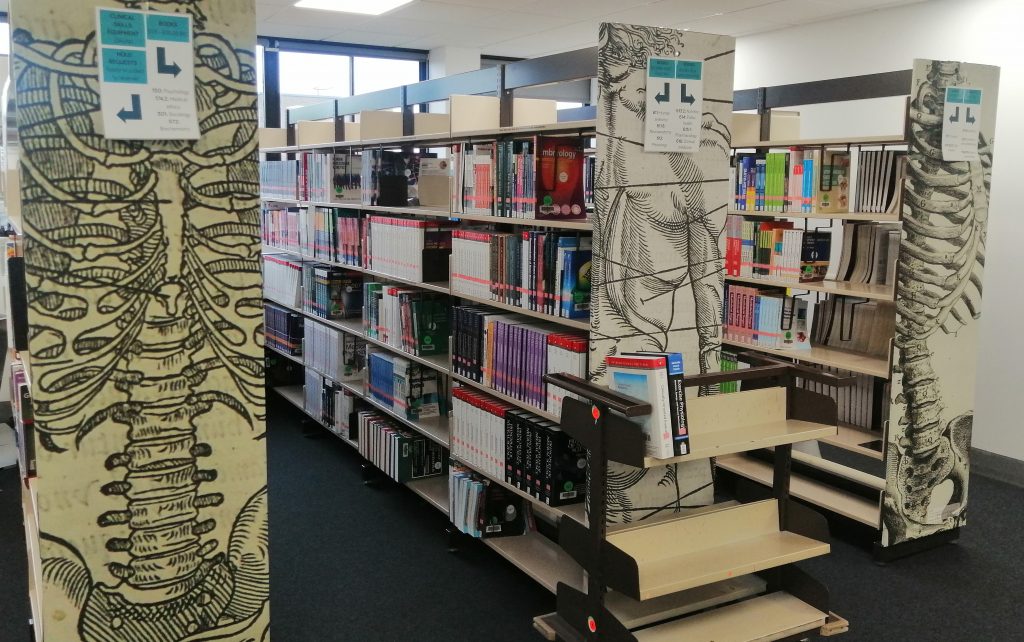
The Student Texts Collection (STC) at the Walton Library.

If you’ve been to the Walton’s service desk asking for a stapler, you may have heard the staff directing you to the STC. STC or Student Texts Collection is a separate room, located next to the printers and the self-issue machine, which contains our high demand texts. Many of these will be essential on your reading lists. These books are available for short loan only – four hours during the day, unless you take them out four hours before the Library closes, when you can loan them overnight (providing you return them before 9:30AM the next weekday and 10:30AM on weekends!)

These short loan books are perfect if you’re on the go. You can issue one before a lecture and then return it just after! They’re also ideal if you only need to use a short section of a book: you can copy up to one chapter or 10% of a book (whatever is greater) using the photocopier.

How does it work?

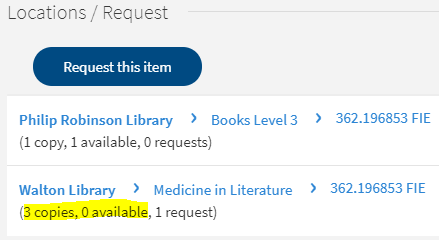
Just like long loan items, STC books are on Library Search. However they can’t be reserved if all the copies are out on loan. STC books need to be checked out and returned from your account using the self-issue machine in the STC room.
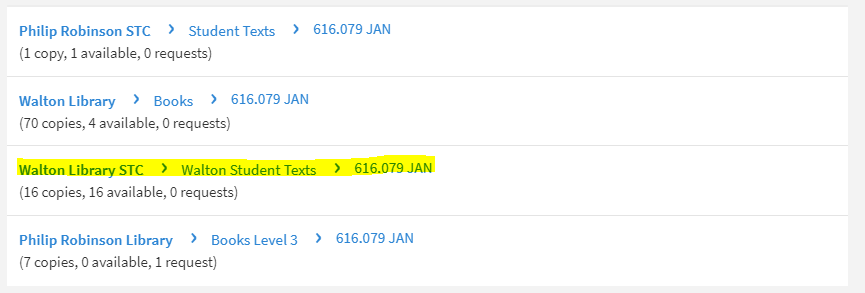
STC books are listed separately on Library Search.

If you have any further queries about the STC, you might want to check out our Library FAQs here. Desk staff at the Walton can also be called upon to lend a hand if you’re stuck.

Freshers’ Guide to the Walton Library

Wishing a Warm Walton Welcome to all new and continuing students in the new academic year!

Just as you are settling into life at University we thought that you might benefit from this list of tips of how to make the most out of your time in the Walton Library.

Opening hours

The Library opening hours change throughout the year, but during term time, we are open normally until 22:00.

Resources

Use your Reading Lists as a great starting point for finding academic material. They can be accessed via your VLE (Virtual Learning Environment), which is either Blackboard or the MLE, depending on the course you are studying.

All academic resources that we purchase will be available via Library Search. It is the most prominent element on our colourful website and it will show you books, articles, journals in both physical or electronic format, databases and others.

The library website can be found here: www.ncl.ac.uk/library/

Use keywords to find the titles that you need and Library Search will tell you whether we have them or not, whether they are available on the shelves, in which library and part of which collection they are. If a book we have in stock is NOT currently available on the shelves, the best thing you can do is to log in with your student ID and password and place a reservation:

Reserving is in your best interest because this is what will prompt a current reader of the book to bring it back so that you can use it. So remember: Shy bairns get nowt.

Specialist help

There are subject-specific guides that give you information directly relevant to your course. You can find them by selecting your course in Subject Support, on the Library website.

Want to ask us a question?

Library Help is the place you seek. You can browse our FAQ database by topic or search it by using keywords. You can also send us an email or chat with us. Library Chat is monitored 24/7, so as long as you have access to the internet, wherever you are in this great, big world, you can contact us.

Identify resources for your research project

A strong research project such as an essay, dissertation or thesis will always be supported by good quality information from a wide range of sources.  There are a huge variety of resources available to you and being able to make appropriate choices when selecting materials to include in your project and explain why you have chosen them, is an important academic skill that demonstrates a good awareness of your subject and an ability to think critically about ideas and research.

Of course, not all information resources will be relevant to your particular research.  You will have to think about the type of information you need then identify the type of resource that will provide that kind information.

For example:

Books will offer an in-depth overview of popular ideas, theories, and opinions in your subject area and are likely to be broader in scope than a journal article or conference paper.

While a conference paper will often discuss ‘work-in-progress’, and therefore can be an ideal way of finding out about up to date research and ideas.

For more information on different resource types, including standards, patents, maps, newspapers and more, take a look at our range of Resource guides.

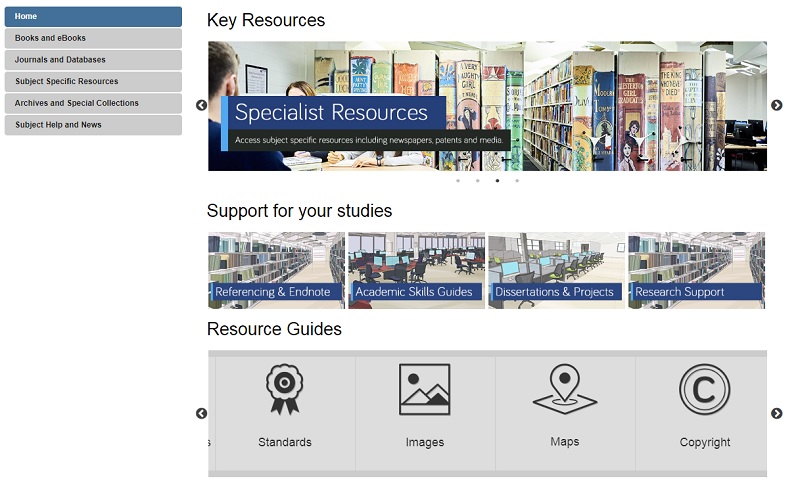
Your Subject Guide can also help you identify useful sources of information for your research as it contains a carefully curated list of resources that are tailored to your subject area.  Here you’ll  find useful lists of online reference books, eBook collections and recommended databases for finding relevant journal articles and conference papers.  Also, under the Subject Specific Resources tab, you’ll discover a further host of specialised materials relevant to your subject such as audiovisual media, data-sets or professional organisation’s websites.

Screen capture of a Library Subject Guide, showing various tabs and resource links.

Depending on your research topic, you might also want to explore the Special Collections tab to see materials held in our Library archives that are relevant to your subject area specifically.

For more advice on finding and evaluating resources for your research take a look at our Finding Information and Evaluating Information Guides.

Brush up on your search skills

A pot of paint brushes

Searching should be easy, right? We do it all the time in our day to day lives and with Google so ingrained into our existence, we don’t give it much thought. We type some words into the search engine and most of the time we find what we are looking for. Nothing to it!

However, while this approach certainly works for checking out cinema times or booking flights, it lets us down where research is concerned. We have high expectations that information will be quick and easy to come by and that it will be neatly organised in one place, rather than having to search in multiple locations, using different techniques. We imagine that the time consuming part of our research will be the analysing, synthesizing and the writing of it and we often don’t even think about the searching side of things.

The reality though is quite different. Without investing in our searching techniques and the development of a search plan, we can often find ourselves overwhelmed by information and not being able to see the wood from the trees. Our stress levels rise and our frustrations explode. Surely finding information shouldn’t be this hard!

The good news is, is that there is help to be had. Our job as Liaison Librarians is to equip you with the skills you need to create that all-important search plan and to encourage you to pause and stop before you dive straight into finding information for your research. We have a fantastic range of online tools for you to do this, not least an interactive search planner that you can keep adding to throughout your search and which you can even email to yourself, your supervisor, or us as a Liaison team for feedback. The Academic Skills Kit has lots of advice on how to start a search, including how to break your concept down into manageable chunks and how to identify keywords and synonyms.

You can also check out this short video to get you started…….

Keep your eyes peeled for our next blog installment of how to find particular resources. See you then!

Photo by Debby Hudson on Unsplash

Beyond the Library

Will you be working on a dissertation or project this summer or next year? Worried that the Library might not have access to the specialist books and other resources which you need? Wondering how you can find out about resources relating to your research topic which are held in other libraries?

Wonder no more! There are three main ways you can find and access books and other resources held elsewhere:

1. Search

You can search the catalogues of over 100 UK and Irish academic libraries, national libraries and other major research libraries via COPAC. For a more in-depth and up to date search, you can also search individual academic library catalogues online. Need to look further afield? Search library catalogues internationally via WorldCat.

2. Visit

We have more information about how you can visit other libraries, locally and nationally, here. The SCONUL Access Scheme enables students to use other academic libraries around the country, but you need to register online first (and be sure to check the access arrangements for any library you are planning to visit, as they may alter during the year).

3. Obtain

If we haven’t got the book you want, you can ask us to consider buying or borrowing it, via our Books on Time service. If you need a copy of a journal article to which we don’t have access, please apply via our inter library loan service.

Image by andreas160578 from Pixabay. 

Pharmaceutical Substances on trial until 31st May 2019

Pills

We have trial access until 31st May 2019 to Pharmaceutical Substances from Thieme.

Pharmaceutical Substances is a one-stop source of information relating to the industrial synthesis and commercial applications of every licensed drug of significance. It provides ready access to syntheses, patents, and applications for more than 2,600 active pharmaceutical ingredients (APIs), including intermediates from the six most important markets.

Professors Axel Kleemann, Jürgen Engel, Bernhard Kutscher, and Dr. Dietmar Reichert present highly evaluated information collected from all the relevant literature and commercial patent data.

Pharmaceutical Substances is aimed at:

  • Researchers and process chemists
  • Teaching in the field of medicinal and pharmaceutical chemistry
  • Everyone involved in design, discovery, development, evaluation, and marketing of drugs

Please explore and if this resource would support your education or research activities then contact your Liaison Librarian with details.

Top tips to get you started with revision

A person writing at a desk

Hoping to get some revision done during the Easter Vacation?

Here are some tips to get you started:

1. Have a look at our MCQ collection in the Quiet study area of the Walton Library. This collection has books with MCQs, EMQs, SBAs, OSCEs and other self  assessment and answer questions on many different subjects including;  anatomy, medicine, physiology, surgery and more. Look out for the green stickers on the spines of the books.

2. Check out the the Exams and Revision Section on the ASK (Academic Skills Kit) webpages for more help.

3. Remember to take regular breaks.

4. Stay well hydrated, eat properly and get some exercise.

5. Remember to check the date, time and place of your exam well in advance of  the day, make sure you know where you are going.

Have a good Easter Vacation. Happy revising and Good Luck in the exams when you get back.

Image by Shurriken from Pixabay

From all the staff in the Walton Library.

Medicine in Literature – some thing different for your Easter Reading

Medical Humanities or Narrative Medicine is a popular academic discipline that explores the crossroads between medicine and the arts.

Our Medicine in Literature collection captures the complexities of what it means to be human through a wide range of literary genres.

These resources range from fiction, non-fiction including medical history, ethics and memoir, graphic novels, poetry and prose or medicine as metaphor, to films. Representations of illness, dis-ease, healing and health are interwoven themes that give voice to a diversity of perspectives and personal experiences of the human condition.

If you’re interested in exploring your subject field from a different viewpoint or simply want a break from revision this Easter, dive right in! The physical stock is located in the Quiet Study area of the Walton Library or you can browse the collection from our Library Guide.

Please email any resource recommendations to lib-medlit@ncl.ac.uk.

See the Top 10 Medicine in Literature books borrowed from the collection this year.


Future proofing your employability

“What would you guess is the most common job?” Michael Lai, Outreach Lead at KGI, asked an audience of students at his Columbia Heights TEDTalk back in 2016. His audience members offer a few suggestions. “Engineer?” “Fast food workers?”  After several failed attempts, Michael puts them out of their misery,

“3.5 billion truck drivers in the United’s States” he tells them. “Experts predict that in the next 12-15 years, most of the cars on America’s highways will be self-driving… so what’s going to happen to the most common job?”

The future of the job market – and it’s inherent uncertainty – has been receiving a lot of attention in the international press in recent years, with Universities UK analysis predicting “65% of children entering primary schools today will work in jobs and functions that don’t currently exist.”  In previous generations, new graduates could expect to work with the same company for several years, steadily climbing the corporate ladder in a predictable, but reassuring linear way. In the 21st century however, the face of the job market is changing, and once you graduate, you may find yourself looking at a “portfolio career” over traditional career progression – something Facebook COO Sheryl Sandberg described as more akin to a career “jungle gym” than a career ladder.

But what does all this talk of truck-driving and emergent markets mean for you, the UK Graduate? Well, if the gig economy becomes the norm in the next 10 years, one of the key challenges for new graduates will be the perpetual need to upskill yourself, and market your own skill base to different employers. This puts the spotlight on what have traditionally been referred to as “soft” transferable skills that are required across many different roles and sectors – skills such as resilience, team-working and critical thinking. Here at the Library, we’d argue that information and digital literacy falls under this bracket (well of course we would, we’re librarians!). The ability to find and use information and make considered use of digital tools is an important capability in any graduate job. Don’t just take our word for it – we spoke to several students returning from placement who told us their information skills had helped them get ahead.

The good news though is that your degree programme offers you the chance to work on and demonstrate all of these skills. Employers will know that you may not have extensive work experience as a new graduate, but make sure you cherry-pick prime examples from your University work, part –time jobs and any voluntary experience to exemplify the skills employers are looking for (and remember, the Careers service can help you with interview preparation.) Make the most of the workshops and sessions open to during your time at University so you are in a great position to articulate these important skills. For more information on how the Library can help, check out our Employability Guide

References

  1. TEDx Talks (2016) Four Key Skills to Lead the Future. Available at: https://www.youtube.com/watch?v=djHTcES2ATg
  2. Universities UK (2018) Solving future skills challenges. 6th August 2018. Available at: https://www.universitiesuk.ac.uk/policy-and-analysis/reports/Documents/2018/solving-future-skills-challenges.pdf
  3. Sandberg, S as quoted by Lebowitz, S and Campbell, D (2019) “Goldman Sachs CEO David Solomon shares his number one piece of advice for millennials who want to get ahead in their careers.” Business insider, Jan 13th 2019. Available at:  https://www.businessinsider.com/career-advice-millennials-goldman-sachs-ceo-david-solomon-2019-1?r=US&IR=T

Shades of Grey [Literature]

Grey literature. Black Literature.

Did you even know they existed? Possibly not.

Depending upon your source, “black literature” can be defined as books and peer-reviewed published journals. This is the familiar material you will source and use through your University Library and its catalogue.

Grey literature is something else entirely. Grey literature is research or material that is not produced by commercial publishers. It may be wholly unpublished or published in a non-commercial form. Think along the lines of industry-related materials, academic publications, government publications and think tank papers.

GreyNet, the Grey Literature Network Service has more detailed information on this vital research resource.

Grey Literature can be unique and an important source of information. There is a range of grey literature you may need to consult to ensure your research is complete. Examples of these materials include:

  • Working papers
  • Conference proceedings
  • Theses and dissertations
  • Government and official publications, including Green and White Papers, Select Committee papers, legislation
  • Policy statements
  • Research reports
  • Newsletters
  • Fact sheets
  • Blogs
  • Transcripts
  • Pre-prints and post-prints of articles
  • Technical reports
  • Professional guidelines
  • Patents
  • Standards
  • Market research
  • Data, e.g. Census, economic data, statistics

Most databases, available via your Subject Guide, will allow you to limit your search by document type, including grey literature, which does improve accessibility to this type of material.

Other resources include:

  • Bielefeld Academic Search Engine

    Operated by Bielefeld University Library this search engine indexes open access academic literature. The Advanced Search option allows you to search for specific types of grey literature.
  • Box of Broadcasts

    Box of Broadcasts provides access to over two million programmes from over 65 TV and radio channels, including most of the UK’s freeview network, all BBC TV and radio content from 2007, and several foreign language channels. You can view archived programmes, record new ones, create clips and playlists and see transcripts. (This resource is not available outside the UK.)
  • Digital Education Resource Archive (DERA)

    The Institute of Education Digital Education (University of London) Resource Archive (DERA) is a digital archive of all documents published electronically by government and related bodies in the area of education.
  • Open Grey

    The System for Information on Grey Literature in Europe provides open access to over 700,000 bibliographical references.
  • Teachers TV from Education in Video

    Provides access to all 3,530 globally-acclaimed instructional videos produced in 2008 by the United Kingdom’s Department of Education to train and develop teachers’ skills through demonstrations and commentary by teachers, administrators, and other educational experts.
  • Newcastle University Theses and Dissertations Guide

    Newcastle University theses are available in the eTheses Repository. Other UK theses may be available via EThOS. There is not one single source for locating non-UK theses. The Guide will give you some starting points.
  • UK Legislation

    UK Legislation is freely available online but be aware there may be delays of up to 2 weeks before any updates appear. Use your subscribed databases available via the Law Subject Guide.

The list can go on…

Once you have located your grey literature, do question it using the CRAAP testcurrency, relevance, authority, accuracy, purpose. Consider what is publicly available versus a subscribed (or paid for) resource. It may be biased and you should include that assessment in your work.

And finally, don’t forget, not everything is available online!