Resource in Focus: Building Types Online

After positive feedback from a trial in 2018 we are delighted to announce we now have access to this database.

This platform is based on Birkhäuser’s architecture books, a selection of Birkhäuser manuals and additional analysis Annual updates which add new building types and more contemporary international case studies.

This resources features :

  • Over 6000 high quality architectural drawings/ building plans. These are mostly vector-based, drawn to scale and available for download.
  • 2500 photos of building types
  • 1200 case studies
  • Over 900 international projects
  • 160 thematic articles providing background information on specific aspects of individual building types e.g. lighting, acoustics, urban considerations, access types or planning processes.
  • Types of buildings include: housing, schools, libraries, office buildings, sacred buildings, hospitals, museums, industrial complexes, infrastructure, transport and other building types.

This makes it an excellent choice for both teaching, research and understanding the practice of architectural design.

Search options include :

  • Full Text
  • Architect
  • Building Types
  • Decade
  • Height
  • Country
  • Author
  • Urban Context

You can also browse by grant systematic access to all content according to Building Type, Urban Context and Morphological Type.

This is an important resource for anyone studying building typology or writing architectural design assignments. In nutshell a fantastic online resource covering building types in the last 30 years. 

The Search Help document from the resources explains the database’s functions in detail. An overview of the terminology used in the building analysis and the Search and Browse options is available as well.

To access the database, click on the link via Library Search.
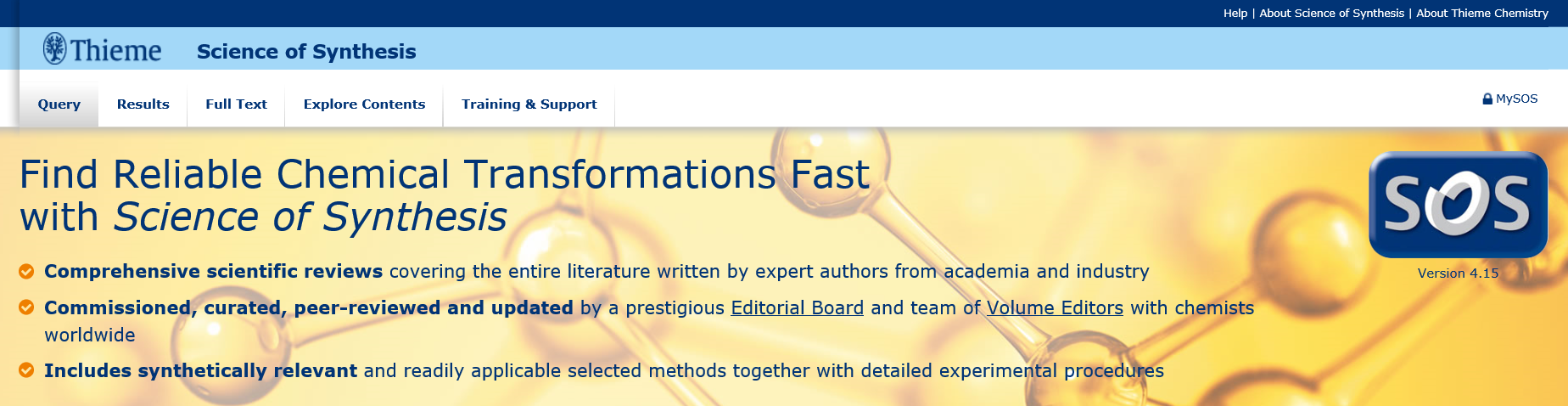
Thieme Science of Synthesis (SOS) trial

We have trial access to Thieme Science of Synthesis (SOS) from now until the end of the year.

Are you looking for critically-reviewed, synthetically-relevant and readily-applicable methods with detailed experimental procedures to support your research projects?

To start getting to the synthesis quicker, try Thieme Science of Synthesis (SOS), a full-text resource for evaluated methods in synthetic organic chemistry.

There is no need to login as you will be recognized automatically by IP address during the trial. However, you can register for a personal account by clicking on “MySoS” in order to save searches and results lists.

Click the “Training & Support” button in the top menu to find case studies, author lists and further help. There is a quick start guide and video tutorials to support you.

We would like to know how this resource supports your research, assessed work and teaching, so please send any comments to Julia Robinson, Faculty Liaison Librarian for chemistry.

Cambridge Histories Online: what’s new?

We subscribe to Cambridge Histories Online, the internationally renowned book series which first started in 1902.  We have access to over 360 volumes online, covering many different subject areas in depth, including history, music, language and literature.

We have recently bought access to several new volumes (in some cases, multiple volumes) which cover the following topics:

Ireland

Moral Philosophy

Intellectual History of Byzantium

Judaism

Communism

Modernism

Slavery

All the Cambridge Histories are individually catalogued and searchable via Library Search, or if you prefer, you can browse them all together on the Cambridge Histories platform.


New resource in focus: Aerial and Lidar Digimap

Digimap is an online map and data delivery service, comprising various collections, including Ordnance Survey and Historic. We have recently acquired access to two more modules: Aerial and Lidar Digimap.

Aerial Digimap 

This provides access to some of the highest quality aerial photography available for Great Britain, created and licensed by Getmapping plc. You can use a range of interactive tools, allowing interrogation and analysis of the data online and offline. You can also:

  • add annotations (text, point, lines and areas)
  • identify image capture date by clicking on the map
  • generate PDF, PNG or JPG files for printing
  • save maps to go back to or print later

Lidar Digimap

This offers detailed Lidar data from the Environment Agency and presents a model of the earth’s surface.

Uses of Lidar data are highly varied, from use in the creation of visual effects for virtual reality and film projects, to archaeology, forestry management, flood and pollution modelling.

You’ll need to agree to the new licence before using these new modules: please see our separate blogpost for more details. If you need help with Digimap, there are extensive help pages online for each component.

To google or not to google?…That is the question

Can you remember life before Google? It is such a huge part of our lives that even those of us who can remember a time before it (hmmm, yes I am that old!) can’t imagine life without it now. It is a great place to find the latest cinema listings or who won last night’s football match, but what about finding information for your latest assignment or research?

There is a time and a place to use Google, but you need to be aware of its limitations. Google, after all, is a business. It earns the majority of its money from advertising, and it will not reveal how it ranks its search results (every wonder how Wikipedia always appears at the top of every search you do?). A search that we do today and repeat tomorrow for a piece of research could give us hugely different results, with no explanation of why. We are also often bombarded with millions of search results and the reality of our searching habits mean that we rarely look beyond the first or second page.  Admittedly, advanced search features on Google and the use of Google Scholar can really help us to become a smarter and effective Google users, but is it enough for our own research? Are we finding everything that is out there?

We need to think about our information needs before we work out where it will be best for us to search. Imagine, for a moment, that we are want to buy a particular local cheese, which we love. Would we go to a general shop or would we go to a specialist deli? We are probably going to need to go to a deli. It is just the same when searching for information. Google may be great for some background information or a starting point of a project, but it may simply not give us the high quality, niche information that we need to give us top marks for an assignment. So what are the other options?

Aimee Cook, a Liaison Librarian here at Newcastle University, explains more.

So next time you think about googling something for an assignment, stop and check out Library Search and your subject guide first for the books, eBooks and specialist databases that are available to you. If you are going to use Google, make use of the advanced search features and get to grips with Google Scholar. Happy searching!

Photo by Emily Morter on Unsplash