A common mistake made in referencing is grouping all sources
found online under the category and reference type of a website. Your aim
should be to reference the information you have in front of you rather than
where it was sourced. Simply grouping items found online as a website would be
the equivalent of referencing a book by the publisher details rather than the
author and title.
For example, a government publication found online would be referenced like this in Chicago:
United Kingdom. Department for Education. Cloud computing: how schools can move services to the cloud. London: The Stationary Office, 2016. Accessed: November 4, 2019. https://www.gov.uk/government/publications/cloud-computing-how-schools-can-move-services-to-the-cloud.
An electronic journal article might appear like this in APA:
Gillum, J. (2012). Dyscalculia: Issues for
practice in education psychology. Educational Psychology in
Practice, 28(3), 287-297. doi:10.1080/02667363.2012.684344
While a video posted on the Tate website would look something like this
in Harvard.
TateShots (2016) Grayson Perry: think like an artist. Available at: https://www.tate.org.uk/whats-on/tate-modern/talk/what-makes-artist-grayson-perry-conversation-sarah-thornton (Accessed: 11 November 2019).
Identifying the type of information you are using as well as the source, are essential skills of evaluation and developing a critical approach to information. In many cases you will be unconsciously using your judgment to assess the value of information for your purpose. So when you are using any source of information, ask yourself what it is you are looking at, what details are recorded about it and whether it measures up as a quality piece of information. You can find more information on evaluating information on the Academic Skills Kit.
These DNA models are part of the Walton’s clinical skills equipment collection. Ask at the desk to loan one today.
While exams may seem a long way away, it’s important to be prepared for them. You can minimise stress and maximise efficiency with a good revision timetable and organised notes.
You can also find helpful material to aid your revision at the Walton Library. Your subject support guide is full of information and resources, tailored to suit your programme of studies. There are boxes of flash cards covering a number of subjects available to borrow from our long loan collection – ask at the service desk if you are interested in loaning a set. You may also find it helpful to broaden your revision from notes and textbooks to include clinical skills equipment and books from our MCQ (Multiple Choice Question) section. This could be the difference between a good and a great exam result! You’ll find more information about both of these collections in this blog post, as well as where to find them and how to loan them.
Multiple Choice Question (MCQ) books
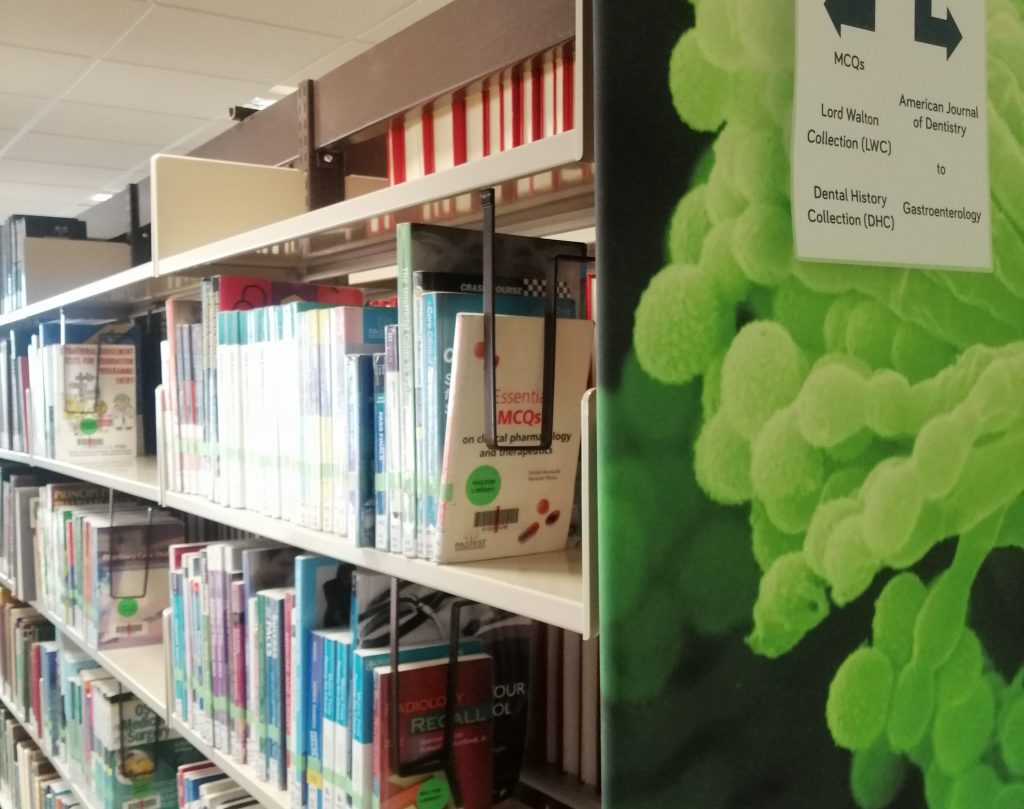
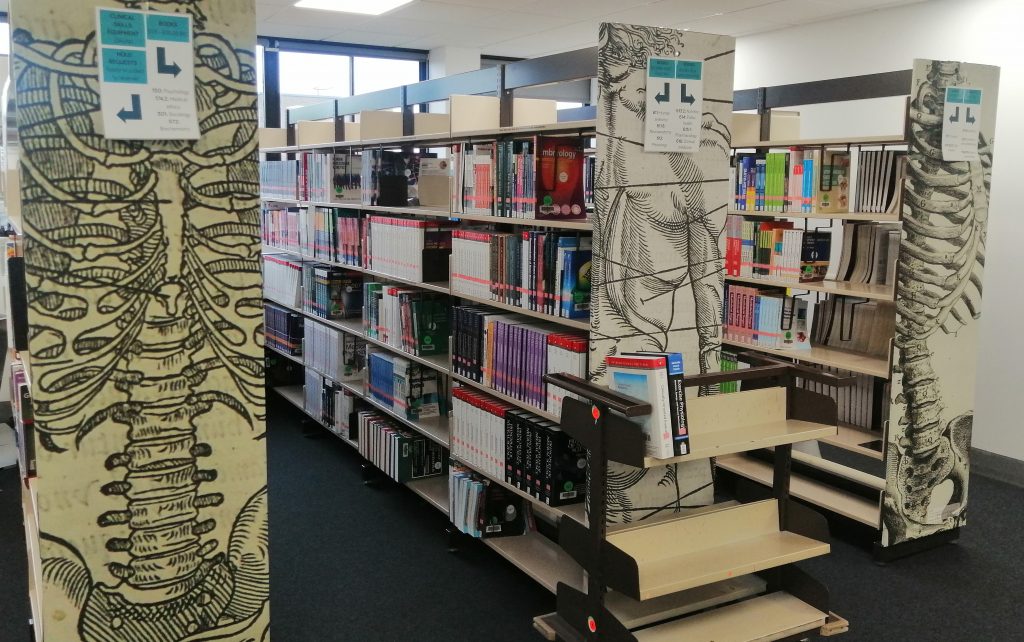
Books in the MCQ collection are located in the quiet study area. You can identify them by the green stickers on the book spines.
There are a variety of topics covered in our Multiple Choice Question (MCQ) section. Within the collection, you’ll find books to on a number of subjects from anaesthesia to surgery. There are also books to aid revision for specific exams – including OSCEs, PACES and MRCS.
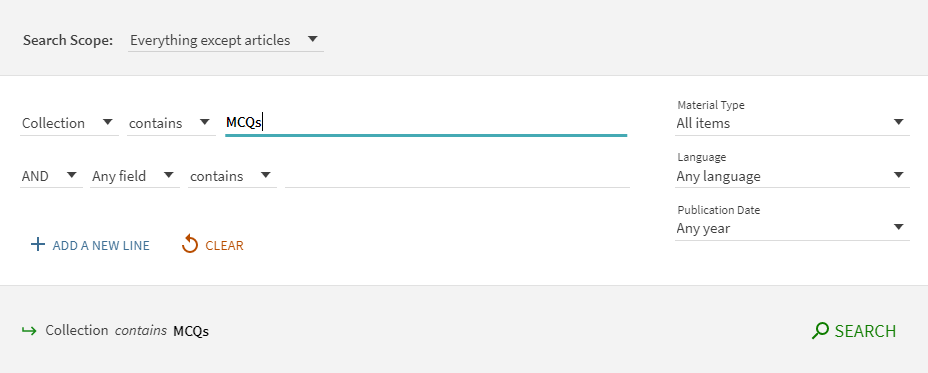
If you’d like to browse the MCQ collection, go to Library Search. You’ll need to click the ‘Advanced Search’ link and then change the “Any field” drop down menu to say ‘Collection’. In the text space, enter “MCQs” and you can view the entire collection. You can narrow down your search by adding a subject, author or title if you’re interested in a specific topic.
You can search the entire MCQ collection by changing the search filters to “Collection” and adding MCQs in the text bar.
You can find the MCQ collection in the quiet study area of
the Walton Library. They’re easily identifiable by the green stickers on the
book’s spine.
The books are long loan – meaning you can have them for up to 20 weeks, providing they’re not requested by another Library user. If the MCQ book is already on loan, follow these instructions to place a request.
If there is a book you think would help your exam revision, use our Books on Time service and recommend it. Find out more about this service here.
Clinical skills equipment
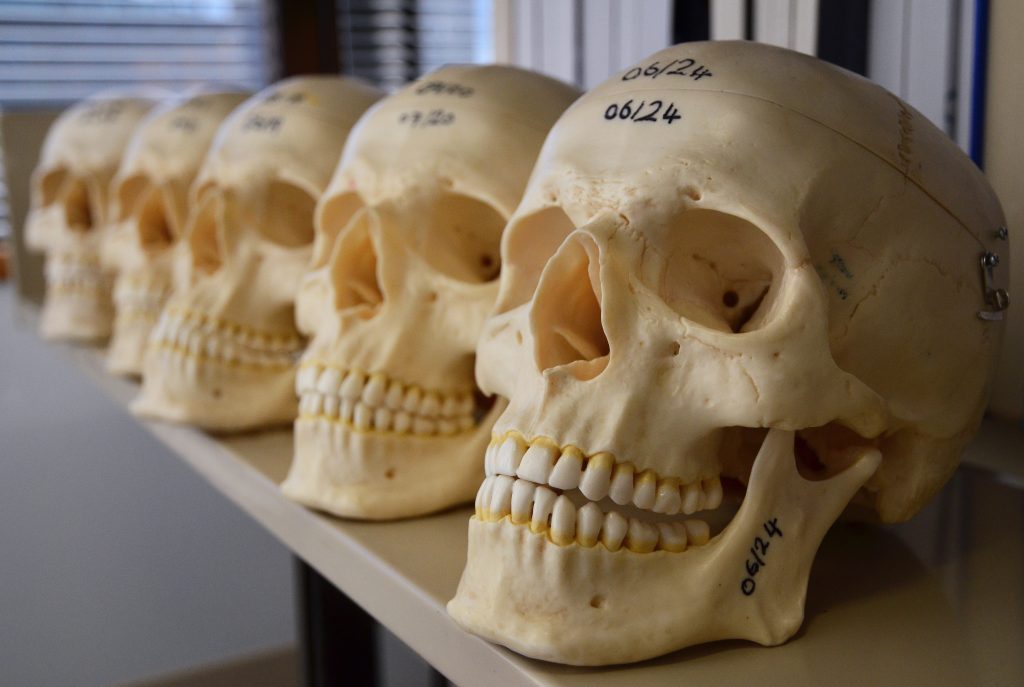
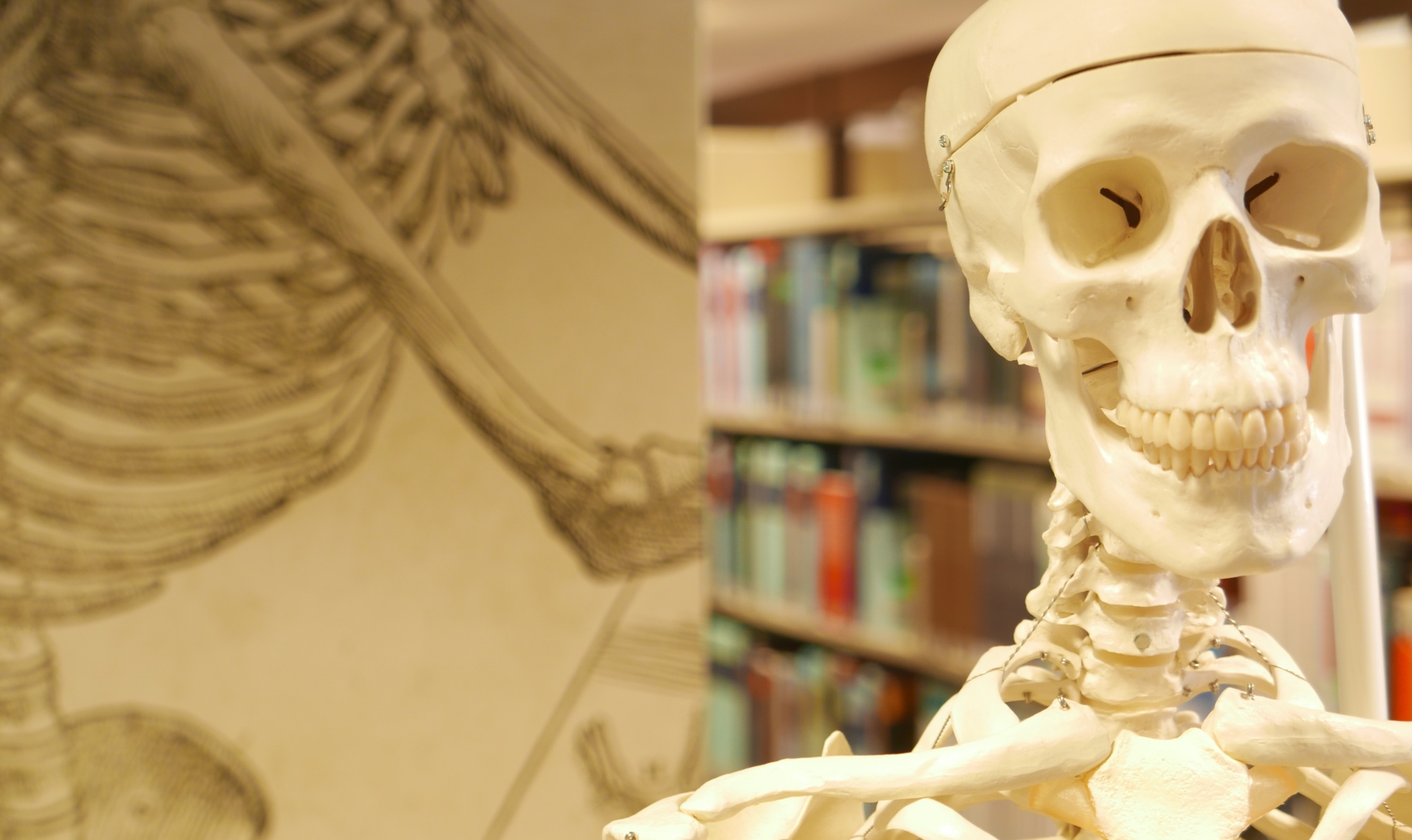
At the Walton Library, there is a wide selection of clinical skills equipment available to loan. There are medical tools, like tendon hammers, sphygmomanometers and otoscopes. Anatomical models, such as skulls and teeth. Plus eye charts, DNA models and even a spine! (A model one, that is.)
You can borrow a skull from the service desk or the STC room at the Walton Library!
The main bulk of clinical skills equipment is located behind the service desk at the Walton Library. Ask a member of staff and they’ll retrieve it for you. You can have up to three clinical skills items on loan at any time. Unfortunately, you can’t place requests on the items if they’re all out on loan.
There are also a small number of skulls available to loan
from the Student Texts Collection (STC) room. You can loan them using the
self-issue machine in the STC.
You may have also noticed a collection of anatomical models on a table in the collaborative study area. These models are free to use within the Library for as long as you like – but they can’t be taken out of the Library.
Clinical skills equipment items are available as a next day loan. This means that if you borrow a skull at 9AM on a Monday morning, it needs to be returned before the Walton Library closes on Tuesday. Items in the clinical skills equipment collection are non-renewable.
Beyond the Walton, there is exam and revision assistance available from the wider Library services and the University. You may find it useful to check out the Academic Skills Kit (ASK) to learn more about different revision strategies and exam techniques. You can also use ASK to find out about available counselling and chaplaincy services to help combat exam stress. Follow this link to ASK!
Harvard at Newcastle is the most frequently used
referencing style and if your school does not have a preferred style, it is the
one that we would recommend. This is because there is the most comprehensive
guidance available for Harvard and it is a style that can manage referencing
all types of information. Whether you are referencing a book, news
article, Instagram or market research, the Harvard at Newcastle style has got
you covered.
There are many
variations of Harvard but the one used at Newcastle can be found in Cite Them Right. Harvard uses an in-text citation (Millican, 2018, p.12)
inserted in the text, coupled with a reference list at the end of the document,
which provides the key. Cite Them Right is available as a published book to borrow from the
library and Cite Them Right Online provides the same comprehensive
guidance in a searchable interface that can be accessed anywhere online. It
includes guidance about how to reference just about every type of information
you can think of, including the more tricky online sources such as social
media.
You will find the Harvard at Newcastle style in EndNote on campus PCs and through the RAS, and are able to download the style from our EndNote guide if you are using it locally on your own device. We’ve also included some useful tips and advice about getting to grips with Harvard on the Academic Skills Kit.
There are lots of different referencing styles, but which one is right for you?
Once you start creating
citations and references, you need to consider referencing styles. There are hundreds of them out there
and each has a slightly different set of rules about how citations and
reference lists should appear in your text.
Most Newcastle University students use the Cite them Right Harvard style, but there is also Vancouver, IEEE, OSCOLA, Chicago, and many more. Your lecturers will expect you to use one specific style and all of your citations and references should conform to that style accurately and consistently; same punctuation, same capitalisation, same everything.
We have lots of help about using some of the popular referencing styles Academic Skills Kit. The Cite Them Right website is also a valuable online resource that will show you how to hit all of the right steps on your way to mastering an individual referencing style.
When walking in the snow we need the right footwear, and to keep warm, a scarf, hat, and gloves are also of great help. By doing so, we are adapting to the environment and using the right tools at the right time for the job at hand.
The same is true when adapting to academic writing where referencing is a key tool.
When you are writing a piece of work and you use someone else’s thoughts, words or ideas, you must reference them. But why do we talk about referencing so much at University, and why is it so important? Why should you bother spending time on ensuring that your references are consistent, accurate and correct?
It all comes down to why we reference in the first place:
To make your contribution clear by showing which words and ideas are yours, and which have come from your reading.
To acknowledge the work of others and to demonstrate how you have built on the knowledge that you’ve gained from your reading.
To ensure that the reader can follow up on your references for themselves.
To avoid being wrongly accused of plagiarism.
Watch our short video to find out a little more about why we should bother with referencing.
Hopefully you are feeling settled at the Walton Library and finding your way around. During your induction session you may have heard Library staff mention reading lists and STC books. This blog post breaks these terms down to help you get the most out of the Library.
What are reading
lists?
When it comes to reading lists, the clue is in the name.
They are materials your lecturer(s) have selected to help you understand your subject
– and are not necessarily books! Reading lists can contain journal articles,
websites and other media, such as podcasts and videos. The material on your
reading list is broken down into essential,
recommended or background
reading for your convenience.
Not all reading lists look the same. Some lists are divided into the above categories, and some are divided into weekly or even daily reading. Speak to your lecturer if you have a query about the content on your module’s reading list.
Where are they?
There’s more than one way to access your reading list. If you use the Medical Learning Environment (MLE), you can access your reading list from the “Reading” tab on the “Learning Materials” window. These are embedded in each Case. See below for reference:
A reading list on the Medical Learning Environment (MLE).
You can click on the items within the reading list and it’ll take you directly to Library Search, where you will be able to see the item’s location and availability.
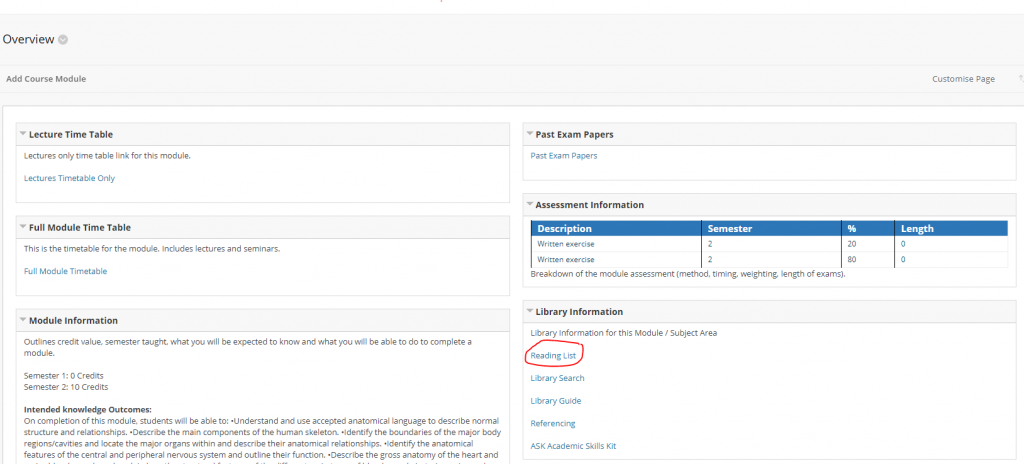
If you use Blackboard, once you’ve logged in, you will see that the “Reading Lists” link is on the “Overview” page for each module you’re registered on. See below for reference:
The location of a module’s reading list on Blackboard.
You can also access your reading lists from the Library
homepage. Follow this
link and click the green “More information for students” button.
If you’re having a technical problem when using your reading list, email: med-reading-lists@ncl.ac.uk and we’ll investigate the problem for you.
What is the STC?
The Student Texts Collection (STC) at the Walton Library.
If you’ve been to the Walton’s service desk asking for a
stapler, you may have heard the staff directing you to the STC. STC or Student
Texts Collection is a separate room, located next to the printers and the
self-issue machine, which contains our high demand texts. Many of these will be
essential on your reading lists.
These books are available for short loan only – four hours during the day,
unless you take them out four hours before the Library closes, when you can
loan them overnight (providing you return them before 9:30AM the next weekday
and 10:30AM on weekends!)
These short loan books are perfect if you’re on the go. You can issue one before a lecture and then return it just after! They’re also ideal if you only need to use a short section of a book: you can copy up to one chapter or 10% of a book (whatever is greater) using the photocopier.
How does it work?
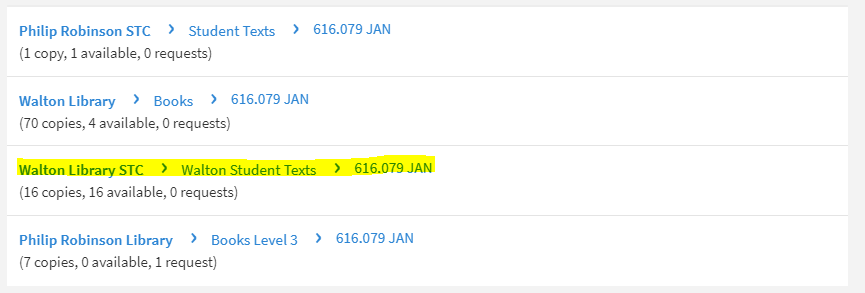
Just like long loan items, STC books are on Library Search. However they can’t be reserved if all the copies are out on loan. STC books need to be checked out and returned from your account using the self-issue machine in the STC room.
STC books are listed separately on Library Search.
If
you have any further queries about the STC, you might want to check out our
Library FAQs here.
Desk staff at the Walton can also be called upon to lend a hand if you’re
stuck.
Wishing a Warm Walton Welcome to all new and continuing students in the new academic year!
Just as you are settling into life at University we thought that you might benefit from this list of tips of how to make the most out of your time in the Walton Library.
The Library opening hours change throughout the year, but during term time, we are open normally until 22:00.
Resources
Use your Reading Lists as a great starting point for finding academic material. They can be accessed via your VLE (Virtual Learning Environment), which is either Blackboard or the MLE, depending on the course you are studying.
All academic resources that we purchase will be available via Library Search. It is the most prominent element on our colourful website and it will show you books, articles, journals in both physical or electronic format, databases and others.
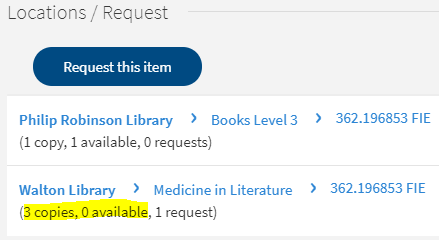
Use keywords to find the titles that you need and Library Search will tell you whether we have them or not, whether they are available on the shelves, in which library and part of which collection they are. If a book we have in stock is NOT currently available on the shelves, the best thing you can do is to log in with your student ID and password and place a reservation:
Reserving is in your best interest because this is what will prompt a current reader of the book to bring it back so that you can use it. So remember: Shy bairns get nowt.
Specialist help
There are subject-specific guides that give you information directly relevant to your course. You can find them by selecting your course in Subject Support, on the Library website.
Want to ask us a question?
Library Help is the place you seek. You can browse our FAQ database by topic or search it by using keywords. You can also send us an email or chat with us. Library Chat is monitored 24/7, so as long as you have access to the internet, wherever you are in this great, big world, you can contact us.
Searching should be easy, right? We do it all the time in our day to day lives and with Google so ingrained into our existence, we don’t give it much thought. We type some words into the search engine and most of the time we find what we are looking for. Nothing to it!
However, while this approach certainly works for checking out cinema times or booking flights, it lets us down where research is concerned. We have high expectations that information will be quick and easy to come by and that it will be neatly organised in one place, rather than having to search in multiple locations, using different techniques. We imagine that the time consuming part of our research will be the analysing, synthesizing and the writing of it and we often don’t even think about the searching side of things.
The reality though is quite different. Without investing in our searching techniques and the development of a search plan, we can often find ourselves overwhelmed by information and not being able to see the wood from the trees. Our stress levels rise and our frustrations explode. Surely finding information shouldn’t be this hard!
The good news is, is that there is help to be had. Our job as Liaison Librarians is to equip you with the skills you need to create that all-important search plan and to encourage you to pause and stop before you dive straight into finding information for your research. We have a fantastic range of online tools for you to do this, not least an interactive search plannerthat you can keep adding to throughout your search and which you can even email to yourself, your supervisor, or us as a Liaison team for feedback. The Academic Skills Kit has lots of advice on how to start a search, including how to break your concept down into manageable chunks and how to identify keywords and synonyms.
You can also check out this short video to get you started…….
Keep your eyes peeled for our next blog installment of how to find particular resources. See you then!
Hoping to get some revision done during the Easter Vacation?
Here are some tips to get you started:
1. Have a look at our MCQ collection in the Quiet study area of the Walton Library. This collection has books with MCQs, EMQs, SBAs, OSCEs and other self assessment and answer questions on many different subjects including; anatomy, medicine, physiology, surgery and more. Look out for the green stickers on the spines of the books.
2. Check out the the Exams and Revision Section on the ASK (Academic Skills Kit) webpages for more help.
3. Remember to take regular breaks.
4. Stay well hydrated, eat properly and get some exercise.
5. Remember to check the date, time and place of your exam well in advance of the day, make sure you know where you are going.
Have a good Easter Vacation. Happy revising and Good Luck in the exams when you get back.
Medical Humanities or Narrative Medicine is a popular academic discipline that explores the crossroads between medicine and the arts.
Our Medicine in Literature collection captures the complexities of what it means to be human through a wide range of literary genres.
These resources range from fiction, non-fiction including medical history, ethics and memoir, graphic novels, poetry and prose or medicine as metaphor, to films. Representations of illness, dis-ease, healing and health are interwoven themes that give voice to a diversity of perspectives and personal experiences of the human condition.
If you’re interested in exploring your subject field from a different viewpoint or simply want a break from revision this Easter, dive right in! The physical stock is located in the Quiet Study area of the Walton Library or you can browse the collection from our Library Guide.