100 years ago last month, over 2 million workers across Britain went on strike. Their aim: a show of support for coal miners fighting against proposed worsening of their wages and working conditions. Through industrial action and class solidarity on a scale few alive in Britain today can conceive of, essential services including the railways, shops, and the docks were brought to a halt for over a week. Local committees coordinating Strike action were established in towns across Britain, organising everything from picketing and publicity to sports events and soup kitchens.
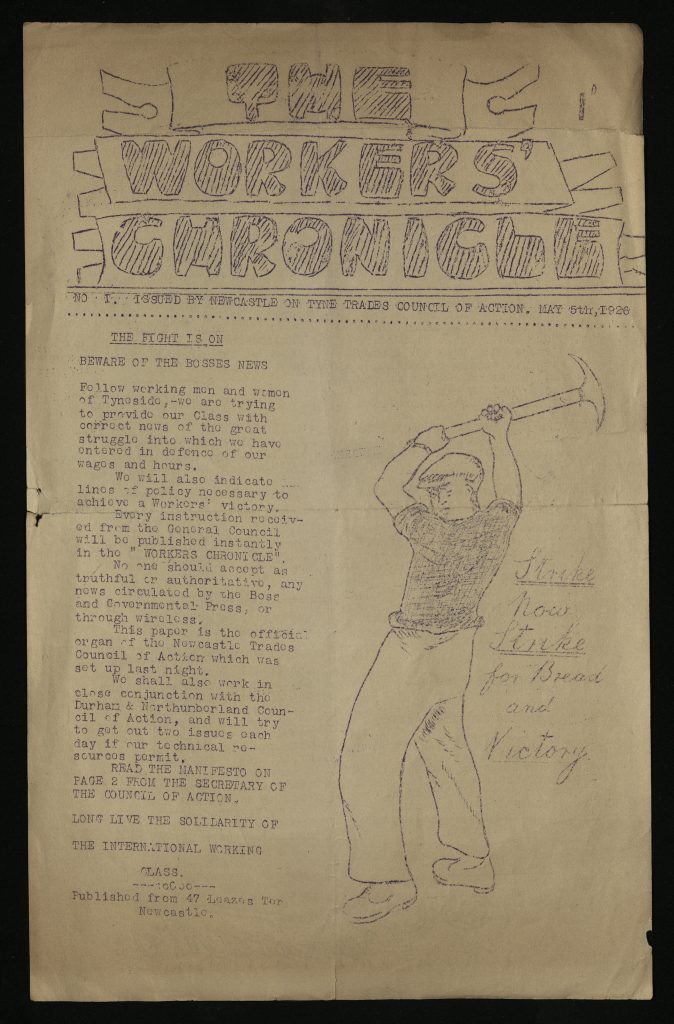
Remember 1926, a collaboration between the Collective and Newcastle’s Labour & Society History Group, launched in 2024 to explore new perspectives and preserve the last remaining direct memories of the Strike. At the 2025 Durham Miners’ Gala, the Remember 1926 team collected oral histories of the General Strike through family and community stories shared in person. Throughout the process, the Remember 1926 team sought to work alongside local people, ensuring they have had a say in how the Strike is represented. This reflects the Collective’s ethos of sustained and meaningful collaboration with community partners.
Communications Intern Lily posed some questions to Collective Researcher Dr Joe Redmayne, who has been working with the Collective for over five years and helped bring When Britain Stood Still to life.
What are the main differences between doing oral histories of events in living memory and postmemory interviews?
Oral histories capture firsthand lived experiences of events within living memory. In contrast, postmemory interviews — like the ones conducted for the 1926 project — engage with the ‘generations after’ and the particular ‘generational transmissions’ of the firsthand account. The transmission of stories is a complex process, involving both a direct handing down of memories, as well as an exchange between generations in which younger generation may set out to change the meaning and narrative of events.
Our overall purpose with Remember 1926 was not to retell the already well-told history of the General Strike but rather to attend to its history of reception and commemoration and, in its retelling, the history of the meaning of the strike to different social groups and generations.
The project moved away from the methodological focus and interviewing style of usual oral history projects. Instead, the project aligned itself with methods of postmemory interviews relying inherited recall. We explored how the General Strike could be mediated through family stories, photographs, family artefacts, as well as re-using ancestral interviews alongside new interviews with descendants. This provided scope to explore intergenerational transmissions and how historical events affected the narrators’ own identity and present-day meanings of 1926.
Why is it important that we keep the memory of 1926 alive, particularly through oral histories?
The outputs and interviews that the Remember 1926 team produced for the centenary commemoration are testament to the importance of labour history, oral history and history ‘from below’ approaches that centre the experiences and memories of workers and working-class communities.
Many modern issues – such as the gender pay gap, climate change, equality, health & safety, immigration policies, union rights, and deindustrialisation – have deep historical roots. Studying how past labour movements navigated previous disputes and remembered them helps us comprehend their afterlives, legacies and informs how we can tackle modern day political and international crises.
By focusing on the General Strike of 1926, both labour and oral history act as vital practices of public memory. Exploring the memories of 1926 can empower communities and trade unions, as well as give working-class people a voice, a sense of belonging, and historical legacy. This is evidenced in the numerous centenary events and exhibits that have been organised across the UK by archives, museums, heritage groups, and trade unions: GeneralStrike100.
The interviews we gathered as part of the project reveal the changing interpretations of what the General Strike has meant through the generations. Narratives are rejected or transformed within their own social contexts. The interviews shed light on areas of consensus or possible tensions in the event of 1926 and its meanings.
What’s your favourite piece on display in the exhibition?
My favourite item in the exhibit is the testimony by John Brown, a Tyneside seafarer and rigger. He recalls the conditions during and after the General Strike. His ‘tramp’ in 1927 became a tour of England, undertaken when he lost his dock-work job after the General Strike at the age of nineteen. From home in South Shields he looked for work in Newcastle, York, Reading, Guilford, Winchester, Southampton, Dover, Canterbury, Reading, Bath, Gloucester, Chester, Manchester, Penrith, Carlisle, Dumfries, Newcastle, Leeds, London and then back to South Shields, casual dock-work and more unemployment. Tramping was a proactive alternative to the boredom of worklessness and queues at the local labour exchange.
What have you enjoyed most about the oral history aspect of the Remember 1926 project?
I have enjoyed meeting people from across the North East and further afield to discuss the project, especially during our participation in the Durham Miners’ Gala when looking for participants (2024 and 2025). During the Gala, many people made comparisons with how the miners were treated in the 1984-’85 strike; the soup kitchens and today’s food banks; as well as discussion about the right to protest, with connections being made to the recent industrial action that had taken place in 2023.
After nine days, the nationwide General Strike was ended. Although the Trades Union Council ultimately did not succeed in getting its demands met, the Strike was still hugely significant for its display of class solidarity. Sympathetic strikes would be banned a year later.
For events like the General Strike, which are fading out of living memory, oral history reuse is becoming more important than ever. This is a key concern for the Collective under our Methodology & Practice theme. Dr Hannah James Louwerse’s recently-completed PhD project in collaboration with the National Trust focused on oral history reuse and maintenance. Ryan Fallon’s ongoing PhD project reuses oral histories of childhood patient experience at the Stannington Sanatorium, near Morpeth.
When Britain Stood Still: The General Strike at 100 is on at the Philip Robinson Library in Newcastle until 18th October 2026.
You can read more about the General Strike in the North East here.