
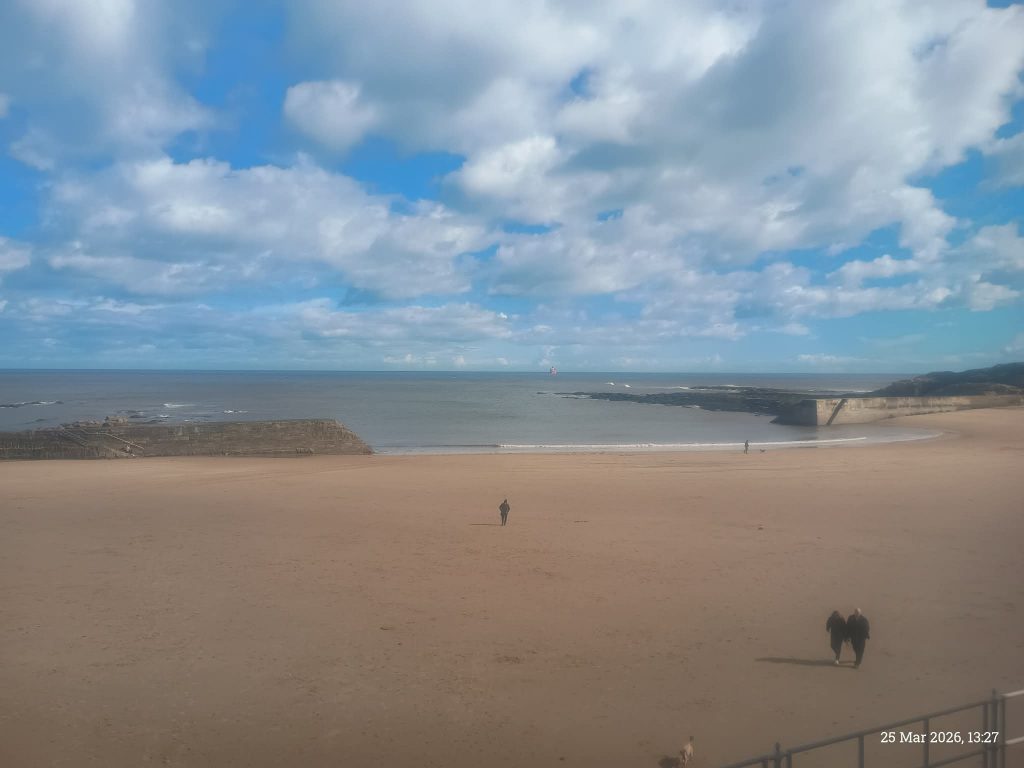
Collective Research Retreat 2025: Collaboration, Care, & Cullercoats

Before Easter, members of the Collective enjoyed a day brainstorming, strategising, and sharing ideas to the backdrop of sunshine (and hail!) by a North Sea beach for the annual Research Retreat. All the Collective’s current projects were represented and members brought expertise from their various backgrounds in planning, graphic design, and archives, to name a few. 
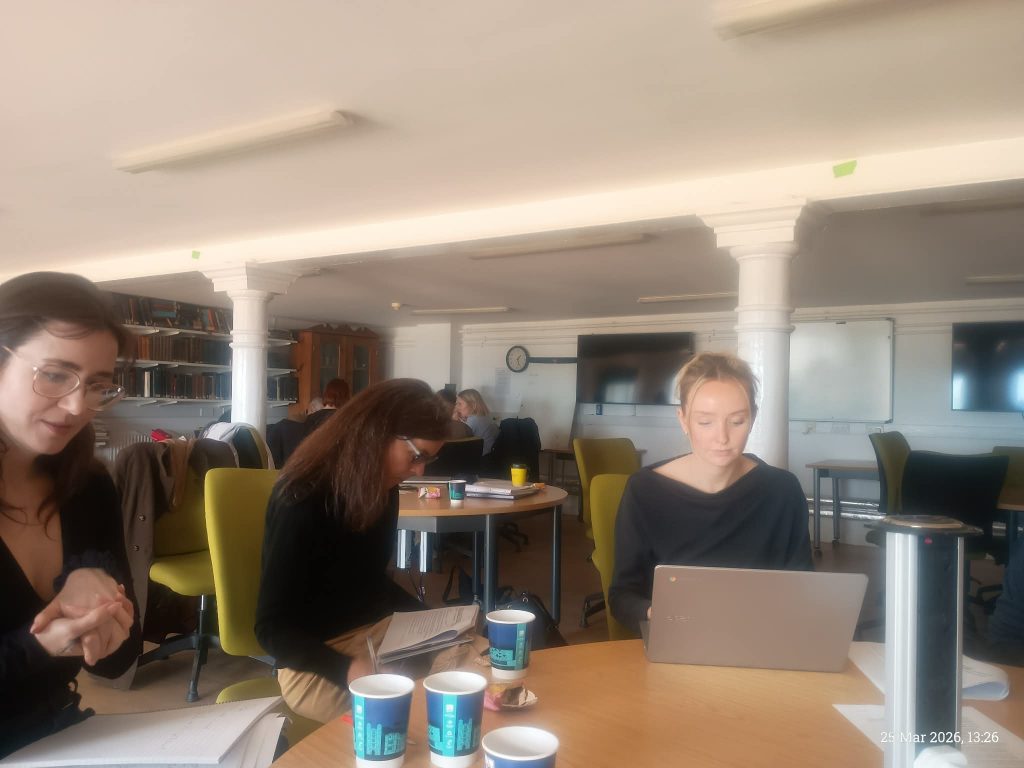
With various projects and community partnerships across the North East and beyond on the go at any given time, it’s rare so many members of the Collective are able to gather together. This was a valuable chance to catch up, meet new faces, and plan for the Collective’s future. Researchers from all stages and walks of the process were present, from recent graduates and PhD students to community oral historians and established lecturers and professors. Emerging researchers learnt from more established oral historians and had a chance to present their own work.  
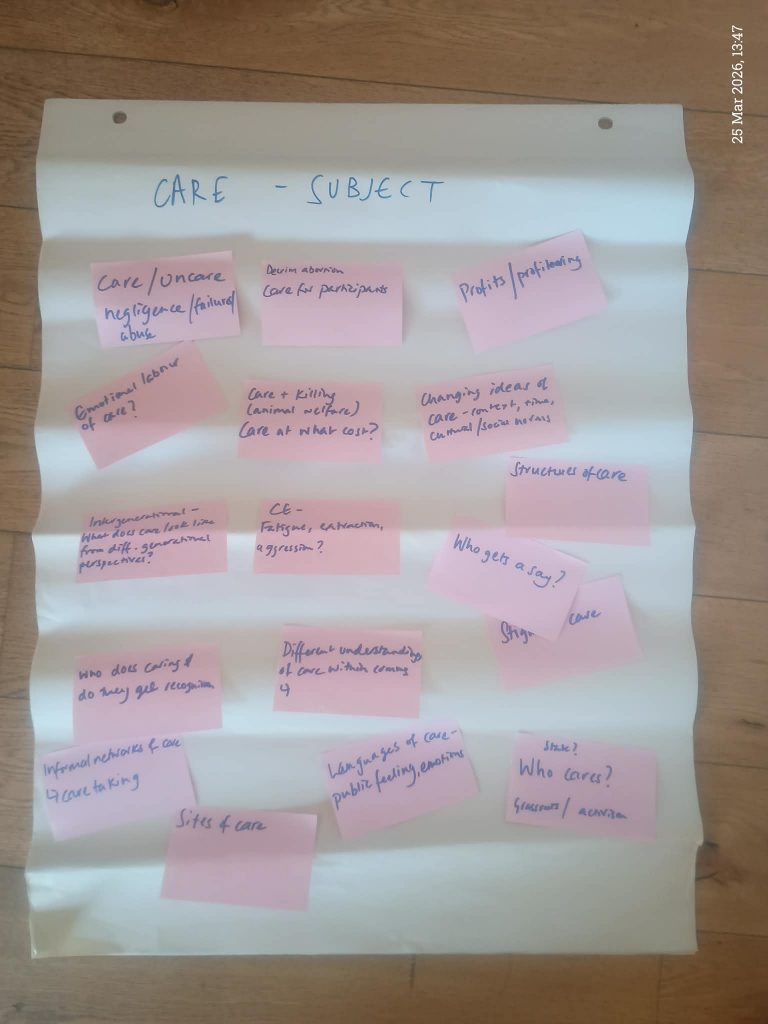
Two key topics for the day were care and collaboration. Workshops on both generated productive discussion and strategies for future outputs and deepening collaboration within the Collective and with community partners. Much energy was devoted to issues of care and ethics in research practice, particularly when working with partners outside academia. Shared positions on heritage, memory, and collaboration were worked towards, and REF 2029 was kept in mind throughout. Ruminations on the position of the Collective within the University were heard, and its distinct identity compared to Strathclyde or Nottingham Trent’s oral history hubs was reinforced.  The Research Retreat was made possible by Research and Innovation funding, which was also instrumental in enabling members based outside the North East to attend – including from over 300 miles away! Thanks also to Newcastle University for the use of the Dove Marine laboratory site in Cullercoats – hardly a more inspiring setting to be found. 

From a lively archive in Bangalore

In this Lug piece, PhD student Hannah James Louwerse offers some insights on her time researching in the Archives at the National Centre of Biological Sciences in Bangalore, and reflects on the workflows and processes which go into keeping an archive running smoothly.

Continue reading

Animals in store: the Book Trade and Animal Histories

Here, Sue Bradley finds some half-forgotten animals and resolves to listen out for more. Sue is a member of the Newcastle University Oral History Unit and Collective and a Research Associate on FIELD (Farm-level Interdisciplinary Approaches to Endemic Livestock Disease) in Newcastle University’s Centre for Rural Economy. Her article, ‘Hobday’s hands: recollections of touch in veterinary practice’ appeared in Oral History, vol 49, no 1, 2021.

Continue reading

“Older people are more concerned with environmental change…”: Living Deltas Hub

In this Lug piece, Siobhan Warrington (NUOHUC) and her colleagues Hue Nguyen (An Giang University) and Laura Beckwith (Northumbria University) provide an update on the participatory oral history, mapping and photography work with two rural communities in the Mekong Delta as part of the Living Deltas Hub. Siobhan, Laura and Hue are working with a student-staff research team at An Giang University: Mai Thị Minh Thuy and Nguyễn Xuân Lan (research coordinators); and Hoang Uyen Cao, Huynh Linh, Lam Duy and Phan Cuong (student researchers). This is a follow-up to the post which introduced this project.

Note: Due to increasing Covid-19 infection rates in Vietnam, it has not been possible for the team to visit the communities since early July; this post is based on their visits between May and July 2021.

Continue reading

Foodbank Histories: Placement Reflection by Jack Hepworth

Foodbank Histories is a collaborative project between Newcastle West End Foodbank, Northern Cultural Projects, and Newcastle University Oral History Unit & Collective. The project began in 2018, recording approximately 30 short oral history interviews with foodbank clients, volunteers, and supporters. Over the past five weeks, PhD candidate Jack Hepworth has completed a short-term placement on Foodbank Histories, funded by the Newcastle University Social Justice Fund. Here he reflects on his experience. 

Continue reading

Deindustrialisation, Heritage and Memory Network: First Workshop

Research Associate, Andy Clark, has recently been organising and coordinating a new network looking at deindustrialisation, heritage and memory. On Friday 28th September, the network held its first workshop at the Scottish Oral History Centre in Glasgow. In this Lug post, Andy reports on the papers, themes and discussions that emerged throughout the day.

Continue reading

Report: Oral History and Creative Practice, ‘Show and Tell’

The interaction between oral history and creative practice has been a key topic of conversation at the Oral History Collective. In this post, Bruce Davenport reflects on the conversations emerging from our recent Show and Tell workshop. 

Continue reading

Using imagination to connect with the recent and deep past

For many – maybe most – of us, imagination is what gets us interested in history in the first place. Recently, the oral history collective have been having a lot of conversations about the connections between oral history and creative practice, including creative interpretation of history. In this post, Alison Atkinson-Phillips takes us on a winding journey of reflection on oral history and imagination, and offers a round-up of some local examples. 

Continue reading

In His Own Voice: Dr Julian Tudor Hart (9 March 1927- 1 July 2018)

In this blog post Graham Smith remembers the pioneering general practitioner Dr Julian Tudor Hart who died on the 1st of July. Graham interviewed him in June 1999.

Click HERE for a .mp3 audio extract from the interview and for a .pdf transcript of that extract: Tudor Hart in His Own Voice pt 1 extract 1

Continue reading