
Spruce up your referencing: When is a website not a website?

Photo by Dominik Dombrowski on Unsplash

We have all heard it said that languages spoken in northern arctic regions have considerably more words for snow than those spoken in southern climates. When dealing with something in detail every day it is often helpful to categorise and clarify its nuances.

A common mistake made in academic referencing is grouping all sources found online under the overarching category of a website. However, your aim should be to reference the information you have in front of you rather than where it was sourced. Grouping all items found online as a website would be the equivalent to referencing a book only by the publisher details, rather than the author and title. Or, by referring to both a snowball and a snowflake as simply snow.

For example, a government publication found online would be referenced like this in Chicago:

United Kingdom. Department for Education. Cloud computing: how schools can move services to the cloud. London: The Stationary Office, 2016. Accessed: November 4, 2019. https://www.gov.uk/government/publications/cloud-computing-how-schools-can-move-services-to-the-cloud. 

An electronic journal article might appear like this in APA:

Gillum, J. (2012). Dyscalculia: Issues for practice in education psychology.  Educational Psychology in Practice, 28(3), 287-297. doi:10.1080/02667363.2012.684344

While a video posted on the Tate website would look something like this in Harvard:

TateShots (2016) Grayson Perry: think like an artist. Available at: https://www.tate.org.uk/whats-on/tate-modern/talk/what-makes-artist-grayson-perry-conversation-sarah-thornton (Accessed: 11 November 2019). 

Identifying the type of information you are using, as well as the source, is an essential evaluation skill which helps in developing a greater critical approach to information. In many cases you will be unconsciously using your judgment to assess the value of information for your purpose. So when you are using any source of information, ask yourself what it is you are looking at, what details are recorded about it, and whether it measures up as a quality piece of information. You’ll find more guidance about evaluating information on our Evaluating Information guide.

Finding Information: Troubleshooting your search results

Photograph of tools, including a hammer, spanner and measuring tape, laid out on a table

You’ve ran your information search and looked at your results with a critical eye only to find that they’re not quite working for you – what can you do now?

In this blog we’ll be looking at the top three problems encountered when searching for information and how to improve your search to get the results you need:

Finding too much

If your search has brought back thousands of results and you’re getting overwhelmed with the options:

Search a more specialised resource

Using a subject-specific database will help narrow the focus of your search to your particular areas of interest.  Take a look at your Subject Guide to find databases and eBook collections tailored to your subject area.

Apply limits

Make use of the ‘refine’ options usually found on the left-hand side of Library Search or your subject database.  Limit your results by date, subject area or information type.  Remember, you may need to justify your limits to your supervisor so think carefully about your choices. 

Combine search terms with ‘AND’

AND is a Boolean operator, a term you can use to have more control over your search. If you want to find information that must contain two different keywords (or phrases), place a capitalised AND operator between them. Your search engine or subject database will only find information that features both, narrowing your results. The more search terms you combine with AND, the narrower your search will be.

Finding too little

If your search has brought back a handful of useful articles but you need a wider range of results:

Combine terms with ‘OR’

OR is another Boolean operator that helps you to control your search more effectively.  Use OR with your search terms that have synonyms or related terms. Your search engine or subject database will find information that features either word or phrase, significantly broadening your results.

Try controlled vocabulary

If you’re not getting enough results, it may be that your search terms or keywords aren’t quite working for you.  Controlled vocabulary are a standardised list of words and phrases used on some databases to ensure that searches retrieve all relevant results, even when authors use different terms. Examples of databases that use this technique include ERIC, PsycInfo, CAB abstracts, Compendex and Medline. If these apply to you and your discipline, you’ll find out how to use them on your Subject Guide.

360 Searching

If you’ve found some useful articles, one simple way to find more relevant material is to take a look at the references used by the authors.  This will lead you to find older material that was published before your original article which may also be useful.  Library Search and some subject databases including Google Scholar and Scopus also allow you to see who has cited the articles you have found in their work (look for the ‘cited by link’).  This is called citation searching and allows you to find more up-to-date analysis of your topic.  By looking back at the references and forward at the citations, you get a 360 degree view of the research.

Finding nothing useful?

If your search has brought back results that aren’t relevant to your research question or you are finding it difficult to find the right search terms or databases to use, you might find it helpful to book a one-to-one appointment with your Liaison Librarian.

You can also find more help and advice on the Academic Skills Kit.

Finding Information: The key to your search

Keys hanging on hooks on a piece of wood.

When it comes to finding academic information, there are a few things you need to think about before you start your search, such as where to actually look for information and the types of information you want to find in your search.  Another thing that is worth taking the time to think carefully about is keywords.

Keywords, sometimes called subject terms, are simple words and phrases that describe information; you can see them in the item record on Library Search and in Subject Databases.

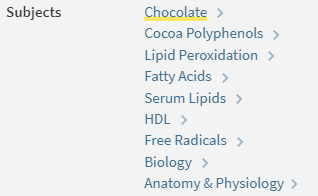
An example of keywords from an article on Library Search

The results that your search returns are based on this information – if your keywords match an item’s keywords, that item will appear in your results.

To get the best results, then, you’ll need to develop a balanced list of targeted keywords – these keywords may come from your essay title or research question, from your subject knowledge or wider reading – you can even borrow them from the subject terms you find on relevant articles!

As ideas and topics can be expressed in different ways you’ll also need to think about synonyms and terms related to your keywords to make sure you can find all of the relevant information.

To find out more about keywords, synonyms and searching take a look at this short video:

There are some useful tricks you can use with your keywords to save you time when you search, take a look at the Academic Skills Kit to learn about Boolean, wildcards and truncation!

Finding Information: Types of Information

Light bulbs

In our previous blog we explored how looking for information in the right place can help save you time and effort.  However, sometimes, the right place to look can depend on what type of information you’re looking for.

While you’re probably familiar with books and you may have been introduced to journal articles, these are just two of the types of academic information available to you.  Depending on your research question or essay title you might also find it useful to explore, for example, conference proceedings, maps, company information or newspapers

Each type of information has its particular use; books provide an in-depth overview of a topic; journal articles are more specialised and focus in-depth on a particular area of a topic, and newspapers give you a useful perspective on events.  While Library Search can help you find a large range of information types, some types of information are only available in special databases or archives.  Before you start your search, it’s therefore important that you decide what types of information you will need to complete your assignment most effectively.  You can find out more about different information types on our Finding Information Guide and in the video below:

When you know which types of information you need for your assignment or project take a look at our Resource Guides, which provide useful links and guides to appropriate sources.

Warm up your referencing techniques


Referencing is the acknowledgement of the sources that you use in your work. You must reference all sources that you use in your assignments, projects or dissertations, and includes quotes, ideas, facts, images, videos, audio, websites, statistics, diagrams and data.

Over the next two weeks we will be producing a series of blogs focusing on how to reference successfully in your work. We will cover…

  • explain why referencing is important
  • advice on how to produce consistent and reliable referencing
  • help on how to manage your information to make your life easier and assignments less stressful
  • point you in the direction of where to find advice and help

So come in from the cold and warm up with some referencing help and keep your eyes peeled for our upcoming blogs.

Finding Information: Knowing Where to Look

Photograph of several closed doors, one painted yellow the others painted white.

When you’re looking for information to help you write your essays, assignments or projects it can be tempting to turn to the source of information you use every day – Google.  While Google can be useful in some ways (such as finding company websites or journal author’s profiles), it wasn’t exclusively designed to help you find good quality, academic information that is reliable and relevant.  This means you’ll likely have to spend more of your time wading through huge amounts of information and fact-checking resources for accuracy.

Thankfully, Google isn’t your only option – there are a number of different places to look that have been created with the aim of providing you with the information that you need, such as your reading lists, Library Search, and key Subject Databases.

Take a look at this video to find out more about how these sources can help you:

For more help on finding information, take a look at the Academic Skills Kit.

Resource in focus – Romanticism: Life, Literature and Landscape

Romanticism: Life, Literature and Landscape is a powerful digital resource, ideal for students and researchers interested in William Wordsworth and the Romantic period.

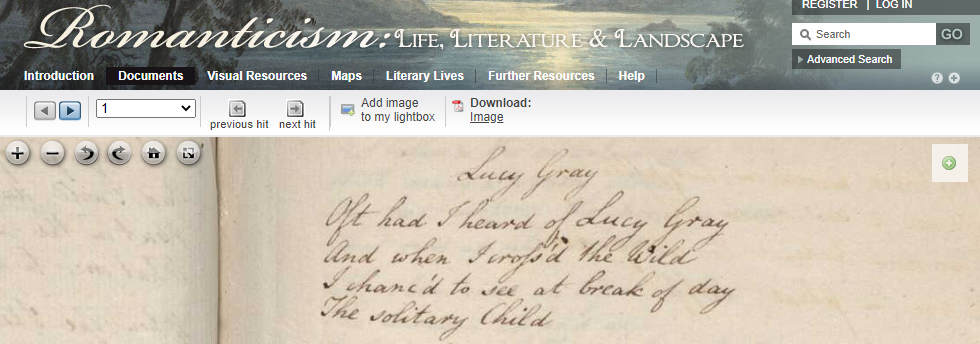
Screen shot of a verse manuscript from Romanticism: Life, Literature and Landscape.

 It provides unique access to the working notebooks, verse manuscripts and correspondence of William Wordsworth and his fellow writers, including Dorothy Wordsworth, Samuel Taylor Coleridge, Thomas De Quincey and Robert Southey.  While also offering a fascinating insight into the wider social, political and natural environment that shaped much of Wordsworth’s work, through the addition of travel journals, legal and financial records, guidebooks and over 2500 pieces of fine art from the Wordsworth Trust. There’s even more to explore with secondary research materials, including essays, biographies, maps, and photographs of the Lake District.

You can choose to browse the database via the Documents and Visual Resources tabs on the menu or use basic / advanced searches to focus your results.

Documents

The Documents section allows you to browse materials by collection (e.g. Dove Cottage manuscripts, Maps, Wordsworth Library Letters) or by document type (e.g. prose manuscript, correspondence, diary) and sort items by date, document type or first line.

You can also run a Document Advanced Search, which allows you to look for keywords within collections, document types or in works by a particular author.

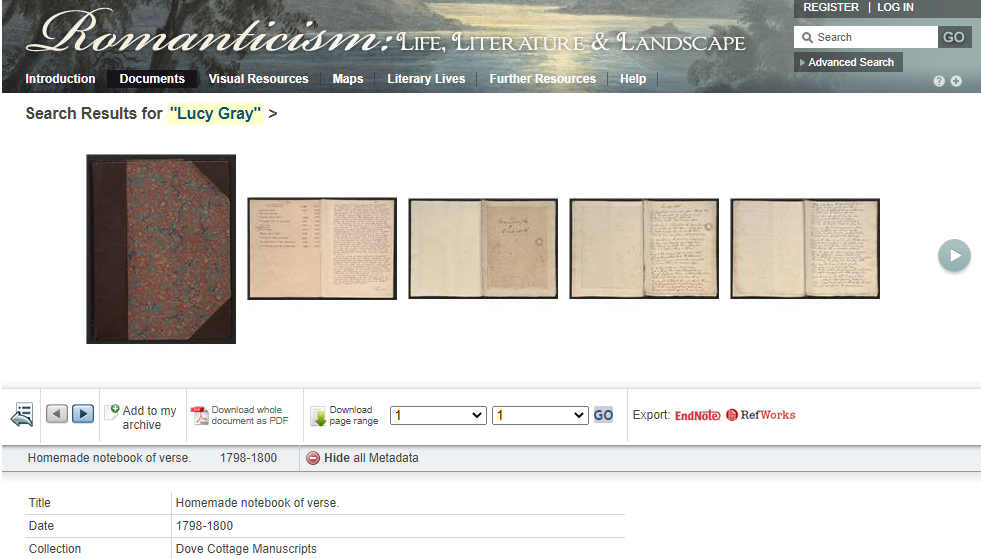
Screen shot of an item record from Romanticism: Life, Literature and Landscape.

Item records contain clear, full colour, digital scans of the document, which you can view in detail online or download as a PDF. You’ll also find bibliographic details and notes with options to export the record to EndNote or RefWorks.

Visual Resources

Under Visual Resources you can browse the Art Gallery, Art Wall, Photograph Gallery, and Effects and Objects.

The Art Gallery showcases paintings, sketches and prints featuring portraits of Wordsworth and his family, alongside landscapes of the Lake District and other inspirational locations.  The Art Wall provides an in-depth look at a small selection of these artworks with a short essay on their history and context.

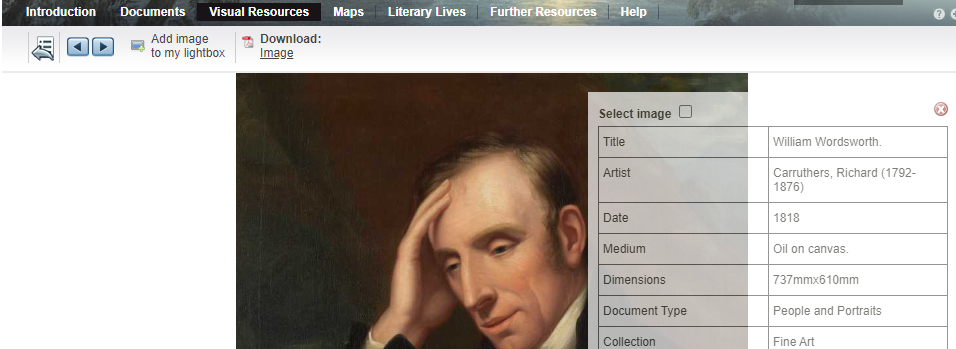
Screen shot of an image record from Romanticism: Life, Literature and Landscape.

The Photograph Gallery provides modern images of the Lake District specially commissioned for the database, while Effects and Objects offers photographs of the rooms and garden of Dove Cottage, and some of Wordsworth’s personal possessions.

You can also run a Visual Resources Advanced Search to focus your exploration.

Images are subject to copyright but may be used for educational purposes.  Take a look at the FAQs in the help section for more details.

More to Explore

Beyond Documents and Visual Resources, you’ll also find a collection of historical maps alongside an interactive map of the Lake District that allows you to explore key areas in the region.  Literary Lives provides brief biographies of the important literary figures of the English Romantic period and in Further Resources you’ll find a timeline of the period as well as a small selection of essays on the theme.

My Archive

You can choose to register for a free My Archive account within the database, which enables you to save searches and build your own library of documents and images. A useful way to keep track of your research and the resources you’ve found.

If you’d like to know more, the Page by Page guide in the Help tab provides detailed guidance on using advanced search features, viewing your search results, using images in teaching and research, and building your collection in My Archive.

Evaluating Information: Choosing the Cream of the Crop

Field of Wheat

With the high volume of information available to you online when you begin your research, it can be difficult to know which of the sources you find to actually use in your assignments or essays.  Ultimately, you’ll want to choose the information that is of good quality and that can help you to answer your research questions most effectively.  This means you need to make some critical decisions about the information you have found.  Even if the materials you find are from reliable sources, such as Library Search or a Subject Database like Scopus you’ll need to consider how the information you’ve found compares to other information and if it is suitable for your purposes.

To help you make effective critical decisions you’ll need to think about these key areas:

Currency – is the information up-to-date?

Relevance – does it help you answer your research question?

Authority – who wrote it?  How qualified are the authors?

Accuracy – how did the authors of the information reach their conclusions? What evidence and data have they used?

Purpose – Why was it written?

The video below looks at these in more detail:

See the Academic Skills Kit for more advice on selecting suitable information for your assignments and for more on the ins and outs of critical thinking take a look at this great blog from the Writing Development Centre: Shopping Around for a Critical Opinion

Where to find Standards?

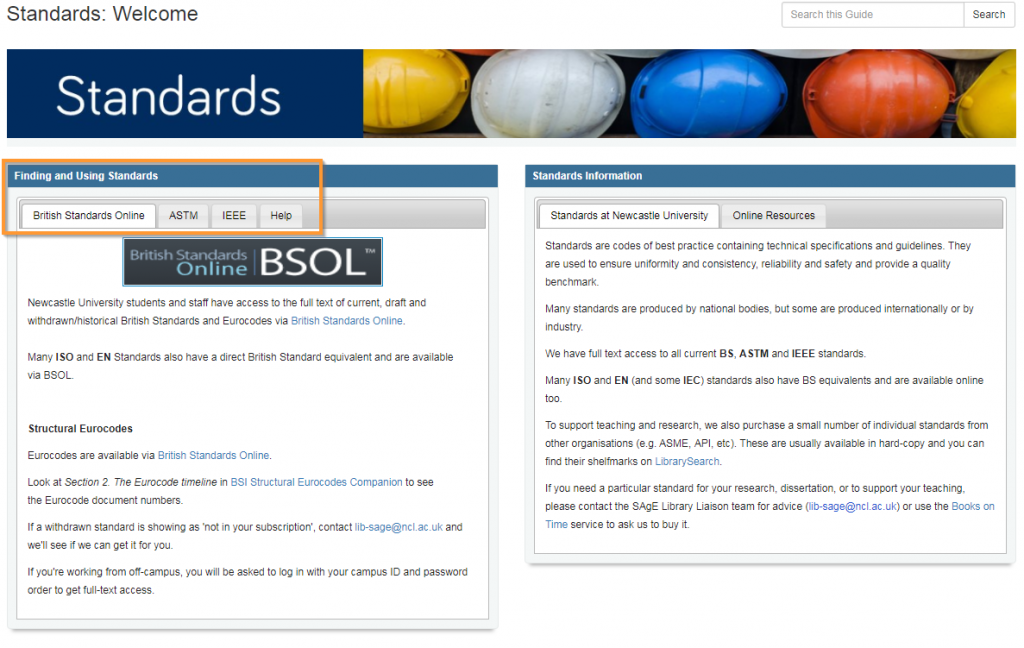
This small, but beautifully formed Standards Resource Guide will give you all you need to know about what standards you can access whilst at Newcastle University.

Standards are codes of best practice containing technical specifications and guidelines. They are used to ensure uniformity and consistency, reliability and safety and provide a quality benchmark.

We have full text access to all current BS, ASTM and IEEE standards.

Many ISO and EN (and some IEC) standards also have BS equivalents and are available online too.

To support teaching and research, we also purchase a small number of individual standards from other organisations (e.g. ASME, API, etc). These are usually available in hard-copy and you can find their shelfmarks on Library Search.

If you need a particular standard for your research, dissertation, or to support your teaching, please contact the Liaison Team or ask us to investigate buying it for library stock.

Decoding your reading list

In the past few weeks you have probably been presented with module handbooks for everything you’re studying, with a list of references to things you are being told to read. Sometimes these will all be in the same referencing style and formatted in a way that you can understand easily what type of information it is. But sometimes, it might be more tricky to work out what exactly it is you are looking for. You can find yourself searching for a journal article, only to discover that it’s a book chapter, and you’ll never find it in a journal database.

If you are feeling a bit confused by your reading list, don’t worry. It’s a common problem and decoding references does get easier as you become more familiar with the referencing conventions of your subject.

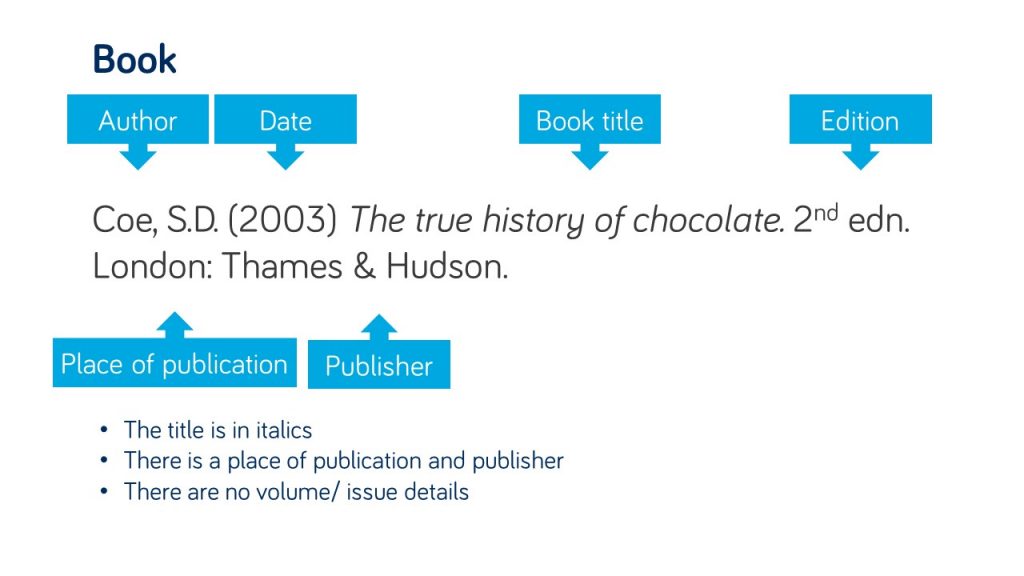
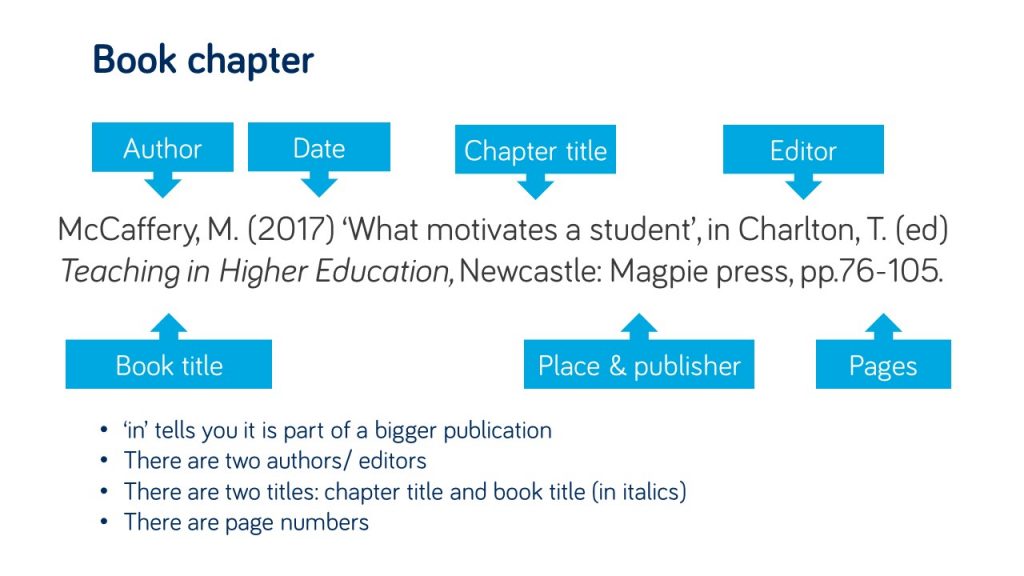
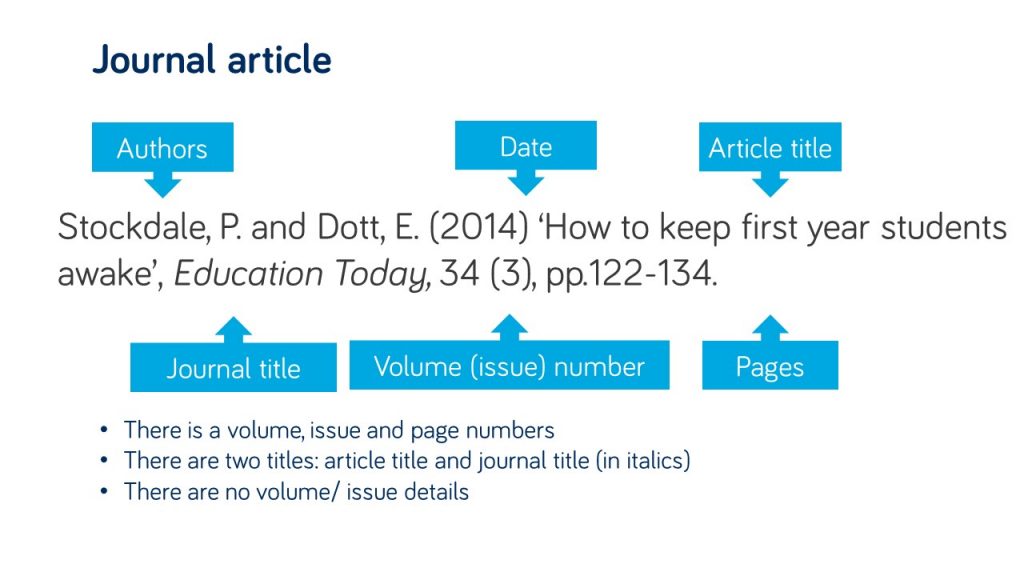
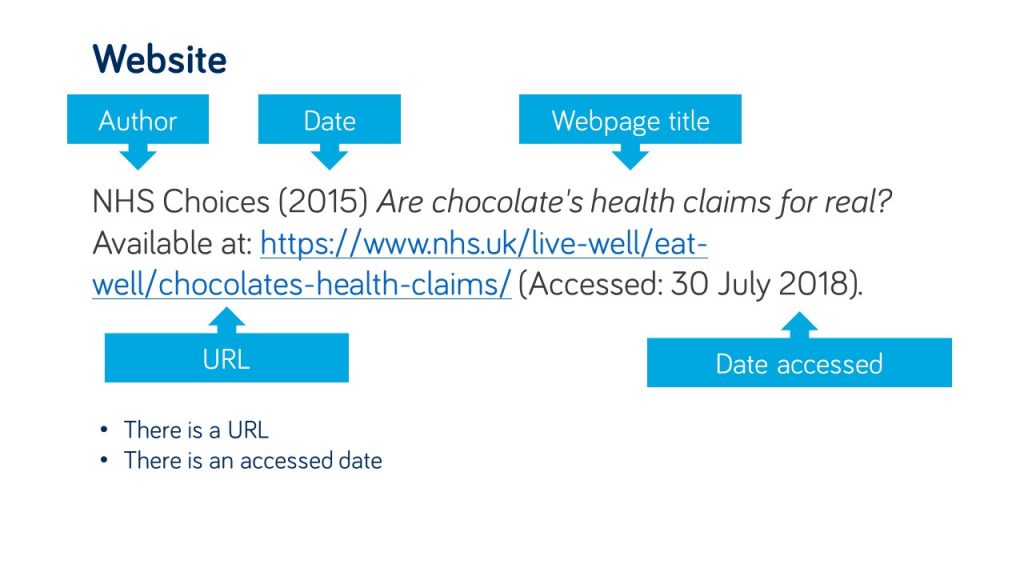
There are some easy things to look out for in your references that will help you identify what type of information it is, and the key details, such as the author and title, that you would need to use in order to find it successfully. Take a look at the examples in the gallery to see what to watch out for.

Reference for a book in the Harvard style with the title in italics.
Reference for a book chapter in the Harvard style which includes the chapter and whole book title.
Reference for a journal article that includes the article title, volume and issue of the journal.
Reference for a website in harvard style which includes a url and accessed date.

Your reading list is also linked from your module course on Canvas. Individual items on your reading list will link through to Library Search, showing you print book availability and linking to e-book and e-journal full text wherever possible. This means you wont need to do a separate search.

Find out more about reading lists on the Library website.